In Solidity, low-level operations like reading/writing to storage, contract to contract calls, or sending messages are performed directly through inline assembly using Yul opcodes like call, sload, and sstore. These opcodes bypass Solidity’s high-level abstractions.
Cairo introduces a similar concept through system calls (syscalls). A syscall is a low-level call from a Starknet contract to the Starknet OS to perform an operation that ordinary Cairo code cannot do by itself, such as calling another contract, deploying a contract, emitting an event, reading execution context, or accessing storage.
In this article, we will walk through the different syscalls available and how they are used in Starknet contracts.
Syscalls and Their Solidity Equivalent
The following list includes all currently available Starknet syscalls and their closest equivalents in Solidity where applicable.
storage_read_syscallandstorage_write_syscallare equivalent to sload and sstore in Solidity assembly respectively.get_block_hash_syscallis equivalent to blockhash(), returns the hash of a given block.call_contract_syscallis comparable to address.call() for contract calls.deploy_syscallis similar to create2 for deploying contracts at a predictable address.emit_event_syscallis similar to event + emit. Both log data for off-chain indexing.keccak_syscallis equivalent to keccak256.get_class_hash_at_syscallis similar to address.codehash, which returns the hash of a contract’s bytecode.library_call_syscallis similar to delegatecall, which executes code from another contract in the current contract’s execution context.replace_class_syscall,get_execution_info_syscall,get_execution_info_v2_syscall,send_message_to_l1_syscall,sha256_process_block_syscallandmeta_tx_v0_syscalldo not have direct Solidity equivalent.
Now let’s see how the above syscalls are used in practice.
Syscalls to read and write to storage
Unlike Cairo’s .read() and .write() methods, which can only read and write storage variables declared in the Storage struct, storage_read_syscall and storage_write_syscall read from and write to raw storage slots directly. They do not require a declared storage variable. If you know a slot’s storage address, you can read from it or write to it directly.
Storage read syscall
The storage_read_syscall function signature is:
fn storage_read_syscall(
address_domain: u32, address: StorageAddress,
) -> SyscallResult<felt252>;
This syscall takes in two arguments;
address_domain: it determines which data availability mode the storage operation uses. Currently, only domain0is supported, so for now always pass0.address: the storage address (slot) to read from, typed asStorageAddress.
storage_read_syscall returns a felt252 value. SyscallResult is just Cairo’s Result type for syscalls, so you can either unwrap it with .unwrap_syscall() (which panics and reverts on failure) or match on it explicitly to handle the error yourself without reverting.
Storage write syscall
The storage_write_syscall function signature is:
fn storage_write_syscall(
address_domain: u32, address: StorageAddress, value: felt252,
) -> SyscallResult<()>;
This syscall takes in three arguments; address_domain, address, and
value: the value (felt252) to write to the storage address.
It returns SyscallResult<()>, where () means there is no value on success, the only thing that matters is whether it succeeded or failed.
Both storage_read_syscall and storage_write_syscall revolve around one key parameter address. Before we can use them effectively, we need to understand how Cairo computes these storage addresses.
Computing the Storage Address (Slot) of a Storage Variable
In Solidity, each storage variable is assigned a sequential slot number at compile time: the first declared variable gets slot 0, the second gets 1, and so on. The EVM identifies variables by slot number. We can get a variable’s slot directly using .slot in assembly:
contract Hello {
uint256 public a; // slot 0
uint256 public b; // slot 1
function getSlot() public {
assembly {
let x := b.slot
}
}
}
Here, b.slot resolves to 1, because b is the second declared variable.
This Solidity slot number assignment model becomes a problem when upgrading contracts. If a new version of the contract removes or reorders a storage variable, the slot numbers shift, and the new variable ends up reading data that belonged to a different variable in the old version.
In Cairo, storage addresses are derived from variable names instead. Cairo computes the sn_keccak hash of each storage variable’s name and uses the result as its storage address. sn_keccak is Starknet’s variant of Ethereum’s keccak256, truncated to the first 250 bits.
Below is the Cairo equivalent of the Solidity contract above. It uses the selector! macro to compute the storage slot for a variable. The explanation that follows breaks down the relevant parts of the code.
use starknet::storage_access::StorageAddress;
#[starknet::interface]
pub trait IHelloStarknet<TContractState> {
fn get_slot(self: @TContractState) -> StorageAddress;
}
#[starknet::contract]
mod HelloStarknet {
// *** IMPORTS *** //
use starknet::storage_access::{
StorageAddress,
storage_address_from_base,
storage_base_address_from_felt252,
};
#[storage]
struct Storage {
a: u256,
b: u256
}
#[abi(embed_v0)]
impl HelloStarknetImpl of super::IHelloStarknet<ContractState> {
fn get_slot(self: @ContractState) -> StorageAddress {
// The `selector!` macro can be used to compute {sn_keccak}.
let selector_in_felt = selector!("b");
// Convert `felt252` to `StorageBaseAddress` type
let slot_base = storage_base_address_from_felt252(selector_in_felt);
// Convert `StorageBaseAddress` to `StorageAddress` type
storage_address_from_base(slot_base)
}
}
}
Here is a step by step explanation of the code above:
-
We import the needed type and helpers:
// *** IMPORTS *** // use starknet::storage_access::{ StorageAddress, storage_address_from_base, storage_base_address_from_felt252, };These helpers let us convert from a raw
felt252to a validStorageAddresstype that the storage read or write syscall expects. -
In the
get_slotfunction,selector!("b")computessn_keccak("b")as afelt252:// The `selector!` macro can be used to compute {sn_keccak}. let selector_in_felt = selector!("b"); -
The result is converted into a
StorageBaseAddressusing thestorage_base_address_from_felt252method:// Convert `felt252` to `StorageBaseAddress` type let slot_base = storage_base_address_from_felt252(selector_in_felt);A
felt252is just a number, and Cairo does not automatically treat numbers as storage addresses. Converting it toStorageBaseAddressdoes not change the underlying value. Instead, it changes how Cairo treats that value, that is, it now understands that this number should be used as a storage address, rather than as an ordinary integer. In other words, the conversion does not modify the data itself, it assigns a storage-address type to it so it can be used in storage operations. -
That base address is then converted into a
StorageAddressusingstorage_address_from_base.StorageAddressis the type expected by the storage syscalls.// Convert `StorageBaseAddress` to `StorageAddress` type storage_address_from_base(slot_base)StorageAddressis the exact format required by the storage read and write syscalls. Think of it as the final, usable form of the address. It’s Cairo’s way of clearly separating “just a number” from "a valid storage address” ready to be used in a syscall.
Now that we know how to compute the storage slot of a declared variable, next is to read from and write to a slot.
Reading and Writing To Storage Variable b via Syscalls
The contract below extends the previous example with two new functions:
- one to write to variable
band - the other to read from it,
both using syscalls directly:
use starknet::storage_access::StorageAddress;
#[starknet::interface]
pub trait IHelloStarknet<TContractState> {
fn get_slot(self: @TContractState) -> StorageAddress;
// *** NEWLY ADDED FUNCTIONS *** //
fn write_to_b_low_level(ref self: TContractState);
fn read_from_b_low_level(self: @TContractState) -> felt252;
}
#[starknet::contract]
mod HelloStarknet {
use starknet::storage_access::{
storage_address_from_base,
storage_base_address_from_felt252,
StorageAddress,
};
// *** NEWLY ADDED IMPORTS *** //
use starknet::syscalls::{
storage_read_syscall,
storage_write_syscall
};
use starknet::SyscallResultTrait;
#[storage]
struct Storage {
a: u256,
b: u256
}
#[abi(embed_v0)]
impl HelloStarknetImpl of super::IHelloStarknet<ContractState> {
// *** LOW-LEVEL WRITE TO VARIABLE `b` *** //
fn write_to_b_low_level(ref self: ContractState) {
// Get the slot for variable `b`
let slot = self.get_slot();
// Perform a syscall to write the value 4 into variable `b`
let _ = storage_write_syscall(0, slot, 4);
}
// *** LOW-LEVEL READ FROM VARIABLE `b` *** //
fn read_from_b_low_level(self: @ContractState) -> felt252 {
// Get the slot for variable `b`
let slot = self.get_slot();
// Perform a syscall to read from variable `b`
// `.unwrap_syscall()` unwraps the syscall result and panics if it failed
storage_read_syscall(0, slot).unwrap_syscall()
}
fn get_slot(self: @ContractState) -> StorageAddress {
let selector_in_felt = selector!("b");
let slot_base = storage_base_address_from_felt252(selector_in_felt);
storage_address_from_base(slot_base)
}
}
}
Below is a detailed explanation of the relevant parts of the code above:
-
Two functions were added to the
IHelloStarknetinterface: one to write to the storage variableb, and the other to read from it.// *** NEWLY ADDED FUNCTIONS *** // fn write_to_b_low_level(ref self: TContractState); fn read_from_b_low_level(self: @TContractState) -> felt252; -
The storage syscalls and
SyscallResultTrait(to unwrap syscall result).// *** NEWLY ADDED IMPORTS *** // use starknet::syscalls::{ storage_read_syscall, storage_write_syscall }; use starknet::SyscallResultTrait;Two new imports were added.
- First,
storage_read_syscallandstorage_write_syscallfromstarknet::syscalls. These are the low-level syscalls we will use to read from and write to storage directly, instead of Cairo’s high-level.read()and.write()methods. - Second,
SyscallResultTraitfromstarknetwhich is needed to call.unwrap_syscall()on the result returned by the syscalls.
- First,
-
In the write function, the storage slot for
bis computed and passed tostorage_write_syscallto write the value4to that slot.// *** LOW-LEVEL WRITE TO VARIABLE `b` *** // fn write_to_b_low_level(ref self: ContractState) { // Get the slot for variable `b` let slot = self.get_slot(); // Perform a syscall to write the value 4 into variable `b` let _ = storage_write_syscall(0, slot, 4); } -
In the read function, the same slot is computed and passed to
storage_read_syscallto read the value, which returns aResult. Calling.unwrap_syscall()on it yields the raw felt252 value.// *** LOW-LEVEL READ FROM VARIABLE `b` *** // fn read_from_b_low_level(self: @ContractState) -> felt252 { // Get the slot for variable `b` let slot = self.get_slot(); // Perform a syscall to read from variable `b` // `.unwrap_syscall()` unwraps the syscall result and panics if it failed storage_read_syscall(0, slot).unwrap_syscall() }
Arbitrary Storage Slot Access Using Syscalls
So far, we have only read from and written to storage variables that were explicitly declared in the Storage struct. But what if you need to access a storage slot that was never declared, for example, inspecting raw storage for debugging, building proxy contracts, or interacting with storage layouts from other contracts?
This is where arbitrary slot access becomes useful. Instead of deriving the slot from a variable name via selector!(), we provide the slot value directly as a raw felt252.
The conversion process is identical to what we covered earlier, convert the raw felt252 to StorageBaseAddress, then to StorageAddress. The only difference is where the slot value comes from.
The contract below reads from and writes to storage slot 1 directly:
#[starknet::interface]
pub trait IHelloStarknet<TContractState> {
fn write_to_slot1_low_level(ref self: TContractState);
fn read_from_slot1_low_level(self: @TContractState) -> felt252;
}
#[starknet::contract]
mod HelloStarknet {
// IMPORTS
use starknet::syscalls::{
storage_read_syscall,
storage_write_syscall
};
use starknet::storage_access::{
storage_address_from_base,
storage_base_address_from_felt252
};
use starknet::SyscallResultTrait; // for .unwrap_syscall()
#[storage]
struct Storage {}
#[abi(embed_v0)]
impl HelloStarknetImpl of super::IHelloStarknet<ContractState> {
// LOW-LEVEL WRITE TO SLOT 1
fn write_to_slot1_low_level(ref self: ContractState) {
// Convert `felt252` to `StorageBaseAddress` type
let slot_base = storage_base_address_from_felt252(1);
// Convert `StorageBaseAddress` to `StorageAddress` type
let slot = storage_address_from_base(slot_base);
// Perform a syscall to write the value 4 into the slot 1
let _ = storage_write_syscall(0, slot, 4);
}
// LOW-LEVEL READ FROM SLOT 1
fn read_from_slot1_low_level(self: @ContractState) -> felt252 {
// Convert `felt252` to `StorageBaseAddress` type
let slot_base = storage_base_address_from_felt252(1);
// Convert `StorageBaseAddress` to `StorageAddress` type
let slot = storage_address_from_base(slot_base);
// Perform a syscall to read from the slot 1
// `.unwrap_syscall()` unwraps the syscall result and panics if it failed
storage_read_syscall(0, slot).unwrap_syscall()
}
}
}
In this example, before reading from and writing to storage address (slot) 1, we converted the value 1 from felt252 to StorageBaseAddress type, and then to StorageAddress, which is the required type for storage addresses in both syscalls.
Cross-contract call syscall
The call_contract_syscall is used to perform low-level cross-contract calls, similar to address.call() in Solidity. Its function signature is:
fn call_contract_syscall(
address: ContractAddress,
entry_point_selector: felt252,
calldata: Span<felt252>,
) -> SyscallResult<Span<felt252>>;
It takes in three arguments;
address: the address of the contract being called.entry_point_selector: the selector of the function being called, derived from the function name viaselector!()macro.calldata: aSpan<felt252>containing arguments passed to the function.
This syscall returns a Span<felt252> because at the syscall level, Cairo has no knowledge of the return type of the function being called, it could return a single value, a tuple, a struct, or nothing at all.
To handle all these cases uniformly, the return data is serialized into a flat sequence of felt252 values. For example, if the called function returns a u256, which is internally represented as two u128 values (low and high), the result would come back as two felt252 elements in the span. It is then the caller’s responsibility to deserialize the returned span back into the expected type.
let result: u256 = u256 {
low: ret_data_low_felt252,
high: ret_data_high_felt252,
};
The code below illustrates how we use call_contract_syscall to invoke the transfer function of another contract in practice. Notice how the selector!() macro is used to derive the function selector from the name, and how the calldata is passed as a Span<felt252>:
use starknet::ContractAddress;
#[starknet::interface]
pub trait IHelloStarknet<TContractState> {
fn call_something(ref self: TContractState, target: ContractAddress, calldata: Span<felt252>);
}
#[starknet::contract]
mod HelloStarknet {
// IMPORTS
use starknet::syscalls::call_contract_syscall;
use starknet::SyscallResultTrait; // for .unwrap_syscall()
use starknet::ContractAddress;
#[storage]
struct Storage {}
#[abi(embed_v0)]
impl HelloStarknetImpl of super::IHelloStarknet<ContractState> {
fn call_something(
ref self: ContractState,
target: ContractAddress,
calldata: Span<felt252>,
) {
// selector for `transfer(felt252,u128)`
let selector = selector!("transfer");
// CALL `target` CONTRACT
let _ = call_contract_syscall(target, selector, calldata).unwrap_syscall();
}
}
}
In the call_something function, the selector! macro hashes the function name "transfer" into a felt252 value that uniquely identifies the entry point in the target contract (the same idea as function selectors in Solidity, where keccak256("transfer(address,uint256)") produces a 4-byte selector). Once we have the selector and the calldata ready, we pass them along with the target address to call_contract_syscall to perform the actual call.
What Happens If the Call Fails?
Unlike Solidity’s address.call(), which returns a boolean indicating success or failure and allows the caller to handle it gracefully, call_contract_syscall does not give you that option. If the invoked contract reverts for any reason, the failure propagates immediately and the entire transaction reverts, there is no way to catch or recover from it on-chain. This is an important distinction to keep in mind when designing contracts that rely on cross-contract calls.
Deploying a New Contract
The deploy_syscall is Cairo’s low-level way of creating contracts, similar to Solidity’s create2. It deploys contract at a predictable address.
The function signature for deploy_syscall is:
fn deploy_syscall(
class_hash: ClassHash,
contract_address_salt: felt252,
calldata: Span<felt252>,
deploy_from_zero: bool,
) -> SyscallResult<(ContractAddress, Span<felt252>)>;
This syscall takes the following arguments:
class_hash: the identifier of the contract’s class to deploy, which is of typeClassHash.contract_address_salt: a salt used to deterministically compute the deployed contract’s address. Type isfelt252.calldata: aSpan<felt252>containing the constructor arguments.deploy_from_zero: aboolthat indicates whether the contract address is computed using the caller’s address or0as the deployer address.
deploy_syscall returns a tuple (ContractAddress, Span<felt252>). The first element is the address of the newly deployed contract. The second element is a span of felt252, representing the return data from the contract’s constructor. Just like call_contract_syscall, the constructor return values are flattened into a contiguous sequence of felts, making it possible to handle multiple return values of varying types.
The following code deploys an example counter contract with a constructor that takes an initial value:
use starknet::ClassHash;
#[starknet::interface]
pub trait IHelloStarknet<TContractState> {
fn deploy_counter(ref self: TContractState, class_hash: ClassHash, initial: felt252);
}
#[starknet::contract]
mod HelloStarknet {
// IMPORTS
use starknet::ClassHash;
use starknet::SyscallResultTrait; // for .unwrap_syscall()
use starknet::syscalls::deploy_syscall;
#[storage]
struct Storage {}
#[abi(embed_v0)]
impl HelloStarknetImpl of super::IHelloStarknet<ContractState> {
fn deploy_counter(ref self: ContractState, class_hash: ClassHash, initial: felt252) {
// Prepare constructor calldata as Span<felt252>
let mut calldata: Array<felt252> = ArrayTrait::new();
calldata.append(initial);
let calldata_span = calldata.span();
// Salt for deterministic address
let salt: felt252 = 123;
// Deploy the contract
let (_contract_address, _) = deploy_syscall(class_hash, salt, calldata_span, false)
.unwrap_syscall();
}
}
}
The deploy_counter function serializes the constructor argument into a Span<felt252>, then calls deploy_syscall with the class hash, salt, and constructor calldata.
Syscalls for emitting events
The emit_event_syscall is the low-level primitive for logging events on Starknet. It serves the same purpose as logN() in low-level Solidity, where N is the number of topics. But unlike the EVM where the log opcode support a maximum of 4 indexed topics, Starknet supports up to 50 keys (topics).
The emit_event_syscall function signature is:
fn emit_event_syscall(
keys: Span<felt252>, data: Span<felt252>,
) -> SyscallResult<()>;
It takes two arguments:
keys: aSpan<felt252>containing the indexed topics used for filtering and searching events (equivalent toindexedparameters in Solidity events).data: aSpan<felt252>containing the non-indexed event data.
emit_event_syscall returns SyscallResult<()>: on success the value is (), and on failure it returns an error without halting execution, allowing the failure to be handled gracefully.
Consider this Solidity contract that logs an event with 2 topics. Don’t worry too much about what the code is doing just jump to the FOCUS HERE comment:
// SPDX-License-Identifier: MIT
pragma solidity ^0.8.20;
contract Hello {
// Event to emit
event MyEvent(address indexed from, uint256 amount);
function emitMyEvent(bytes32 t0, bytes32 t1) external {
assembly {
// Write the non-indexed data (amount = 4) to memory ptr 0x00
mstore(0x00, 4)
// **** FOCUS HERE ****
// _____data_____ _____keys_____
// | | | |
// log2(memPtr, memSize, topic0, topic1)
log2(0x00, 0x20, t0, t1)
}
}
}
The log2 opcode in the code above:
- reads
0x20bytes (memSize) of data from memory starting at0x00(memPtr): this is the event data (non-indexed). - uses
t0andt1as the two topics (indexed).
Thereby separating the non-indexed data from the topics.
Below is the Cairo equivalent using emit_event_syscall:
#[starknet::interface]
pub trait IHelloStarknet<TContractState> {
fn emit_my_event(ref self: TContractState, amount: felt252);
}
#[starknet::contract]
mod HelloStarknet {
use starknet::get_caller_address;
use starknet::SyscallResultTrait; // for .unwrap_syscall()
use starknet::syscalls::emit_event_syscall;
#[storage]
struct Storage {}
#[abi(embed_v0)]
impl HelloStarknetImpl of super::IHelloStarknet<ContractState> {
fn emit_my_event(ref self: ContractState, amount: felt252) {
// event MyEvent(address indexed from, uint256 amount);
let t0: felt252 = selector!("MyEvent");
let t1: felt252 = get_caller_address().into(); // like msg.sender
// ---- keys (topics) ----
let mut keys: Array<felt252> = ArrayTrait::new();
keys.append(t0); // topic0 = event selector
keys.append(t1); // topic1 = indexed "from"
// ---- data (non-indexed) ----
let mut data: Array<felt252> = ArrayTrait::new();
data.append(amount);
// low-level syscall (assembly-like)
// __keys___ ___data___
// | | | |
emit_event_syscall(keys.span(), data.span()).unwrap_syscall();
}
}
}
Notice how emit_event_syscall explicitly separates keys and data as two Span<felt252> parameters, similar to how log2 takes memory pointer and size for data and separate parameters for topics.
Getting Block Hash
In Solidity, getting a block hash is straightforward with the builtin blockhash(blockNumber) (only works for the 256 most recent blocks). Cairo exposes similar capability through the get_block_hash_syscall, but with different availability constraints.
This syscall is available for block numbers in the range first_v0_12_0_block (the first Starknet block number produced after the network upgraded to Starknet v0.12.0) to current_block - 10. There is a 10-block lag because newer blocks must be finalized before their hashes can be safely exposed, meaning you cannot query the hash of the 10 most recent blocks. Asking for anything outside that range would throw a BLOCK_NUMBER_OUT_OF_RANGE error.
The get_block_hash_syscall function signature is:
fn get_block_hash_syscall(
block_number: u64,
) -> SyscallResult<felt252>;
It takes an argument block_number of type u64 and returns a felt252 representing the hash of the requested block.
Here’s a simple contract that retrieves the block hash for a given block number:
#[starknet::interface]
pub trait IHelloStarknet<TContractState> {
fn get_block_hash(self: @TContractState, block_number: u64) -> felt252;
}
#[starknet::contract]
mod HelloStarknet {
// IMPORTS
use starknet::SyscallResultTrait; // for .unwrap_syscall()
use starknet::syscalls::get_block_hash_syscall;
#[storage]
struct Storage {}
#[abi(embed_v0)]
impl HelloStarknetImpl of super::IHelloStarknet<ContractState> {
fn get_block_hash(self: @ContractState, block_number: u64) -> felt252 {
// Call the syscall and unwrap the result
// Will throw if the `block_number` is outside the valid range
let block_hash: felt252 = get_block_hash_syscall(block_number).unwrap_syscall();
// Return the block hash as a felt252
block_hash
}
}
}
Getting Execution Context
In Solidity, values such as block.timestamp, msg.sender, tx.origin and so on are available as built-in globals.
Cairo doesn’t provide built-in global variables for these values. Instead, you must retrieve them by calling the get_execution_info_syscall syscall.
The get_execution_info_syscall function signature is:
fn get_execution_info_syscall() ->
SyscallResult<Box<starknet::info::ExecutionInfo>>
It takes no arguments and returns a Box<ExecutionInfo> struct wrapped in a SyscallResult. The struct contains fields for caller address, block information, transaction info, and other execution context data as seen below:
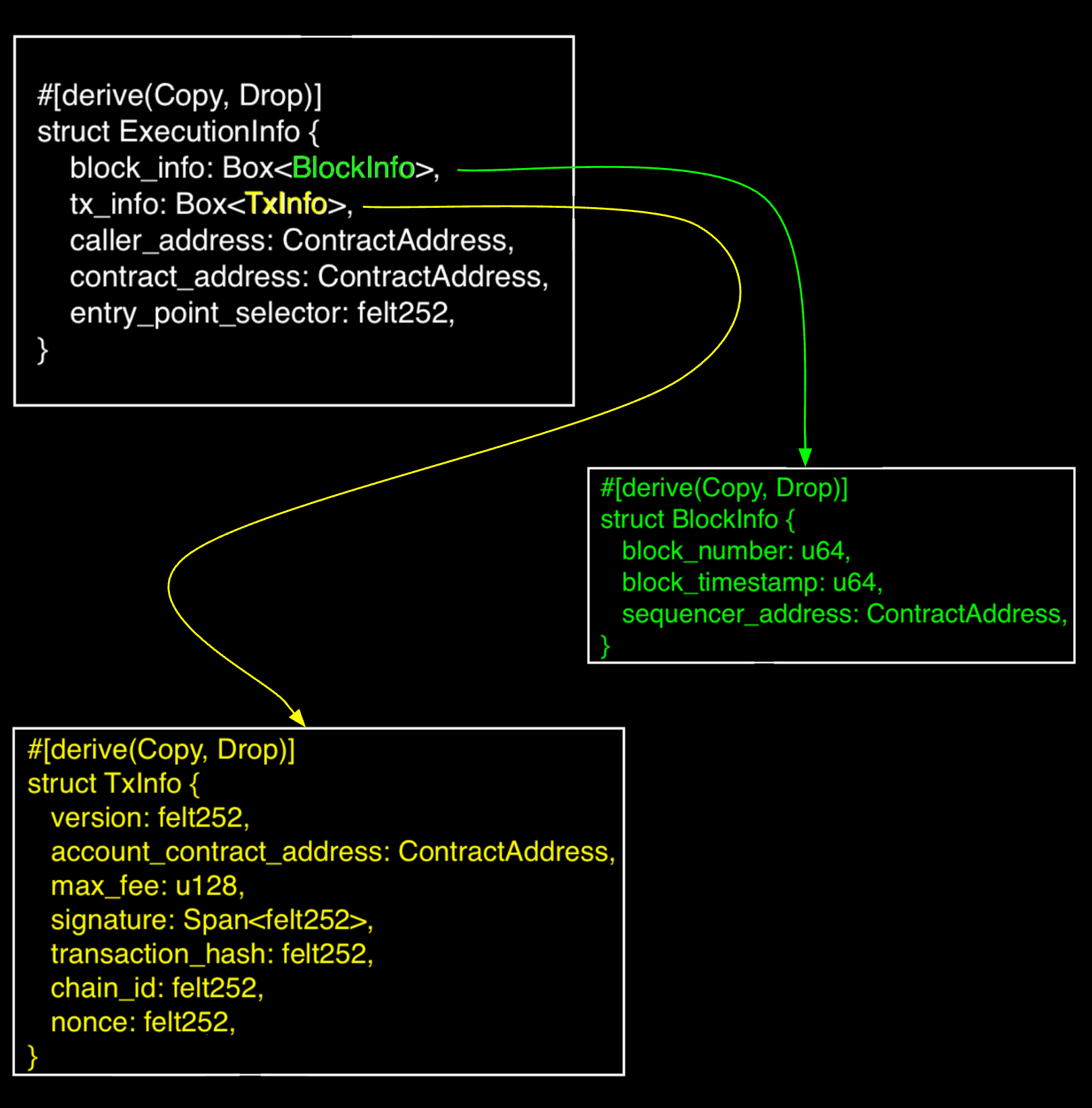
The returned struct (Box<ExecutionInfo>) can then be destructured to extract the specific fields of interest, such as the caller address, block information, transaction info and so on.
The following code example retrieves the caller’s address and block timestamp from the execution context:
#[starknet::interface]
pub trait IHelloStarknet<TContractState> {
fn context_info(self: @TContractState);
}
#[starknet::contract]
mod HelloStarknet {
// IMPORTS
use starknet::SyscallResultTrait; // for .unwrap_syscall()
use starknet::syscalls::get_execution_info_syscall;
#[storage]
struct Storage {}
#[abi(embed_v0)]
impl HelloStarknetImpl of super::IHelloStarknet<ContractState> {
fn context_info(self: @ContractState) {
// Call syscall
let info = get_execution_info_syscall().unwrap_syscall();
// Extract sender and timestamp
let (_sender, _timestamp) = (info.caller_address, info.block_info.block_timestamp);
}
}
}
The context_info function calls get_execution_info_syscall() to retrieve the execution context. It accesses caller_address directly from the returned struct (info.caller_address) and block_timestamp from the nested block_info field (info.block_info.block_timestamp).
Note: This example extracts but doesn’t return or use the values for simplicity. In a real contract, you would typically return these values or use them for access control, timing logic, or other logic.
Getting Execution Context v2
This is similar to Getting Execution Context, except that the TxInfo field is replaced with v2::TxInfo, which includes both the original transaction fields and additional fields introduced in newer transaction versions.
Below is an image of the ExecutionInfo struct with the new v2::TxInfo
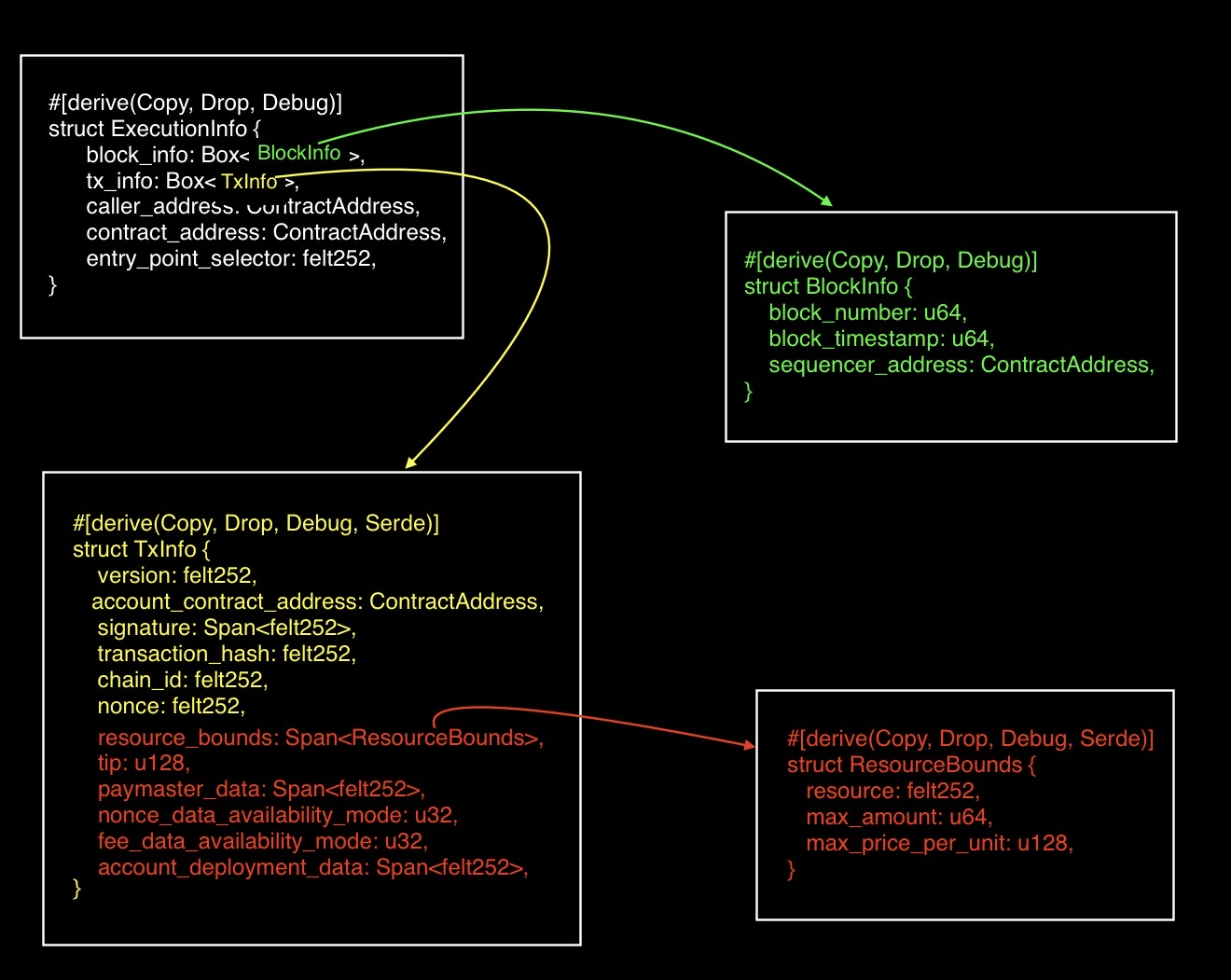
The newer fields (highlighted in red) in v2::TxInfo were added to support V3 transactions. They describe how much of the network’s resources a transaction is allowed to use, how fees may be paid, where certain transaction data is stored, and whether the transaction includes account-deployment data.
resource_bounds: Sets limits on the resources the transaction is allowed to consume. You can think of this as a budget: the transaction declares how much network work it is willing to pay for. In V3, this is part of how transaction fees are described.tip: An extra amount attached to the transaction to incentivize faster transaction processing by prioritizing them over others.paymaster_data: Contains data that includes the address of the paymaster (an account other than the transaction sender that pays the transaction fees) and extra data to send to the paymaster. This extra data is not fixed by the protocol, it exists so the paymaster can enforce its own logic for sponsoring a transaction.nonce_data_availability_mode: Specifies the data-availability mode used for the transaction’s nonce. In other words, it indicates whether the transaction’s nonce data should be made available on L1 (Ethereum) or L2 (Starknet).- L1 data-availability mode is 0 (default).
- L2 data-availability mode is 1.
fee_data_availability_mode: Specifies the data-availability mode for the account balance used to pay transaction fees. Like the nonce field above, it determines whether the fee-related account data should be made available on L1 or L2.account_deployment_data: This field is used when you want to combine account contract deployment and transaction execution into a single operation. It contains the deployment parameters (class hash, address salt, and constructor calldata). When populated, it deploys the account contract before executing the transaction. When empty, it skips deployment and executes from an existing account contract.
The following code example shows how to retrieve the transaction tip from the execution context (v2):
#[starknet::interface]
pub trait IHelloStarknet<TContractState> {
fn context_info(self: @TContractState);
}
#[starknet::contract]
mod HelloStarknet {
// IMPORTS
use starknet::syscalls::{get_execution_info_v2_syscall};
use starknet::SyscallResultTrait; // for .unwrap_syscall()
#[storage]
struct Storage {}
#[abi(embed_v0)]
impl HelloStarknetImpl of super::IHelloStarknet<ContractState> {
fn context_info(self: @ContractState) {
// Call syscall
let info = get_execution_info_v2_syscall().unwrap_syscall();
// Extract tip
let _tip = info.tx_info.tip;
}
}
}
Get Class Hash - get_class_hash_at_syscall
In Starknet, every deployed contract is associated with a class hash, a unique identifier that represents its compiled contract class (analogous to the bytecode hash in the EVM).
The get_class_hash_at_syscall is used to retrieve the class hash of any contract given its address. This is similar to address.codehash in Solidity, which returns the bytecode hash at an address.
The get_class_hash_at_syscall function signature is:
fn get_class_hash_at_syscall(contract_address: ContractAddress) ->
SyscallResult<ClassHash>
It takes one argument, contract_address (the address of the deployed contract), and returns a ClassHash representing the class hash of the contract at that address.
The following code example retrieves and return the class hash of a contract using get_class_hash_at_syscall:
use starknet::{ContractAddress, ClassHash};
#[starknet::interface]
pub trait IHelloStarknet<TContractState> {
fn get_class_hash(self: @TContractState, target: ContractAddress) -> ClassHash;
}
#[starknet::contract]
mod HelloStarknet {
// IMPORTS
use starknet::{ContractAddress, ClassHash};
use starknet::SyscallResultTrait; // for .unwrap_syscall()
use starknet::syscalls::get_class_hash_at_syscall;
#[storage]
struct Storage {}
#[abi(embed_v0)]
impl HelloStarknetImpl of super::IHelloStarknet<ContractState> {
fn get_class_hash(self: @ContractState, target: ContractAddress) -> ClassHash {
// Retrieve and return the class hash of the contract at `target`.
get_class_hash_at_syscall(target).unwrap_syscall()
}
}
}
Library_call syscall
In Solidity, executing another contract’s code in the context of the caller’s storage is done with the delegatecall opcode. Cairo provides a similar mechanism through the library_call syscall, which invokes a function defined in a different class hash (the identifier for a contract’s compiled code) while keeping the caller’s storage context.
This means that although the code being executed comes from the target contract, any reads and writes to storage will affect the calling contract’s storage rather than that of the target contract itself.
The library_call_syscall function signature is:
fn library_call_syscall(
class_hash: ClassHash, function_selector: felt252, calldata: Span<felt252>,
) -> SyscallResult<Span<felt252>>;
It takes the following arguments:
class_hash: the hash of the class (contract code hash) containing the function to call. It is of typeClassHash.function_selector: the selector of the function to execute. Typefelt252.calldata: the array of arguments to pass to that function. TypeSpan<felt252>.
It returns the called function’s return data as a Span<felt252>, wrapped in a SyscallResult to handle potential errors.
Below is a code example that shows how the library_call_syscall is used:
use starknet::ClassHash;
#[starknet::interface]
pub trait IHelloStarknet<TContractState> {
fn lib_call(
ref self: TContractState,
class_hash: ClassHash,
selector: felt252,
calldata: Span<felt252>
);
}
#[starknet::contract]
mod HelloStarknet {
// IMPORTS
use starknet::ClassHash;
use starknet::SyscallResultTrait; // for .unwrap_syscall()
use starknet::syscalls::library_call_syscall;
#[storage]
struct Storage {}
#[abi(embed_v0)]
impl HelloStarknetImpl of super::IHelloStarknet<ContractState> {
fn lib_call(ref self: ContractState, class_hash: ClassHash, selector: felt252, calldata: Span<felt252>) {
// Call syscall
let _ = library_call_syscall(class_hash, selector, calldata).unwrap_syscall();
}
}
}
Just like call_contract_syscall, if the library_call_syscall fails (for example, if the target function reverts or the class hash is invalid), the entire transaction will revert.
library_call_syscall Storage Layout
Just like delegatecall in Solidity, library_call_syscall in Cairo executes a function in the target contract in the storage context of the calling contract. The difference is how those storage locations are addressed.
In Solidity, storage is slot-based:
- Variables are assigned sequential slot numbers.
- Names do not matter at runtime.
- As long as the slot layout matches, different variable names are harmless.
In Cairo, storage is name-based:
- Storage addresses are derived from
sn_keccak("variable_name"). - The variable name is the address.
- If names differ, the addresses differ.
This means that when using library_call_syscall, the calling contract and the target contract must use identical storage variable names for any shared state. If they don’t, the target contract will hash a different name, compute a different address, and end up reading from or writing to the wrong storage location.
Upgrade Contract - replace_class syscall
In Ethereum, contract upgrades are usually done through proxy patterns. The proxy holds all the storage, while the implementation contract contains the logic. To upgrade, the proxy updates the address of the implementation contract it delegates calls to.
Starknet takes a different approach. Instead of routing through a proxy, contracts can upgrade themselves natively with the replace_class_syscall.
This syscall is used to swap out its current class hash (the runtime code) for a new class hash, while keeping its storage untouched. The contract’s “body” can be replaced while its “memory” (storage) stays the same.
The replace_class_syscall function signature is:
fn replace_class_syscall(
class_hash: ClassHash,
) -> SyscallResult<()>;
It takes one argument, class_hash (the class hash of the new implementation to replace the current one, type ClassHash), and returns nothing on success.
Below is a code example that shows how it is used:
use starknet::ClassHash;
#[starknet::interface]
pub trait IHelloStarknet<TContractState> {
fn upgrade(ref self: TContractState, class_hash: ClassHash);
}
#[starknet::contract]
mod HelloStarknet {
// IMPORTS
use starknet::ClassHash;
use starknet::SyscallResultTrait; // for .unwrap_syscall()
use starknet::syscalls::replace_class_syscall;
#[storage]
struct Storage {}
#[abi(embed_v0)]
impl HelloStarknetImpl of super::IHelloStarknet<ContractState> {
fn upgrade(ref self: ContractState, class_hash: ClassHash) {
// access control logic so only authorised can upgrade
// Call syscall
let _ = replace_class_syscall(class_hash).unwrap_syscall();
}
}
}
In practice, calling replace_class_syscall directly without safeguards is unsafe. Upgrades change the logic of a contract, so they should be safeguarded somehow. One way is by making sure only the owner can upgrade the contract.
Things to note before upgrading a contract:
- Storage is preserved, only the logic is swapped.
- In Ethereum, upgrading requires maintaining the same sequential storage slot layout across versions. In Cairo, since storage slots are derived from variable names, the new class must use the same variable names for storage variables to avoid reading from or writing to incorrect storage locations.
- After calling
replace_class_syscall, the code currently executing from the old class will finish running. The new class code will be used starting from the next transaction that calls this contract, or if this contract is called again viacall_contract_syscalllater in the same transaction (after the replacement has occurred).
Keccak-256 Syscall
The keccak_syscall provides direct access to the keccak hash function in Cairo. Its function signature is:
fn keccak_syscall(
input: Span<u64>,
) -> SyscallResult<u256>;
It takes one argument, input, a Span<u64> containing the data to be hashed as 64-bit words in little-endian format, and returns a u256 hash value in little-endian format.
Example of little and big endian format: Suppose you have a 4-byte number
0x12345678.
- Big-endian (most significant byte first):
12 34 56 78- Little-endian (least significant byte first):
78 56 34 12So in little-endian, the “last” byte comes first.
The input must be pre-padded according to Cairo’s version of the keccak “pad10*1” rule:
- Start marker: Append a single byte
0x01immediately after the preimage. - Zero fill: Add as many
0x00bytes as needed to reach the required block size. - End marker: Append a final byte
0x80to signal the end of the padding.
After padding, the total length must be a multiple of 1088 bits (i.e. 17 × u64 words), else, we will get a runtime saying “Invalid input length":

To illustrate the difference in how input data is constructed, we’ll first look at the Solidity version and then compare it with Cairo’s approach.
The low-level Solidity contract below returns the Keccak hash of the preimage "hello":
// SPDX-License-Identifier: MIT
pragma solidity ^0.8.0;
contract KeccakExample {
function hashHello() external pure returns (bytes32 hash) {
assembly {
// "hello" in ASCII is 5 bytes long (0x68656c6c6f)
// Store bytes in memory
mstore(0x00, 0x68656c6c6f)
// Compute keccak256 over the last 5 bytes in memory
// keccak256(memory_ptr, length)
hash := keccak256(0x1b, 0x05)
}
}
}
Inside the assembly block, mstore writes the input value hello into a full 32-byte memory word, right-aligned, which means the first 27 bytes are zeros and the last 5 bytes contain "hello", like so:
// ______________first 27 bytes are zeros______________ _hello__
// | | | |
0x 000000000000000000000000000000000000000000000000000000 68656c6c6f
Because of this layout, the call to keccak256(0x1b, 0x05) starts hashing at offset 0x1b (27) and hashes exactly 5 bytes, targeting only the "hello" bytes and ignoring the zero padding. Straightforward right?
The Cairo equivalent requires a deeper look, because the keccak_syscall expects its input to be pre-padded to a multiple of 1088 bits (17 × 64-bit words) following the Keccak pad10*1 rule.
Before hashing, the ASCII bytes of "hello" (0x68656c6c6f) are transformed like this:
-
Append the start bit – add a single byte
0x01immediately after the message.0x68 65 6c 6c 6f 01 -
Zero padding – fill with
0x00bytes until the total length is 136 bytes (1088 bits ÷ 8). -
Final bit – append a single byte
0x80to mark the end of the padding.0x68 65 6c 6c 6f 01 ...00... 80
The green part represents the actual message (the preimage to be hashed). The red part marks the start
0x01and end0x80padding bytes required by the Keccak pad101 rule. The blue part shows the zero-padding bytes that fill the gap so the total length reaches a full 1088-bit block.*
After padding, the total length must be a multiple of 1088 bits (136 bytes).
In this example the message is only 5 bytes long, so the padded block expands to a full 136 bytes. If the preimage were larger, say 154 bytes, you would need two 136-byte blocks (272 bytes total) since 154 bytes doesn’t fit in one 136-byte block.
Now that the message (hello) is padded to 136 bytes, the next step is to split it into 17 little-endian u64 words ( 17 × 64 bits = 1088 bits ), which then becomes the input span for the keccak_syscall.
Here’s an animation illustrating the conversion from the padded 136-byte block into 17 little-endian u64 chunks:
The Cairo equivalent for the solidity example above:
#[starknet::interface]
pub trait IHelloStarknet<TContractState> {
fn hasher(ref self: TContractState) -> u256;
}
#[starknet::contract]
mod HelloStarknet {
// IMPORTS
use starknet::SyscallResultTrait; // for .unwrap_syscall()
use starknet::syscalls::keccak_syscall;
#[storage]
struct Storage {}
#[abi(embed_v0)]
impl HelloStarknetImpl of super::IHelloStarknet<ContractState> {
fn hasher(ref self: ContractState) -> u256 {
// Encode the input as a span<u64>
let mut input: Array<u64> = ArrayTrait::new();
input.append(0x0000016f6c6c6568);
input.append(0x0000000000000000);
input.append(0x0000000000000000);
input.append(0x0000000000000000);
input.append(0x0000000000000000);
input.append(0x0000000000000000);
input.append(0x0000000000000000);
input.append(0x0000000000000000);
input.append(0x0000000000000000);
input.append(0x0000000000000000);
input.append(0x0000000000000000);
input.append(0x0000000000000000);
input.append(0x0000000000000000);
input.append(0x0000000000000000);
input.append(0x0000000000000000);
input.append(0x0000000000000000);
input.append(0x8000000000000000);
// Call syscall
keccak_syscall(input.span()).unwrap_syscall()
}
}
}
The keccak_syscall returns a little-endian u256.
To compare it directly with Solidity’s bytes32 result, we have to convert it to big-endian hex format, which will be covered in a later chapter (hash functions).
To summarize
When using keccak_syscall in Cairo:
- Manually pad the preimage to multiple of 1088-bit blocks with the pad10*1 rule.
- Supply the padded message as 17 little-endian
u64words. - Reverse the resulting bytes to big-endian if a Solidity-compatible
bytes32is required.
Sha-256 Syscall
Like Solidity, which provides SHA-256 hashing algorithm via a precompile, Starknet provides access to it through a syscall. Both give access to the same hash function, but at different levels of abstraction.
- In Solidity,
sha256is exposed as an EVM precompile, which takes in arbitrary-length input, and the function automatically handles the correct padding and processes all required blocks under the hood. The result is returned as abytes32value in big-endian format. - In Cairo, SHA-256 hashing is available through the
sha256_process_block_syscall, which operates at a much lower level:- It operates only on a single 512-bit (64-byte) block at a time.
- It takes in an initial SHA-256 state and the input provided to compute the next SHA-256 state.
- The output returns the next SHA-256 state of the input passed as a little-endian
Sha256StateHandle, represented as a boxed array of eight 32-bit words.
The sha256_process_block_syscall function signature is:
fn sha256_process_block_syscall(
state: Sha256StateHandle,
input: Box<[u32; 16]>
) -> SyscallResult<core::sha256::Sha256StateHandle>;
It takes two arguments:
-
state: ASha256StateHandlerepresenting the internal hash state (eight 32-bit words,[u32; 8]). For the first block, this state is initialized to the SHA-256 initialization constants. After each block is processed, the updated state becomes the new internal state and is passed into subsequent calls. -
input: A boxed array of 16 words ([u32; 16]), each word being 32 bits. Together, this represents a single 512-bit block (64 bytes) of the message to be hashed. Inputs shorter than 64 bytes must be manually padded according to sha256 standard:- append
0x80immediately after the message, - append zero bytes (
0x00), and - append the (message length * 8) in the last byte to complete a full 512-bit block
For example, the padded input for the message
hellowill be: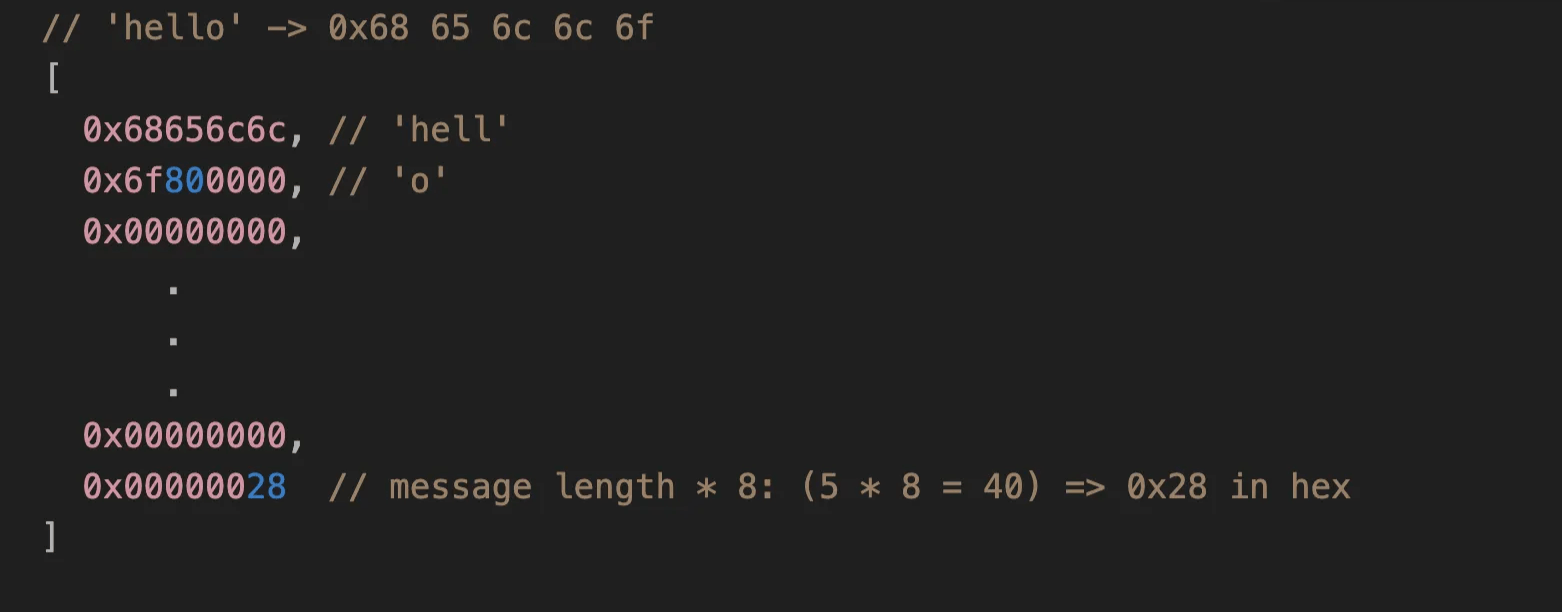
The padded input for the message
catwill be: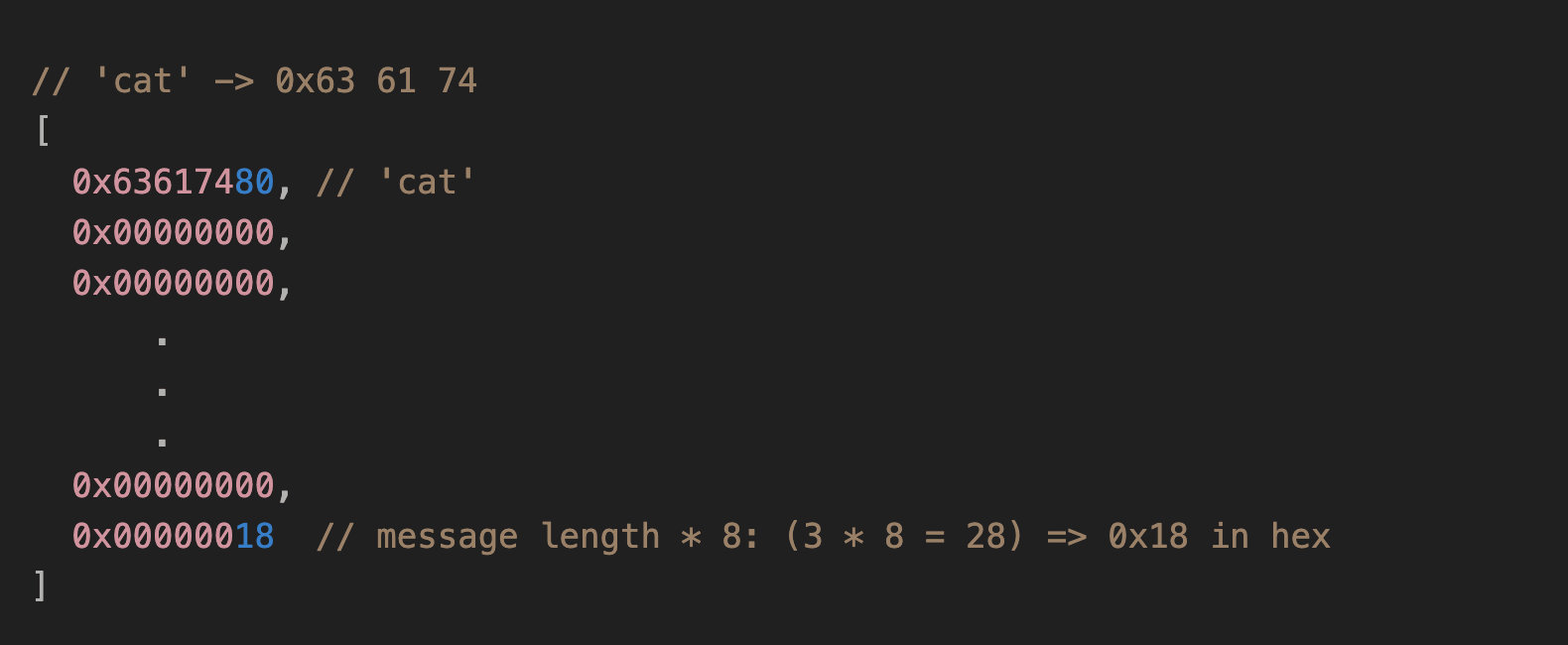
- append
It returns:
SyscallResult<Sha256StateHandle>: The updated internal state after processing the block. This new state should be fed into the next round if more blocks remain, or treated as the final digest (after applying SHA-256 padding if necessary).
Why sha256_process_block Cannot Be Called Directly
As of this writing, user contracts cannot directly call the sha256_process_block syscall because its state handle is declared with restricted visibility:
/// A handle to the state of a SHA-256 hash.
pub(crate) extern type Sha256StateHandle;
The pub(crate) visibility means that Sha256StateHandle is only accessible within the core library’s crate and not to user contracts. In other words, even though the syscall exists, its state handle type isn’t exposed publicly, preventing us from interacting with it directly.
That said, the core library does provide higher-level functions that internally handle this:
compute_sha256_byte_arraycompute_sha256_u32_array
However, we won’t cover these in this article since our focus is specifically on syscalls.
Send Message to Ethereum L1 syscall
So far, we have looked at syscalls used within Starknet itself. However, Starknet contracts can also communicate with Ethereum (L1). This is done using the send_message_to_l1_syscall, which allows a Starknet (L2) contract to send messages or pass data to an L1 contract.
Practical use cases include bridging tokens to Ethereum, notifying an L1 contract about events that occurred on Starknet, or finalizing a cross-chain action.
The send_message_to_l1_syscall function signature is:
fn send_message_to_l1_syscall(
to_address: felt252, payload: Span<felt252>,
) -> SyscallResult<()>;
It takes two arguments:
to_address: the 20-byte Ethereum address (as afelt252) of the target L1 contract.payload: aSpan<felt252>representing the message. This can contain any encoded data (function selectors, parameters, etc.) that the L1 contract understands.
It returns nothing.
It’s important to note that the syscall itself does not directly invoke a function on an Ethereum contract. Instead, the flow works through the Starknet Core contract deployed on L1:
-
The Cairo contract on L2 calls
send_message_to_l1_syscall, pushing the payload into the messaging bridge. -
On L1, the destination Solidity contract (the address you specified in
to_address) consumes the message by calling a functionconsumeMessageFromL2in the Starknet Core contract (a Solidity contract deployed on Ethereum. It verifies Starknet state updates, maintains the L2 ↔ L1 messaging queues, and exposes functions that L1 contracts use to send and consume messages to and from Starknet):consumeMessageFromL2(l2_sender, payload)l2_sender: The Starknet L2 address (as auint256) of the contract that sent the message.- This must be the exact L2 contract address that executed
send_message_to_l1_syscall. - Represent it on L1 as a
uint256with the same numeric value as the L2 felt address (no extra encoding). - The Starknet Core contract validates that
msg.sendermatches the destination address. Therefore, you must callconsumeMessageFromL2from the exact L1 contract address specified into_address. Calling from an EOA or a different contract will cause the transaction to revert.
- This must be the exact L2 contract address that executed
payload: The exact array of words (asuint256[]) that the L2 contract sent—same order, same values, same length.
-
The
consumeMessageFromL2function then marks the message as consumed, preventing it from being processed multiple times (replay protection). -
The Solidity contract can then trigger any follow-up logic—such as updating state, minting tokens, or invoking other functions.
Example
Let’s create a simple Cairo contract that sends a message to L1 and then test that it indeed sends message to L1.
We start by creating a new Scarb project, let’s call it l1_msg:
scarb new l1_msg
Then replace the generated code in lib.cairo with the one below. This contract defines a function greetings_to_l1 that sends the message Hello from RareSkills! to L1.
#[starknet::interface]
pub trait IHelloStarknet<TContractState> {
fn greetings_to_l1(ref self: TContractState);
}
#[starknet::contract]
mod HelloStarknet {
// IMPORTS
use starknet::syscalls::send_message_to_l1_syscall;
use starknet::SyscallResultTrait; // for .unwrap_syscall()
#[storage]
struct Storage {}
#[abi(embed_v0)]
impl HelloStarknetImpl of super::IHelloStarknet<ContractState> {
fn greetings_to_l1(ref self: ContractState) {
// payload must be Span<felt252>
let mut payload: Array<felt252> = ArrayTrait::new();
payload.append('Hello from RareSkills!'); // any data you want to send
// call the syscall
send_message_to_l1_syscall(0x1234, payload.span()).unwrap_syscall();
}
}
}
Here we are sending the message Hello from RareSkills! to the recipient’s L1 address 0x1234.
Now to test that the Cairo contract correctly sends a message to L1, we will use helpers from the snforge_std library. Navigate to tests/test_contract.cairo and replace the code with the following:
use snforge_std::{
ContractClassTrait, DeclareResultTrait, declare,
// ======== 3 NEW HELPERS =========
spy_messages_to_l1,
MessageToL1,
MessageToL1SpyAssertionsTrait,
};
use starknet::{ContractAddress, EthAddress};
use l1_msg::{IHelloStarknetDispatcher, IHelloStarknetDispatcherTrait};
fn deploy_contract(name: ByteArray) -> ContractAddress {
let contract = declare(name).unwrap().contract_class();
let (address, _) = contract.deploy(@ArrayTrait::new()).unwrap();
address
}
#[test]
fn test_send_message_to_l1() {
let main_contract_addr = deploy_contract("HelloStarknet");
let main_dispatcher = IHelloStarknetDispatcher { contract_address: main_contract_addr };
// Start spying L2->L1 messages
let mut spy = spy_messages_to_l1();
// Call the Cairo function
let _ = main_dispatcher.greetings_to_l1();
// Choose any L1 address (EthAddress wraps a felt252 under-the-hood)
let to: EthAddress = 0x1234.try_into().unwrap();
// Build our expected message
let expected_payload = array!['Hello from RareSkills!'];
// Assert the message was sent (from our contract to the expected L1 address with payload)
spy.assert_sent(
@array![
(main_contract_addr, MessageToL1 { to_address: to, payload: expected_payload }),
],
);
}
The test uses spy_messages_to_l1() to act as an observer on the L2 → L1 messaging queue, call the Cairo contract function greetings_to_l1 and then assert that a message was successfully sent from the contract to the expected L1 address with the correct payload.
Exercise:
- Run the test with
scarb testand confirm it passes. - Modify the
expected_payloadin the test toHi from RareSkills!. - Re-run the test and see how the assertion fails when the payload does not match.
Meta_tx_v0 Syscall
meta_tx_v0_syscall is a backward compatibility syscall introduced in Starknet v0.14.0.
Starknet transactions have gone through several versions, v0 being the first and v3 being the current one. When v0, v1, and v2 transactions were deprecated in favour of v3, account contracts written for the v0 transaction format could no longer be called directly.
This syscall bridges that gap, allowing a v3 transaction to invoke an account contract that was written to expect the v0 transaction format.
The function signature for meta_tx_v0_syscall is:
fn meta_tx_v0_syscall(
address: ContractAddress,
entry_point_selector: felt252,
calldata: Span<felt252>,
signature: Span<felt252>,
) -> SyscallResult<Span<felt252>>;
This syscall takes the following arguments:
address: The contract address of the target version 0 account to be called.entry_point_selector: the selector of the function to be called on the target account. In v0, this is also computed assn_keccak(function_name).calldata: the arguments to pass to the function, as a span offelt252values.signature: the transaction signature as a span offelt252values. Unlike a v3 transaction where the signature is derived from the transaction context automatically, here it must be computed and passed explicitly. To produce it:-
Hash the transaction data using Pedersen to get version 0 transaction hash:
invoke_v0_tx_hash = h( "invoke", version, contract_address, entry_point_selector, h(calldata), max_fee, chain_id ); -
Sign the resulting hash with the account’s private key to produce the
(r, s)signature values, then pass them as thesignaturespan.
-
It returns the called function’s return data as a Span<felt252>.
How this syscall works under the hood
When you call meta_tx_v0_syscall, Starknet modifies the execution context to make it look like an old-style v0 transaction:
- The signature is replaced with the one you pass in via the
signatureparameter - The caller becomes address 0 (the OS/protocol itself)
- The transaction version is changed to 0 (pretending it’s an old-style transaction)
- The transaction hash is recalculated as a version-0 transaction hash
The diagram below shows exactly what each field looks like before and after the syscall is invoked:
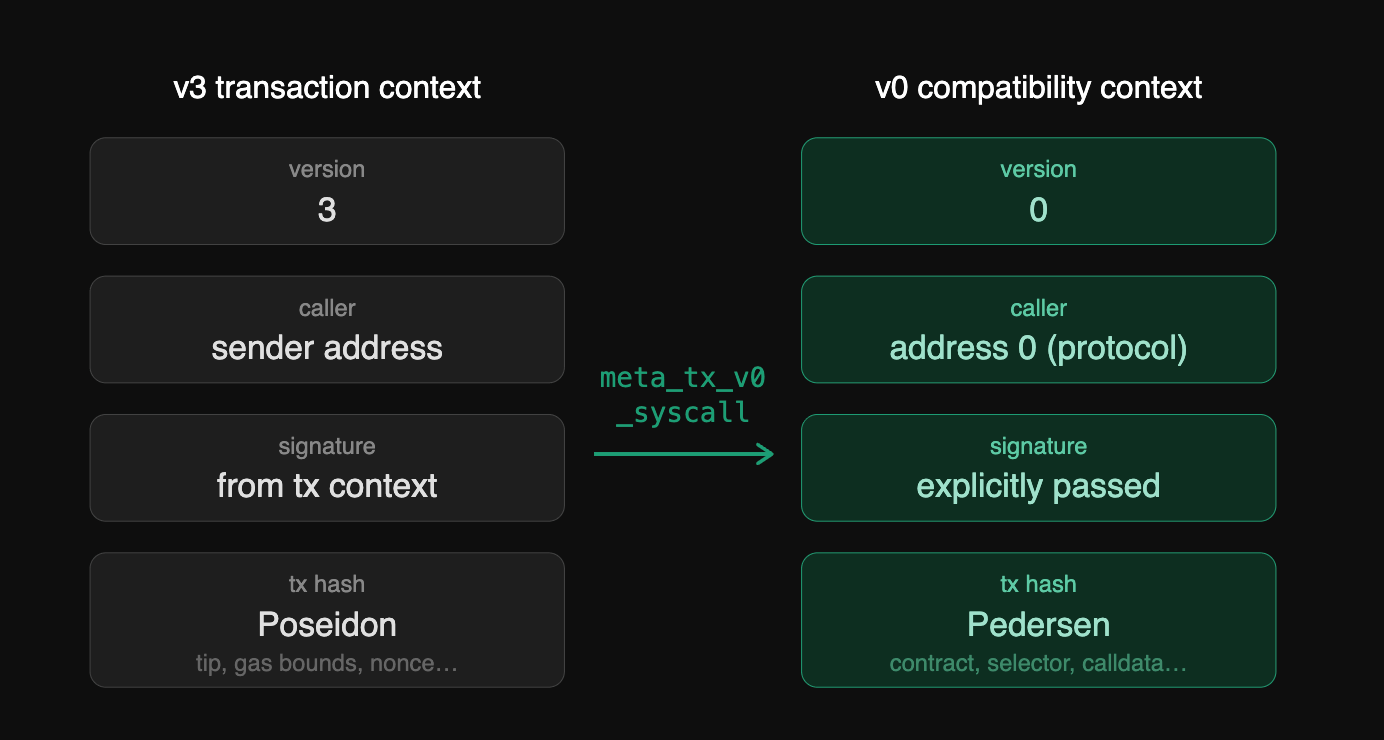
These changes apply not only to the called contract but also to any inner contracts it calls. It ensures the entire call chain operates in “v0 compatibility mode.”
Note: The syscall documentation explicitly states it “should only be used to allow support for old version 0 account contracts, and should not be used for other purposes.” If you need to call newer version account contracts, always use
call_contract_syscallinstead.