On Ethereum, the proxy pattern is the most common approach for contract upgradeability. In this pattern, a proxy contract holds the contract’s storage and delegates function calls to a separate implementation contract. When an upgrade is needed, you deploy a new implementation contract and point the proxy to it.
Starknet takes a different approach, it uses the replace_class_syscall to swap the class hash of a deployed contract without changing the storage and address. This article covers how replace_class_syscall works and how to implement contract upgrades on Starknet.
How replace_class_syscall Works
Recall from the Chapter on “Understanding Starknet’s Contract Deployment Model” that every contract is an instance of a contract class: the class contains bytecode, and the instance holds storage with its address. Because the bytecode and storage live separately, you can point the contract instance to a new class while preserving storage.
To upgrade a contract using replace_class_syscall, we pass the class hash of the new implementation as an argument (new_class_hash: ClassHash).
The replace_class_syscallfunction signature is:
fn replace_class_syscall(new_class_hash: ClassHash) -> SyscallResult<()>
It returns SyscallResult<()>: A result type that wraps either Ok(()) on success or Err with error details on failure. The syscall fails when the class hash hasn’t been declared on Starknet or when the caller doesn’t have permission to perform the upgrade.
When replace_class_syscall executes successfully:
- The contract address stays the same (regardless of how many upgrades occur)
- All storage data remains in the contract’s own storage
- The contract instance begins using the logic from the new class hash once execution returns to the caller.
Now that we understand how replace_class_syscall works, let’s use it to upgrade a contract.
Contract Upgrades with replace_class_syscall
We’ll upgrade a Counter contract that increments a count by 1 and retrieves the current count to a new class implementation, the Greeter contract.
Counter Contract
To follow along, create a new project and navigate into it:
scarb new counter_upgrade
cd counter_upgrade
Then create a src/counter.cairo file and add the code below.
We’ll focus on the upgrade function implementation.
use starknet::{ClassHash};
#[starknet::interface]
pub trait ICounter<TContractState> {
fn get_count(self: @TContractState) -> u32;
fn increment(ref self: TContractState);
fn upgrade(ref self: TContractState, new_class_hash: ClassHash);
}
#[starknet::contract]
mod Counter {
use starknet::storage::{StoragePointerReadAccess, StoragePointerWriteAccess};
use starknet::syscalls::replace_class_syscall;
use starknet::SyscallResultTrait;
use starknet::{ClassHash, ContractAddress, get_caller_address};
#[storage]
struct Storage {
count: u32,
owner: ContractAddress,
current_class_hash: ClassHash,
}
#[event]
#[derive(Drop, starknet::Event)]
enum Event {
ContractUpgraded: ContractUpgraded,
}
#[derive(Drop, starknet::Event)]
struct ContractUpgraded {
old_class_hash: ClassHash, // Previous implementation class hash
new_class_hash: ClassHash, // New implementation class hash
}
#[constructor]
fn constructor(ref self: ContractState, owner: ContractAddress, initial_class_hash: ClassHash) {
self.count.write(1); // Initialize counter to 1
self.owner.write(owner); // Sets the contract owner
self.current_class_hash.write(initial_class_hash); // Just to track the class hashes
}
#[abi(embed_v0)]
impl CounterImpl of super::ICounter<ContractState> {
// returns the current counter value
fn get_count(self: @ContractState) -> u32 {
self.count.read()
}
// increments the counter by 1
fn increment(ref self: ContractState) {
let current = self.count.read();
self.count.write(current + 1);
}
// FOCUS HERE: upgrades the contract to use a new implementation
fn upgrade(ref self: ContractState, new_class_hash: ClassHash) {
let caller = get_caller_address();
assert(caller == self.owner.read(), 'Only contract owner can upgrade');
let old_class_hash = self.current_class_hash.read();
replace_class_syscall(new_class_hash).unwrap_syscall();
self.current_class_hash.write(new_class_hash);
self.emit(ContractUpgraded { old_class_hash, new_class_hash });
}
}
}
The upgrade function accepts the new class hash as an argument and ensures that the caller is the contract owner to prevent unauthorized upgrades.
let caller = get_caller_address();
assert(caller == self.owner.read(), 'Only contract owner can upgrade');
The actual upgrade occurs on line:
replace_class_syscall(new_class_hash).unwrap_syscall();
unwrap_syscall() panics if the replace_class_syscall returns an error which causes the transaction to revert. This means the upgrade either completes successfully or the transaction panics, rolls back and leaves the contract unchanged.
Once the upgrade completes, the function emits a ContractUpgraded to log the change:
self.emit(ContractUpgraded { old_class_hash, new_class_hash });
Replace the contents of src/lib.cairo with mod counter; to tell the compiler which modules to include in the build.
Declaring and Deploying the Counter Contract
Now let’s declare and deploy the contract to test the upgrade functionality.
Run the following command to declare the Counter contract. Replace YOUR_ACCOUNT_NAME with your account name and YOUR_API_KEY with your Alchemy API key:
sncast \
--account <YOUR_ACCOUNT_NAME> \
declare \
--url https://starknet-sepolia.g.alchemy.com/starknet/version/rpc/v0_10/<YOUR_API_KEY> \
--contract-name Counter
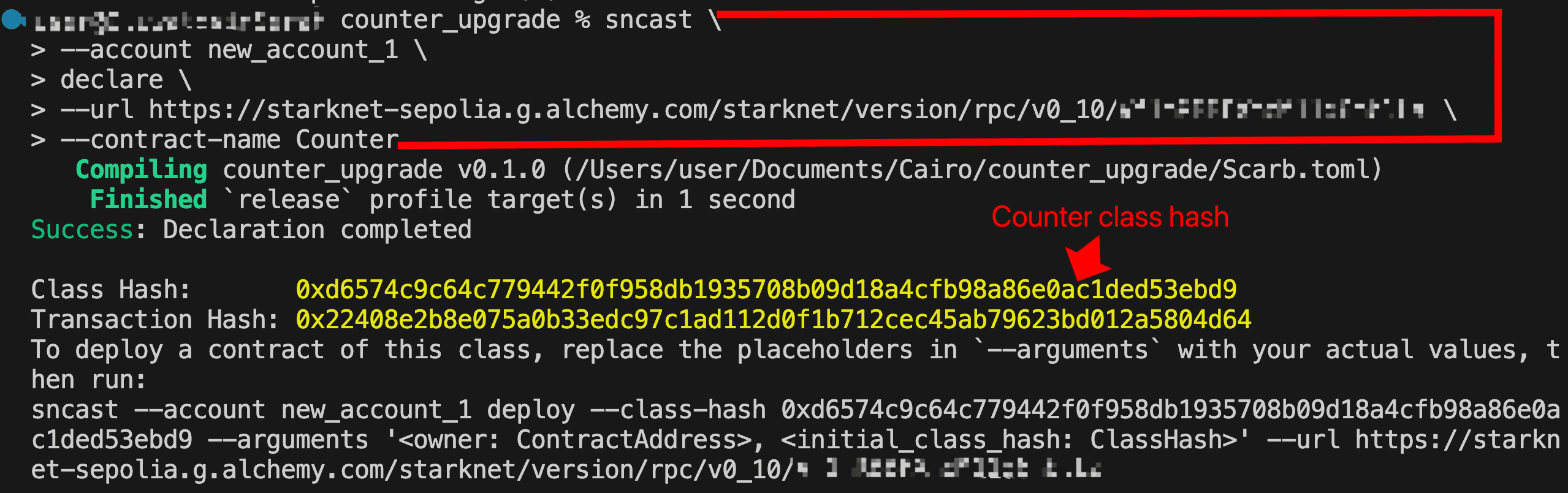
Deploy the Counter contract
Since the Counter constructor expects the initial class hash as an argument to track upgrades, we pass it the class hash from the declaration step above, along with the owner address. Run the following command to deploy, replacing the placeholders with their concrete values:
sncast \
--account <YOUR_ACCOUNT_NAME> \
deploy \
--class-hash <COUNTER_CLASS_HASH> \
--arguments '<OWNER_ADDRESS>, <COUNTER_CLASS_HASH>' \
--url https://starknet-sepolia.g.alchemy.com/starknet/version/rpc/v0_10/<YOUR_API_KEY>
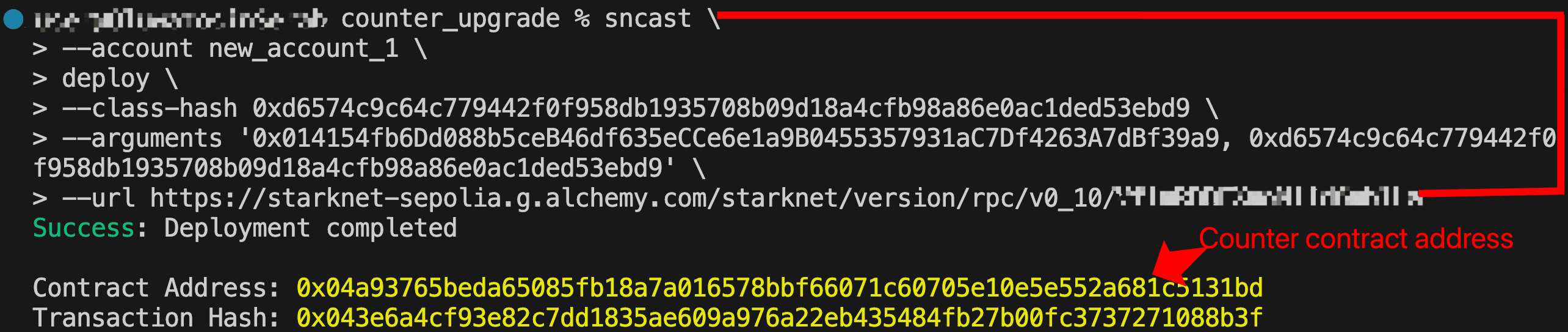
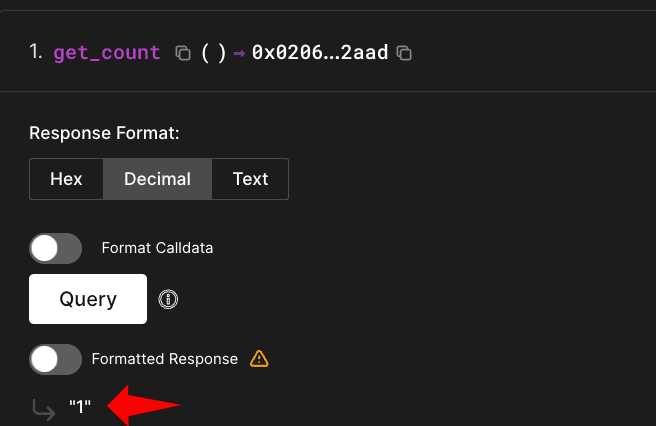
After deployment, the count should be 1 since we initialized it to 1 in the constructor. We can verify this by calling get_count through Voyager’s read contract interface, which returns 1.
To upgrade the Counter contract, we need a new class hash. We get this by declaring a second contract called Greeter.
Creating the Greeter Contract
The Greeter contract will set and retrieve greeting messages, track the greeting count, and include upgrade functionality. We’re using a structurally different contract rather than a newer Counter version to demonstrate three things:
- How storage is preserved across upgrades
- How field name collisions behave
- When exactly the new implementation takes effect after calling
replace_class_syscall
Each of these is covered in the sections that follow.
Create a src/greeter.cairo file in the same counter_upgrade project and add the following code to it:
use starknet::{ClassHash, ContractAddress};
#[starknet::interface]
pub trait IGreeter<TContractState> {
fn set_greeting(ref self: TContractState, message: ByteArray);
fn get_greeting(self: @TContractState) -> ByteArray;
fn get_greeting_count(self: @TContractState) -> u32;
fn upgrade(ref self: TContractState, new_class_hash: ClassHash);
fn get_owner(self: @TContractState) -> ContractAddress;
}
#[starknet::contract]
mod Greeter {
use starknet::storage::{StoragePointerReadAccess, StoragePointerWriteAccess};
use starknet::syscalls::replace_class_syscall;
use starknet::SyscallResultTrait;
use starknet::{ClassHash, ContractAddress, get_caller_address};
#[storage]
struct Storage {
greeting: ByteArray,
greeting_count: u32,
owner: ContractAddress,
}
#[event]
#[derive(Drop, starknet::Event)]
enum Event {
ContractUpgraded: ContractUpgraded,
}
#[derive(Drop, starknet::Event)]
struct ContractUpgraded {
new_class_hash: ClassHash,
}
#[constructor]
fn constructor(ref self: ContractState, owner: ContractAddress) {
self.owner.write(owner); // Set the contract owner
}
#[abi(embed_v0)]
impl GreeterImpl of super::IGreeter<ContractState> {
// Updates the greeting message and increments the usage counter
fn set_greeting(ref self: ContractState, message: ByteArray) {
self.greeting.write(message);
let current_count = self.greeting_count.read();
let new_count = current_count + 1;
self.greeting_count.write(new_count);
}
// Returns the current greeting message
fn get_greeting(self: @ContractState) -> ByteArray {
self.greeting.read()
}
// Returns how many times the greeting has been updated
fn get_greeting_count(self: @ContractState) -> u32 {
self.greeting_count.read()
}
// Upgrades the contract to use a new implementation
fn upgrade(ref self: ContractState, new_class_hash: ClassHash) {
let caller = get_caller_address();
assert(caller == self.owner.read(), 'Only owner can upgrade');
replace_class_syscall(new_class_hash).unwrap_syscall();
self.emit(ContractUpgraded { new_class_hash });
}
// Returns the contract owner's address
fn get_owner(self: @ContractState) -> ContractAddress {
self.owner.read()
}
}
}
Then add mod greeter; to src/lib.cairo, so we have the following in the lib.cairo:
mod counter;
mod greeter;
Declare the Greeter contract to get the class hash for upgrading the Counter contract:
sncast \
--account <YOUR_ACCOUNT_NAME> \
declare \
--url https://starknet-sepolia.g.alchemy.com/starknet/version/rpc/v0_10/<YOUR_API_KEY> \
--contract-name Greeter
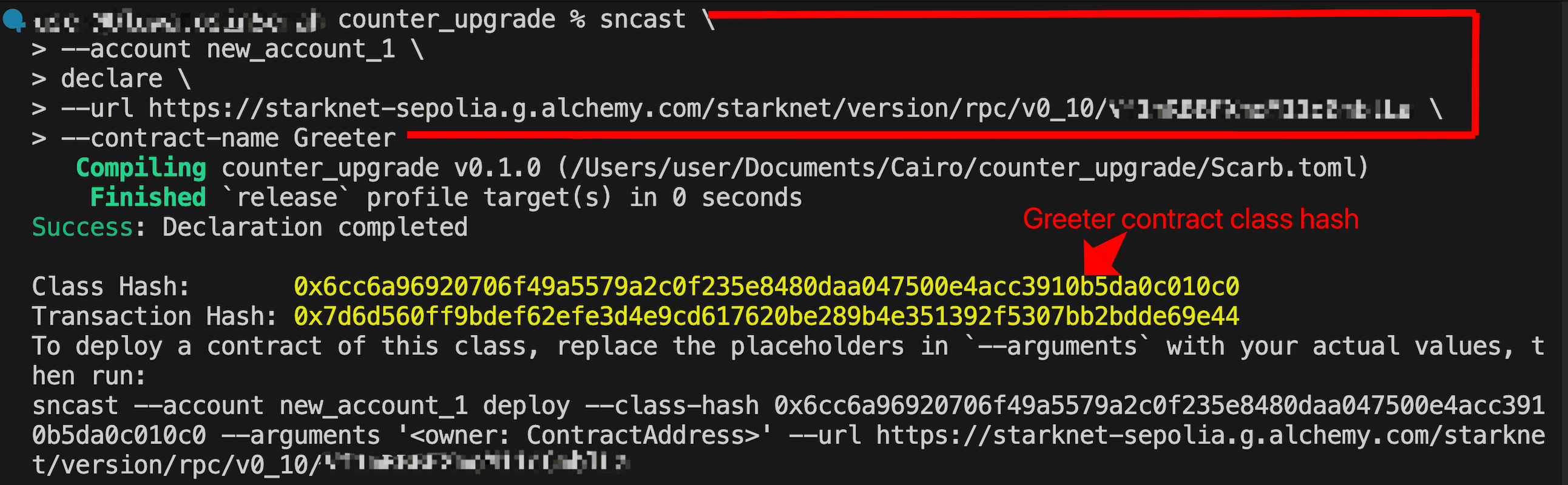
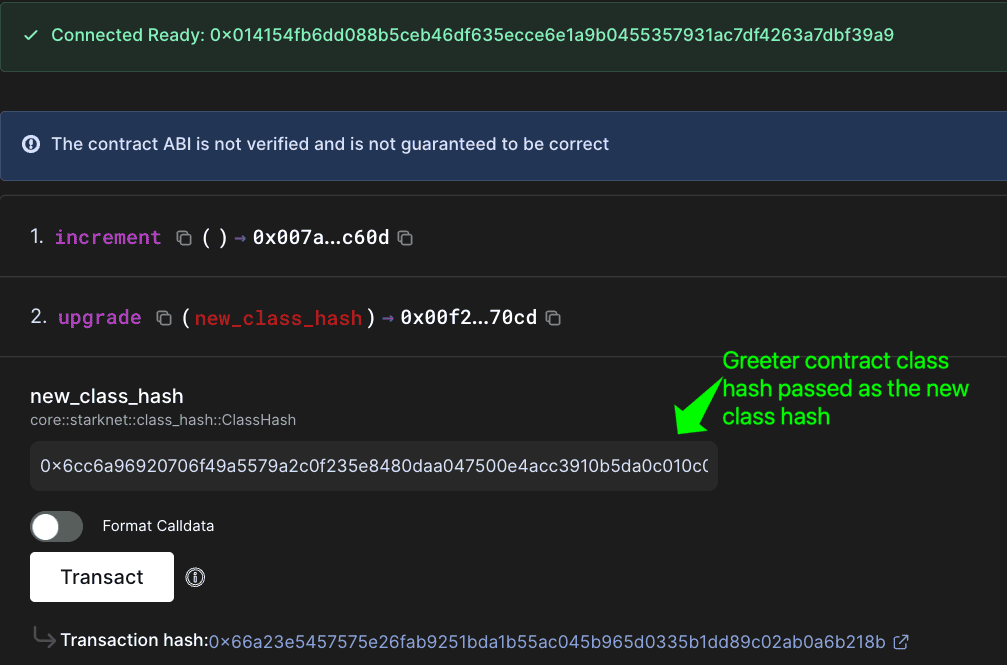
Using the address set as the owner during the Counter deployment, call the upgrade function on Voyager’s “Write Contract” tab with the Greeter’s class hash as the argument and the transaction should succeed:
Contract Storage Before and After Upgrade
Before the upgrade, the Counter contract had this state:
- count =
1 - owner =
0x014154fb6Dd088b5ceB46df635eCCe6e1a9B0455357931aC7Df4263A7dBf39a9 - current_class_hash =
0xd6574c9c64c779442f0f958db1935708b09d18a4cfb98a86e0ac1ded53ebd9
After upgrading, the contract keeps all its stored data while executing code from the Greeter class hash:
- count =
1 - owner =
0x014154fb6Dd088b5ceB46df635eCCe6e1a9B0455357931aC7Df4263A7dBf39a9 - current_class_hash =
0x6cc6a96920706f49a5579a2c0f235e8480daa047500e4acc3910b5da0c010c0 - greeting =
0 - greeting_count =
0
Notice that both contracts have an owner field that maps to the same storage location (computed from sn_keccak("owner")).
We can verify this using Voyager’s storage query interface. Voyager’s current interface only lets you query one storage slot at a time.
To query all slots at once, click “View old version of this page” at the top of the contract page, and select “Struct” from the query type dropdown.
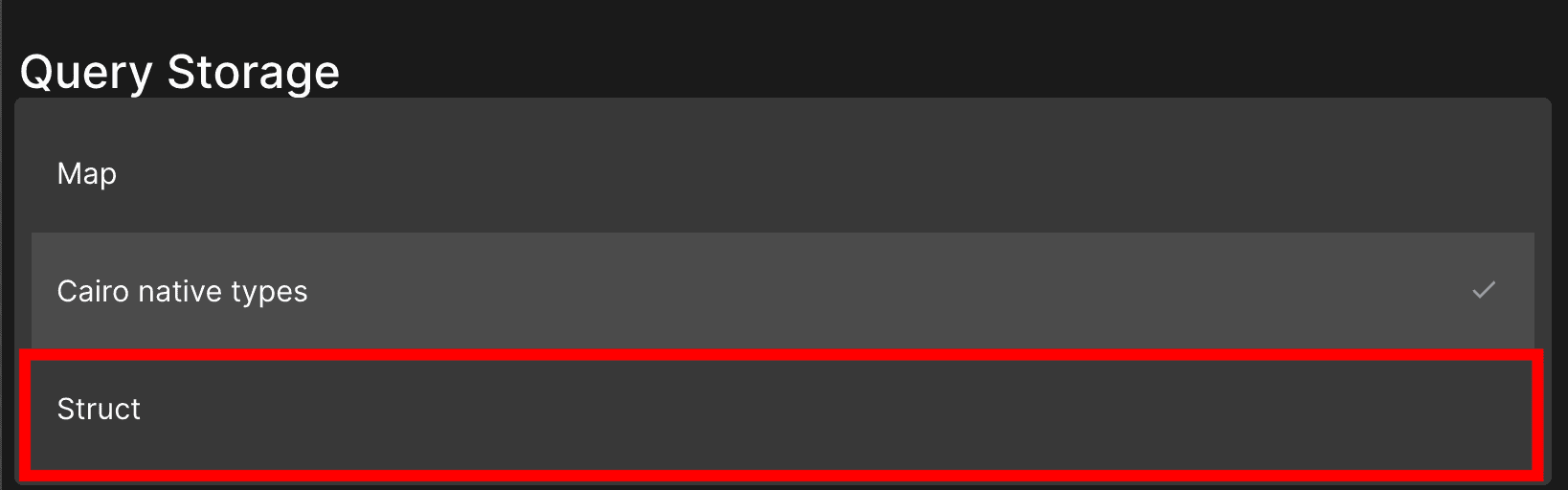
Then paste the following struct into the input field. Note that this struct combines the storage variables from both the Counter and Greeter class implementations:
#[storage]
struct Storage {
count: u32,
owner: ContractAddress,
current_class_hash: ClassHash,
greeting: ByteArray,
owner: ContractAddress,
}
Click “Query Struct Data” to see how the same storage is interpreted through the contract’s structure:
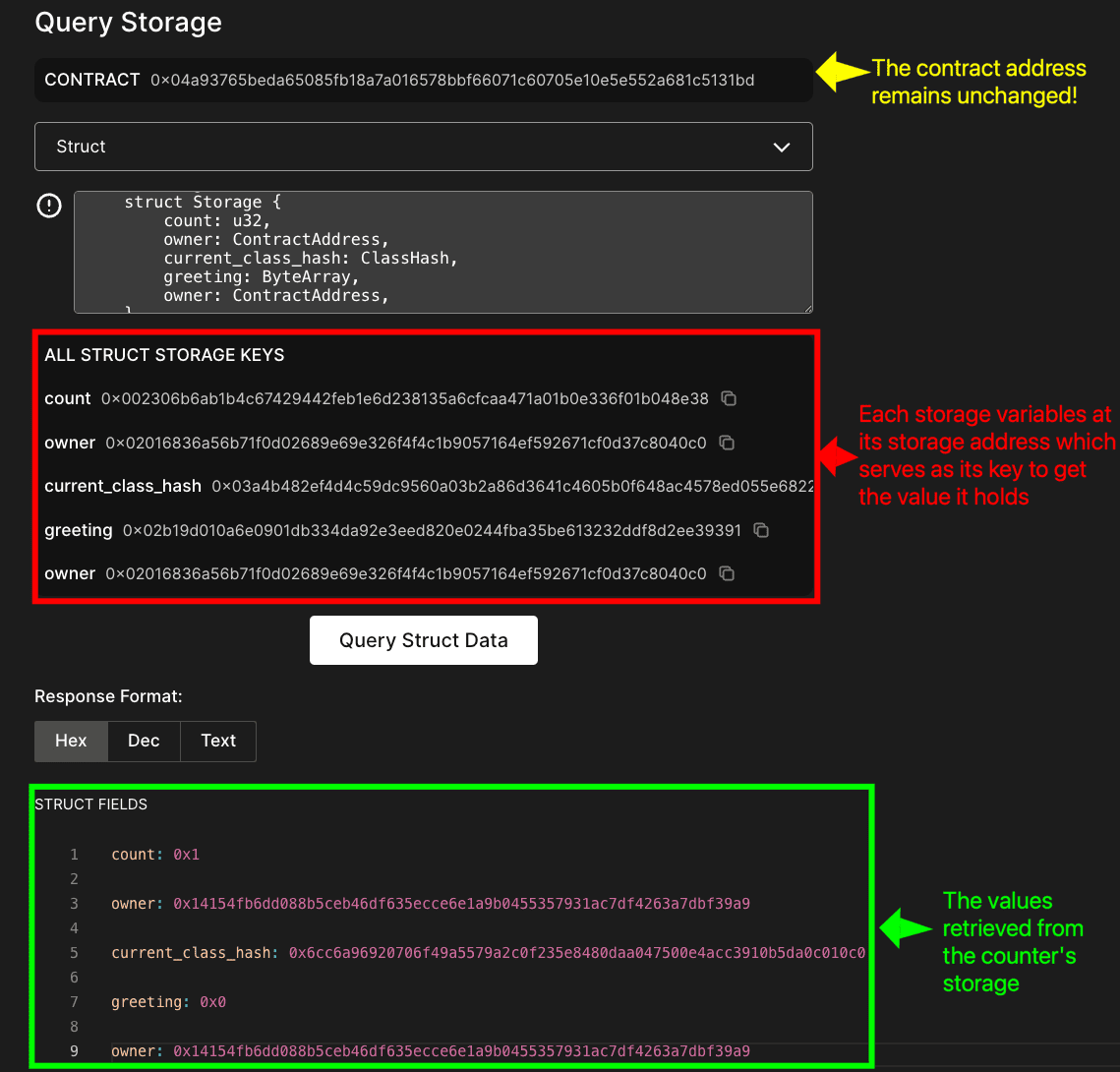
Note that the new class hash applies to subsequent calls only after the current function upgrade call ends.
Consider this example code that shows exactly when the upgrade takes effect within the upgrade function:
fn upgrade(ref self: ContractState, new_class_hash: ClassHash) {
let count_before = self.count.read(); // count_before = 1
replace_class_syscall(new_class_hash).unwrap(); // Syscall succeeds
// But this STILL uses the OLD implementation!
self.increment(); // count goes from 1 to 2 (old logic)
let count_after = self.count.read(); // count_after = 2
}
- While the
upgradecall is executing:count_before = 1, then afterself.increment()using old logic,count_after = 2 - After the upgrade function completes: subsequent calls to the contract execute code from the new class hash
This means replace_class_syscall registers the new class hash but the current call continues to execute code from the old class. If you need to execute code from the new class within the same transaction, combine replace_class_syscall with call_contract_syscall.
Using replace_class_syscall with call_contract_syscall for Upgrades
When upgrading, replace_class_syscall is always called first to register the new class. If you then need to immediately invoke the new implementation within the same function, you need to follow it with call_contract_syscall.
Any call_contract_syscall invocations to the same contract after replace_class_syscall will execute using the new implementation, even though direct function calls within the upgrade function itself still runs under the old implementation.
Here’s the same upgrade function rewritten to use call_contract_syscall instead of self.increment():
fn upgrade(ref self: ContractState, new_class_hash: ClassHash) {
let count_before = self.count.read(); // count_before = 1
replace_class_syscall(new_class_hash).unwrap(); // Registers the new class
let increment_selector = selector!("increment");
call_contract_syscall( // Immediately executes using the NEW implementation
get_contract_address(),
increment_selector, // Dispatches the increment call
array![].span()
).unwrap();
let count_after = self.count.read(); // count_after = 1 (new increment does nothing)
}
Unlike self.increment() which continues to use the old implementation for the duration of the upgrade function, call_contract_syscall dispatches the increment call to the new class. Since replace_class_syscall has already updated the contract to point to that new class, call_contract_syscall executes the new implementation. This is why count_after remains 1 instead of incrementing to 2.
Let’s verify both upgrade approaches on-chain with an updated Counter contract that implements them as separate functions.
Version 1: Standard replace_class_syscall
We’ll test whether the upgrade takes effect immediately by checking the count before and after calling increment() within the same function.
Start by updating the ContractUpgraded event in the Counter to include count tracking:
#[derive(Drop, starknet::Event)]
struct ContractUpgraded {
old_class_hash: ClassHash,
new_class_hash: ClassHash,
count_before: u32, //ADD THIS
count_after: u32, //ADD THIS
}
Replace the upgrade function with upgrade_standard:
fn upgrade_standard(ref self: ContractState, new_class_hash: ClassHash) {
let caller = get_caller_address();
assert(caller == self.owner.read(), 'Only owner can upgrade');
// Check count before upgrade
let count_before = self.count.read();
let old_class_hash = self.current_class_hash.read();
replace_class_syscall(new_class_hash).unwrap_syscall();
self.current_class_hash.write(new_class_hash);
// Test: Does this use old or new implementation?
self.increment();
// Check count after increment
let count_after = self.count.read();
self.emit(ContractUpgraded {
old_class_hash,
new_class_hash,
count_before,
count_after
});
}
Then, update the interface to reflect the upgrade_standard function:
#[starknet::interface]
pub trait ICounter<TContractState> {
fn get_count(self: @TContractState) -> u32;
fn increment(ref self: TContractState);
fn upgrade_standard(ref self: TContractState, new_class_hash: ClassHash); //ADD THIS
}
Here’s the full updated Counter contract with the upgrade_standard function:
use starknet::ClassHash;
#[starknet::interface]
pub trait ICounter<TContractState> {
fn get_count(self: @TContractState) -> u32;
fn increment(ref self: TContractState);
fn upgrade_standard(ref self: TContractState, new_class_hash: ClassHash);
}
#[starknet::contract]
mod Counter {
use starknet::storage::{StoragePointerReadAccess, StoragePointerWriteAccess};
use starknet::syscalls::replace_class_syscall;
use starknet::{ClassHash, ContractAddress, SyscallResultTrait, get_caller_address};
#[storage]
struct Storage {
count: u32,
owner: ContractAddress,
current_class_hash: ClassHash,
}
#[event]
#[derive(Drop, starknet::Event)]
enum Event {
ContractUpgraded: ContractUpgraded
}
#[derive(Drop, starknet::Event)]
struct ContractUpgraded {
old_class_hash: ClassHash,
new_class_hash: ClassHash,
count_before: u32,
count_after: u32,
}
#[constructor]
fn constructor(ref self: ContractState, owner: ContractAddress, initial_class_hash: ClassHash) {
self.count.write(1); // Initialize counter to 1
self.owner.write(owner); // Sets the contract owner
self.current_class_hash.write(initial_class_hash); // to track the class hashes
}
#[abi(embed_v0)]
impl CounterImpl of super::ICounter<ContractState> {
// returns the current counter value
fn get_count(self: @ContractState) -> u32 {
self.count.read()
}
// increments the counter by 1
fn increment(ref self: ContractState) {
let current = self.count.read();
self.count.write(current + 1);
}
fn upgrade_standard(ref self: ContractState, new_class_hash: ClassHash) {
let caller = get_caller_address();
assert(caller == self.owner.read(), 'Only owner can upgrade');
// Check count before upgrade
let count_before = self.count.read();
let old_class_hash = self.current_class_hash.read();
replace_class_syscall(new_class_hash).unwrap_syscall();
self.current_class_hash.write(new_class_hash);
// Test: Does this use old or new implementation?
self.increment();
// Check count after increment
let count_after = self.count.read();
self
.emit(
ContractUpgraded { old_class_hash, new_class_hash, count_before, count_after },
);
}
}
}
Redeclare and deploy the updated Counter contract, then call upgrade_standard with the Greeter’s class hash through Voyager’s Write Contract tab.
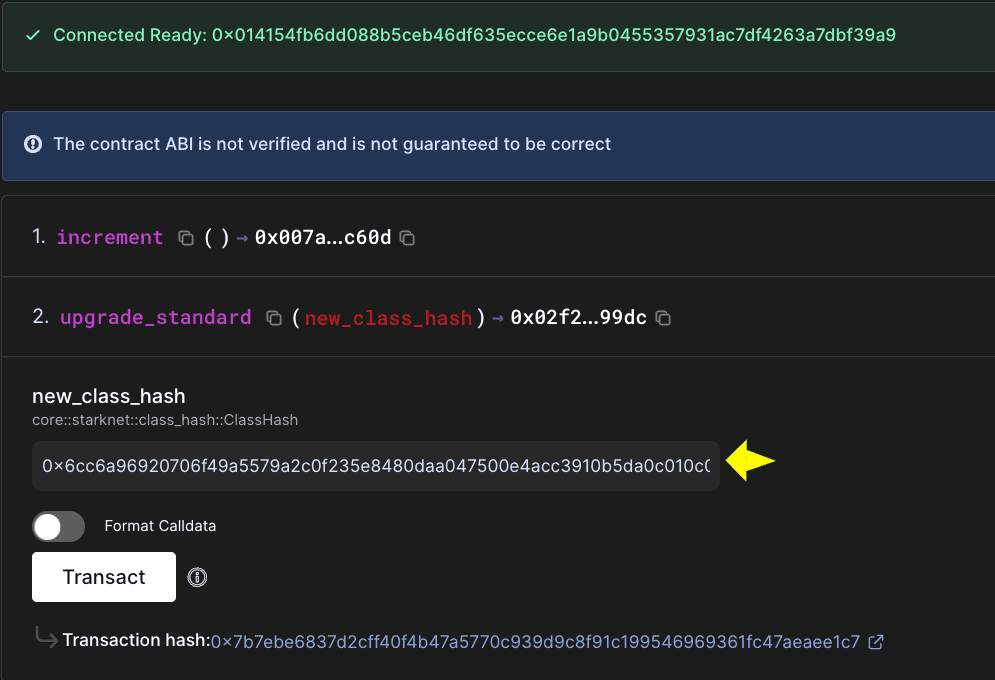
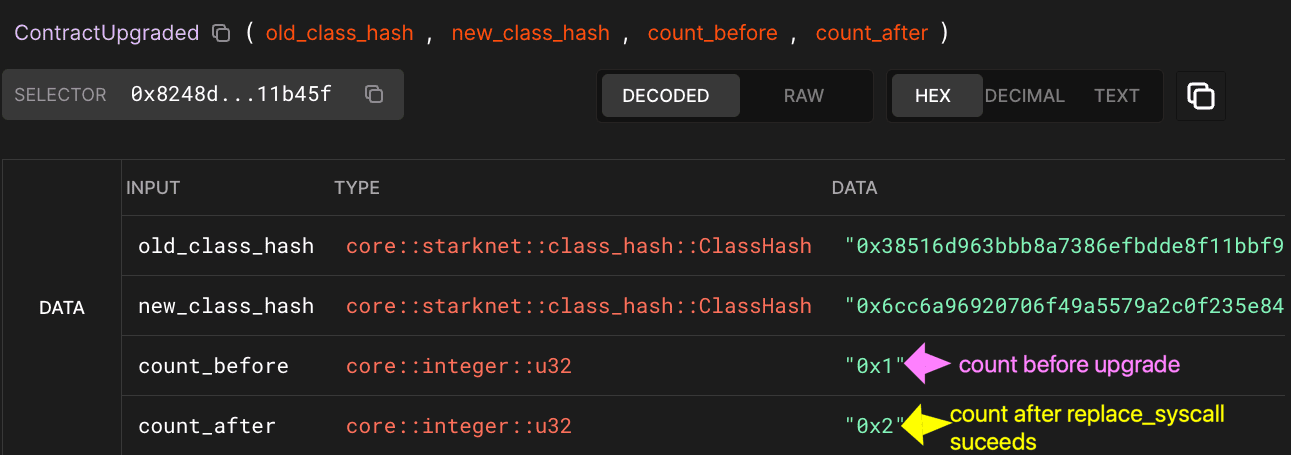
The emitted ContractUpgraded event shows the count increased from 1 to 2, confirming that the old implementation’s increment() function was used during the upgrade function execution:
Version 2: Using call_contract_syscall within the upgrade function
Now let’s create an upgrade version that uses call_contract_syscall to confirm if we can immediately access the new implementation within the same transaction.
Replace the upgrade_standard function with the following upgrade_with_call implementation that uses call_contract_syscall:
fn upgrade_with_call(ref self: ContractState, new_class_hash: ClassHash) {
let caller = get_caller_address();
assert(caller == self.owner.read(), 'Only owner can upgrade');
// Check count before upgrade
let count_before = self.count.read();
let old_class_hash = self.current_class_hash.read();
replace_class_syscall(new_class_hash).unwrap_syscall();
self.current_class_hash.write(new_class_hash);
// Test: Call increment using call_contract_syscall to see if new implementation is used
let increment_selector = selector!("increment");
call_contract_syscall(get_contract_address(), increment_selector, array![].span())
.unwrap_syscall();
// Check count after increment
let count_after = self.count.read();
self
.emit(
ContractUpgraded { old_class_hash, new_class_hash, count_before, count_after },
);
}
Import call_contract_syscall from the starknet syscalls module and get_contract_address from starknet. The complete contract with the updates becomes:
use starknet::ClassHash;
#[starknet::interface]
pub trait ICounter<TContractState> {
fn get_count(self: @TContractState) -> u32;
fn increment(ref self: TContractState);
fn upgrade_with_call(ref self: TContractState, new_class_hash: ClassHash);
}
#[starknet::contract]
mod Counter {
use starknet::storage::{StoragePointerReadAccess, StoragePointerWriteAccess};
use starknet::syscalls::{call_contract_syscall, replace_class_syscall};
use starknet::{
ClassHash, ContractAddress, SyscallResultTrait, get_caller_address, get_contract_address,
};
#[storage]
struct Storage {
count: u32,
owner: ContractAddress,
current_class_hash: ClassHash,
}
#[event]
#[derive(Drop, starknet::Event)]
enum Event {
ContractUpgraded: ContractUpgraded,
}
#[derive(Drop, starknet::Event)]
struct ContractUpgraded {
old_class_hash: ClassHash,
new_class_hash: ClassHash,
count_before: u32,
count_after: u32,
}
#[constructor]
fn constructor(ref self: ContractState, owner: ContractAddress, initial_class_hash: ClassHash) {
self.count.write(1); // Initialize counter to 1
self.owner.write(owner); // Sets the contract owner
self.current_class_hash.write(initial_class_hash); // to track the class hashes
}
#[abi(embed_v0)]
impl CounterImpl of super::ICounter<ContractState> {
// returns the current counter value
fn get_count(self: @ContractState) -> u32 {
self.count.read()
}
// increments the counter by 1
fn increment(ref self: ContractState) {
let current = self.count.read();
self.count.write(current + 1);
}
fn upgrade_with_call(ref self: ContractState, new_class_hash: ClassHash) {
let caller = get_caller_address();
assert(caller == self.owner.read(), 'Only owner can upgrade');
// Check count before upgrade
let count_before = self.count.read();
let old_class_hash = self.current_class_hash.read();
replace_class_syscall(new_class_hash).unwrap_syscall();
self.current_class_hash.write(new_class_hash);
// Test: Call increment using call_contract_syscall to see if new implementation is used
let increment_selector = selector!("increment");
call_contract_syscall(get_contract_address(), increment_selector, array![].span())
.unwrap_syscall();
// Check count after increment
let count_after = self.count.read();
self
.emit(
ContractUpgraded { old_class_hash, new_class_hash, count_before, count_after },
);
}
}
}
Redeclare and deploy the newly updated Counter contract, then attempt to upgrade to the Greeter using the original Greeter class hash. The transaction should fail:
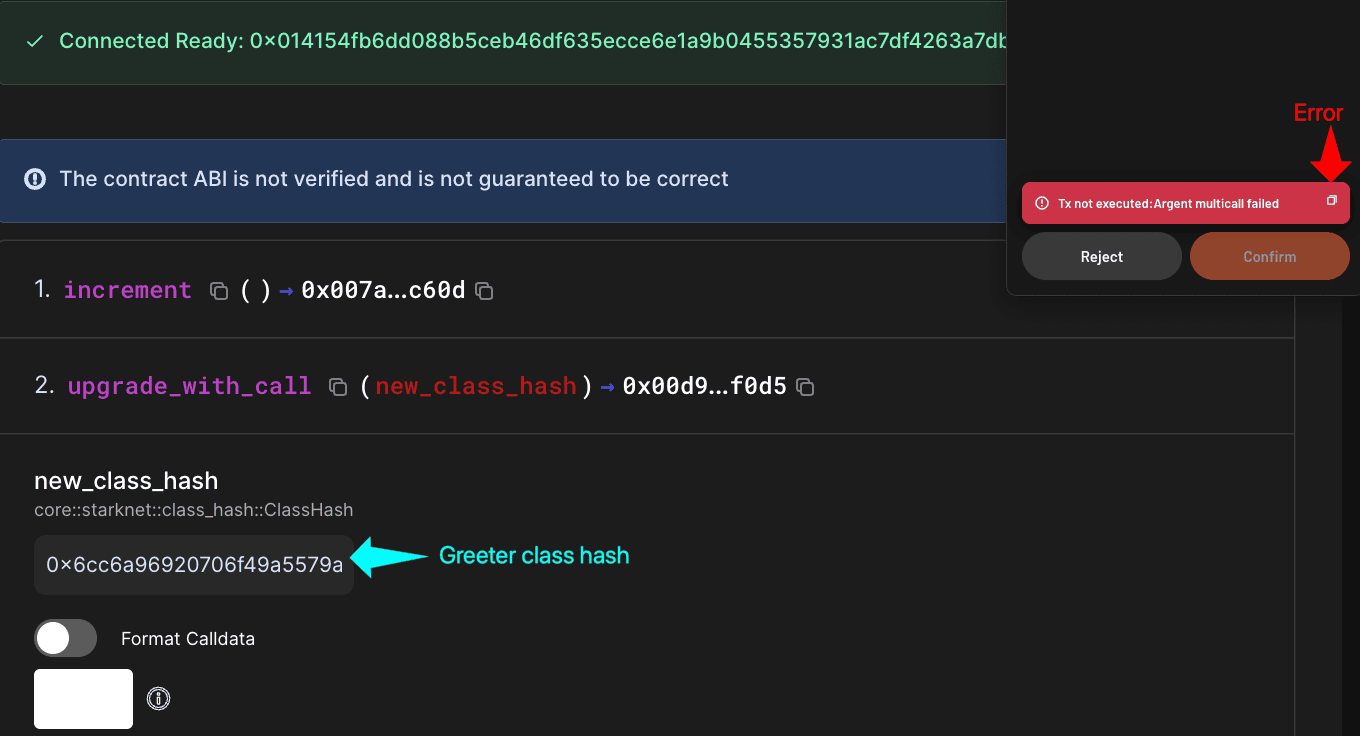
With the error:
Transaction execution has failed: 0: Error in the called contract (contract addre
ss: 0x014154fb6dd088b5ceb46df635ecce6e1a9b0455357931ac7df4263a7dbf39a9, class has
h: 0x036078334509b514626504edc9fb252328d1a240e4e948bef8d0c08dff45927f, selector:
0x015d40a3d6ca2ac30f4031e42be28da9b056fef9bb7357ac5e85627ee876e5ad): Execution fa
iled. Failure reason:(0x617267656e742f6d756c746963616c6c2d6661696c6564 ('argent/m
ulticall-failed'), 0x0 (''), 0x454e545259504f494e545f4e4f545f464f554e44 ('ENTRYPO
INT_NOT_FOUND'), 0x454e545259504f494e545f4641494c4544 ('ENTRYPOINT_FAILED'), 0x45
4e545259504f494e545f4641494c4544 ('ENTRYPOINT_FAILED')).
This happens because the Greeter contract doesn’t have an increment function, so call_contract_syscall cannot find the entry point after the upgrade. This means the target contract must implement any function that call_contract_syscall invokes after the upgrade.
To solve this, we add an empty increment function to the Greeter contract:
#[starknet::interface]
pub trait IGreeter<TContractState> {
fn set_greeting(ref self: TContractState, message: ByteArray);
fn get_greeting(self: @TContractState) -> ByteArray;
fn get_greeting_count(self: @TContractState) -> u32;
fn upgrade(ref self: TContractState, new_class_hash: ClassHash);
fn get_owner(self: @TContractState) -> ContractAddress;
//NEWLY ADDED
fn increment(ref self: TContractState); // Added for testing
}
And implement it as an empty function:
fn increment(ref self: ContractState) {
// This function does nothing - just for demonstration
// In a real scenario, this might have different logic than the Counter's increment
}
So we have the updated Greeter contract:
use starknet::{ClassHash, ContractAddress};
#[starknet::interface]
pub trait IGreeter<TContractState> {
fn set_greeting(ref self: TContractState, message: ByteArray);
fn get_greeting(self: @TContractState) -> ByteArray;
fn get_greeting_count(self: @TContractState) -> u32;
fn upgrade(ref self: TContractState, new_class_hash: ClassHash);
fn get_owner(self: @TContractState) -> ContractAddress;
// Empty increment function for testing call_contract_syscall
fn increment(self: @TContractState); // NEWLY ADDED
}
#[starknet::contract]
mod Greeter {
use starknet::storage::{StoragePointerReadAccess, StoragePointerWriteAccess};
use starknet::syscalls::replace_class_syscall;
use starknet::{ClassHash, ContractAddress, SyscallResultTrait, get_caller_address};
#[storage]
struct Storage {
greeting: ByteArray,
greeting_count: u32,
owner: ContractAddress,
}
#[event]
#[derive(Drop, starknet::Event)]
enum Event {
ContractUpgraded: ContractUpgraded,
}
#[derive(Drop, starknet::Event)]
struct ContractUpgraded {
new_class_hash: ClassHash,
}
#[constructor]
fn constructor(ref self: ContractState, owner: ContractAddress) {
self.owner.write(owner);
}
#[abi(embed_v0)]
impl GreeterImpl of super::IGreeter<ContractState> {
fn set_greeting(ref self: ContractState, message: ByteArray) {
self.greeting.write(message);
let current_count = self.greeting_count.read();
let new_count = current_count + 1;
self.greeting_count.write(new_count);
}
fn get_greeting(self: @ContractState) -> ByteArray {
self.greeting.read()
}
fn get_greeting_count(self: @ContractState) -> u32 {
self.greeting_count.read()
}
fn upgrade(ref self: ContractState, new_class_hash: ClassHash) {
let caller = get_caller_address();
assert(caller == self.owner.read(), 'Only owner can upgrade');
replace_class_syscall(new_class_hash).unwrap_syscall();
self.emit(ContractUpgraded { new_class_hash });
}
fn get_owner(self: @ContractState) -> ContractAddress {
self.owner.read()
}
// NEWLY ADDED
fn increment(self: @ContractState) { // This function does nothing - just for demonstration
// In a real scenario, this might have different logic than the Counter's increment
}
}
}
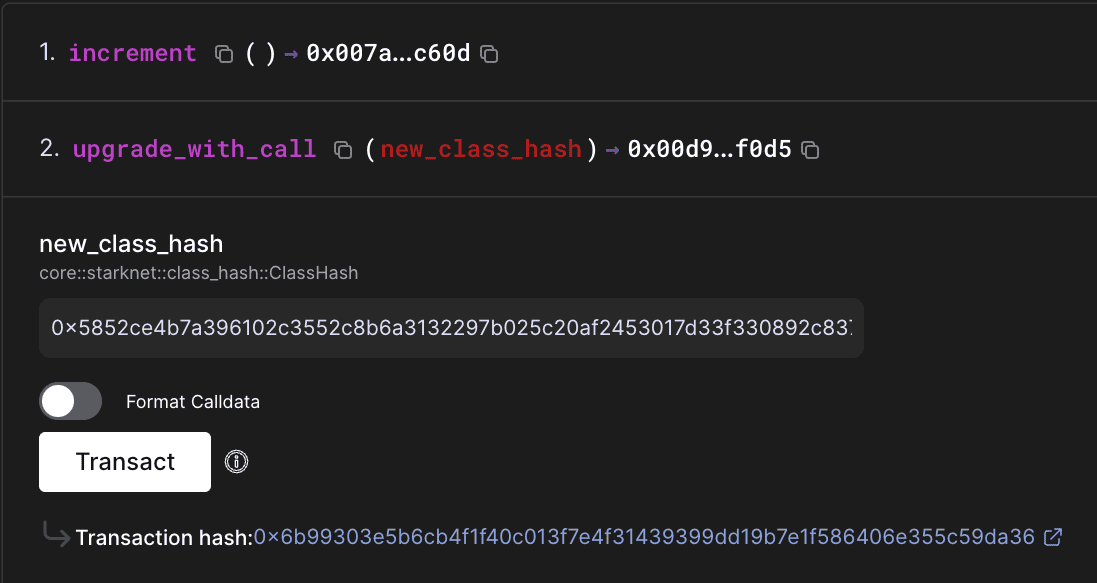
Redeclare the updated Greeter contract to get its new class hash, then call upgrade_with_call with that class hash through Voyager’s Write Contract tab:
The ContractUpgraded event shows:
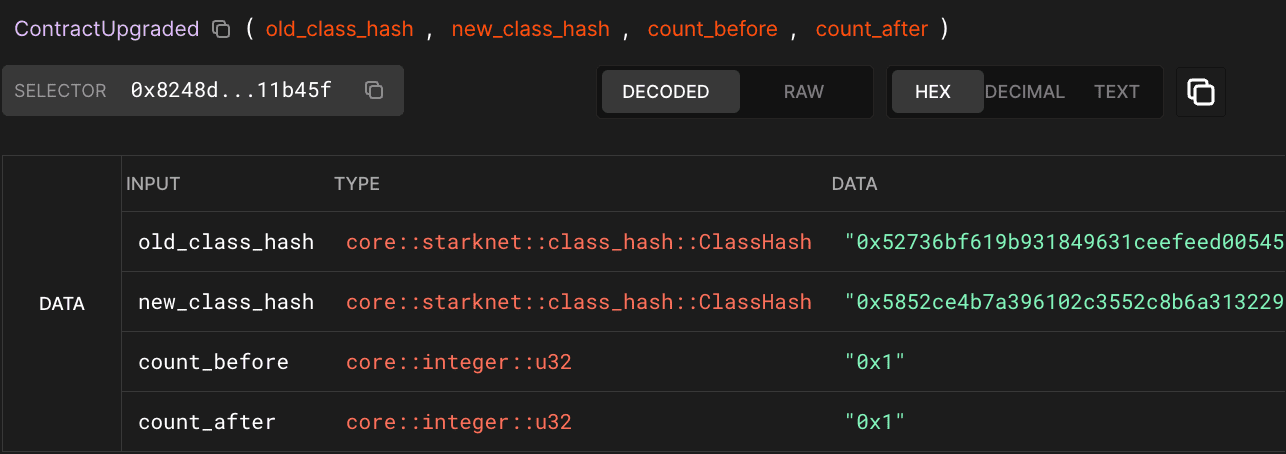
The count remained unchanged (1 before and after) because the Greeter’s empty increment function doesn’t modify the storage. This proves that:
call_contract_syscallexecuted the new implementation: If it had used the oldCounterlogic, the count would have increased to 2- The upgrade was immediately effective for the syscall: The empty
Greeterfunction ran, not theCounter’s increment logic
To summarize, any direct function calls within the upgrade function always run under the old implementation, regardless of where they appear relative to replace_class_syscall. call_contract_syscall is the only way to execute the new implementation within the same transaction.
Storage Compatibility Consideration
Since both contracts have variables with the same names (like owner), they read from and write to the same storage addresses computed from those variable names. Any writes from the new implementation will affect the same storage addresses, potentially causing data loss or corruption if not carefully managed.
OpenZeppelin Upgrade Components
OpenZeppelin contracts for Cairo provides standardized upgrade components that handle common upgrade patterns. Their implementation includes both direct upgrade functionality and an upgrade-and-call pattern that combines replace_class_syscall with call_contract_syscall. The upgrade-and-call allows you to upgrade and immediately execute functions from the new implementation within the same transaction, similar to what we demonstrated earlier with manual call_contract_syscall usage.
Conclusion
Starknet’s approach to contract upgrades is fundamentally different from Ethereum’s proxy patterns. With replace_class_syscall, we get direct code replacement while keeping the same address and preserving all storage data.
Remember that upgrades preserve all storage data; the same contract now uses the new implementation’s code to access storage, so variables with matching names between the old and new implementations access the same storage addresses. The timing matters too: upgrades take effect after the current function completes, though call_contract_syscall can immediately access the upgraded implementation.