In the previous chapter, we covered how to reason about environment-dependent functions in CVL by focusing on msg.sender in non-payable contexts. In those examples, access control depended on the caller’s address. We also explained how to handle reverts caused by unexpected non-zero msg.value.
In this chapter we will cover how to:
- write rules for functions that expect a non-zero payment (i.e., functions marked as
payable) - how to make assertions about account balances
- how to get the balance of the current contract, akin to
address(this).balancein Solidity
e.msg.sender and e.msg.value (payable)
Consider a whitelisting contract where users register by calling the register() function, which is marked as payable, and send at least 0.05 ETH. Once registered, the caller’s address (msg.sender) is marked as whitelisted by setting its value to true in the whitelisted mapping:
/// Solidity
contract PayableWhitelist {
mapping(address => bool) public whitelisted;
function register() external payable {
require(msg.value >= 0.05 ether, "whitelist fee is 0.05 eth");
require(!whitelisted[msg.sender], "already whitelisted");
whitelisted[msg.sender] = true;
}
function isWhitelisted(address _account) external view returns (bool) {
return whitelisted[_account];
}
}
We will formally verify the property: “the caller can successfully call register() if and only if they pay at least 0.05 ETH”. To verify this, we write the following CVL rule:
rule register_payEthToWhitelist(env e) {
require !isWhitelisted(e.msg.sender);
register@withrevert(e);
assert !lastReverted <=> e.msg.value >= 5 * 10^16;
}
Note: Exponentiation in CVL uses ^__, while Solidity uses **__.
As we know, since we are using the biconditional operator, we have to rule out other revert cases via the precondition. We add require(!isWhitelisted(e.msg.sender)) as a precondition to rule out the case where msg.sender is not initially whitelisted.
Now, for the biconditional assertion:
assert !lastReverted <=> e.msg.value >= 5 * 10^16.
Since we ruled out the case where the sender is whitelisted (require !isWhitelisted(e.msg.sender)), we expect this to be VERIFIED, meaning the function will not revert only if e.msg.value >= 5 * 10^16.
However, as is often the case in formal verification, a sneaky counterexample emerges, causing a violation. It’s when the sender’s ETH balance is less than the intended amount to be sent or insufficient balance:
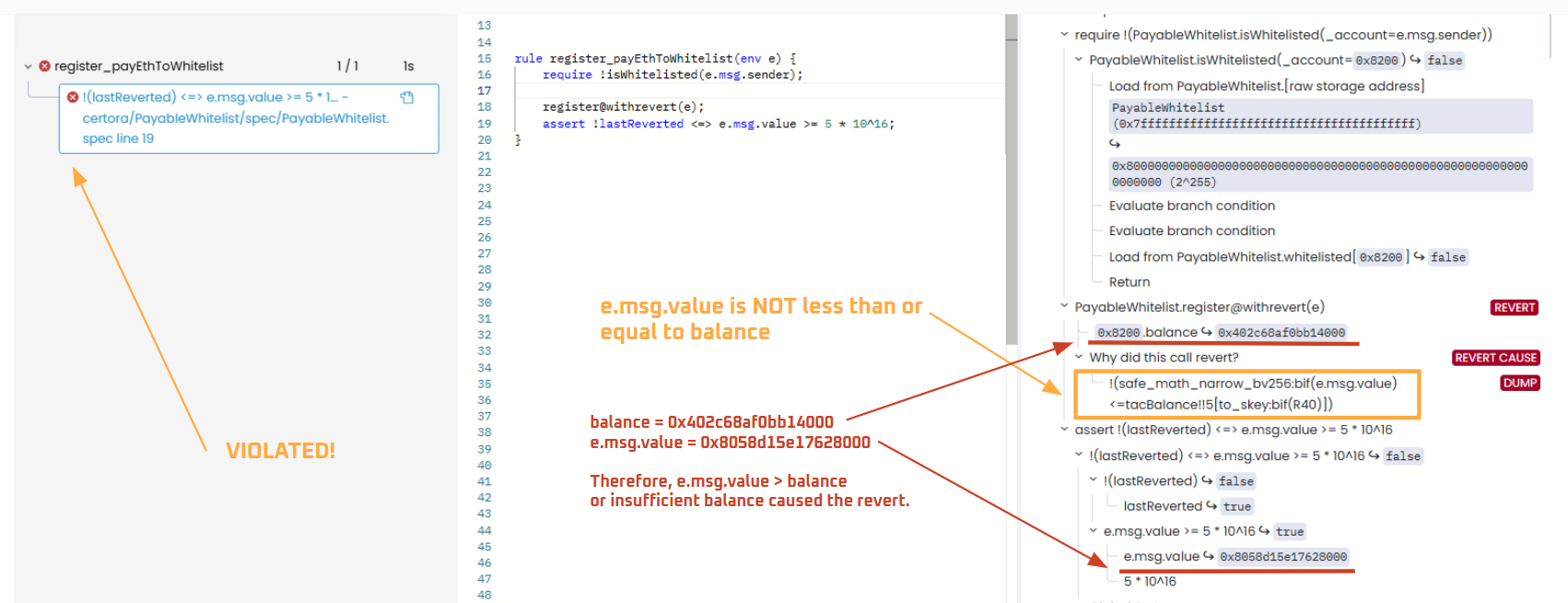
This can be fixed by adding require(nativeBalances[e.msg.sender] >= e.msg.value) to the precondition, ruling out insufficient balance as a cause of revert.
nativeBalances in CVL
nativeBalances[address] is a built-in function in CVL that retrieves the current ETH balance of a given address. Below, we require that nativeBalances for the sender is at least as large as the msg.value:
rule register_payEthToWhitelist(env e) {
require !isWhitelisted(e.msg.sender);
require nativeBalances[e.msg.sender] >= e.msg.value;
register@withrevert(e);
assert !lastReverted <=> e.msg.value >= 5 * 10^16;
}
Now, the rule is VERIFIED:
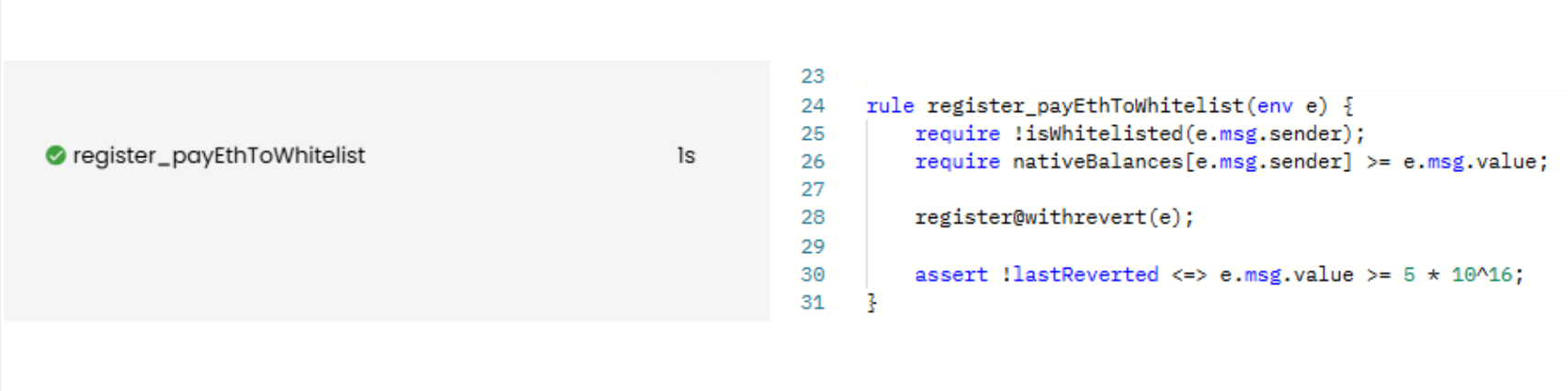
Prover run: link
Verifying Whitelist Status
Now that we have verified that “the caller can successfully call register() if and only if they pay at least 0.05 ETH”, let’s improve the rule scope by also asserting that the caller is isWhitelisted after a successful call.
Here’s the updated property to formally verify: “the transaction succeeds if and only if the caller sends at least 0.05 ETH and becomes whitelisted.” To achieve this, we can reuse the previous rule and add an additional assertion: isWhitelisted.
Here’s the updated CVL rule:
rule register_payEthToWhitelist_modified(env e) {
require !isWhitelisted(e.msg.sender);
require nativeBalances[e.msg.sender] >= e.msg.value;
register@withrevert(e);
assert !lastReverted <=> e.msg.value >= 5 * 10^16 && isWhitelisted(e.msg.sender);
}
The rule above means that the transaction does not revert (!lastReverted) if and only if the sender sends at least 0.05 ETH (e.msg.value >= 5 * 10^16) and becomes whitelisted (isWhitelisted(e.msg.sender)).
In other words, if !lastReverted is true (the transaction succeeded), both conditions — sufficient ETH and whitelisting — must hold.
Here’s the Prover report and it is VERIFIED:
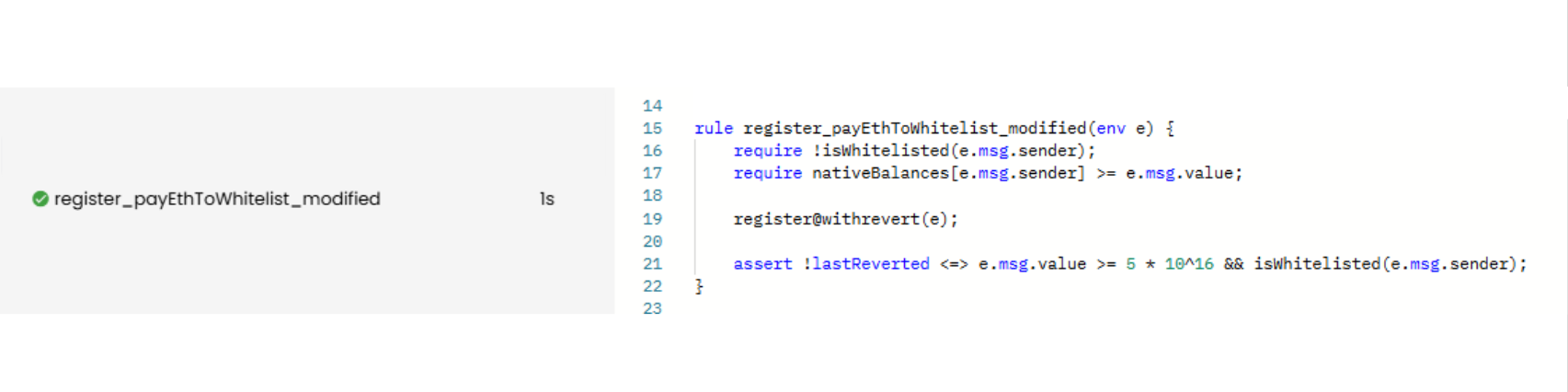
Prover run: link
Relaxing Preconditions With => Instead Of <=>
Another approach is to use the implication operator. If your goal is simply to check that the function reverts when an incorrect msg.value is sent, the following rule is sufficient. This rule doesn’t preclude other revert causes, such as the sender not having enough balance. It only says if less than 0.05 ether is sent, then it definitely reverts.
rule register_payEthToWhitelist_implication(env e) {
register@withrevert(e);
assert e.msg.value < 5 * 10^16 => lastReverted;
}
If we use this rule, we see that it is VERIFIED:
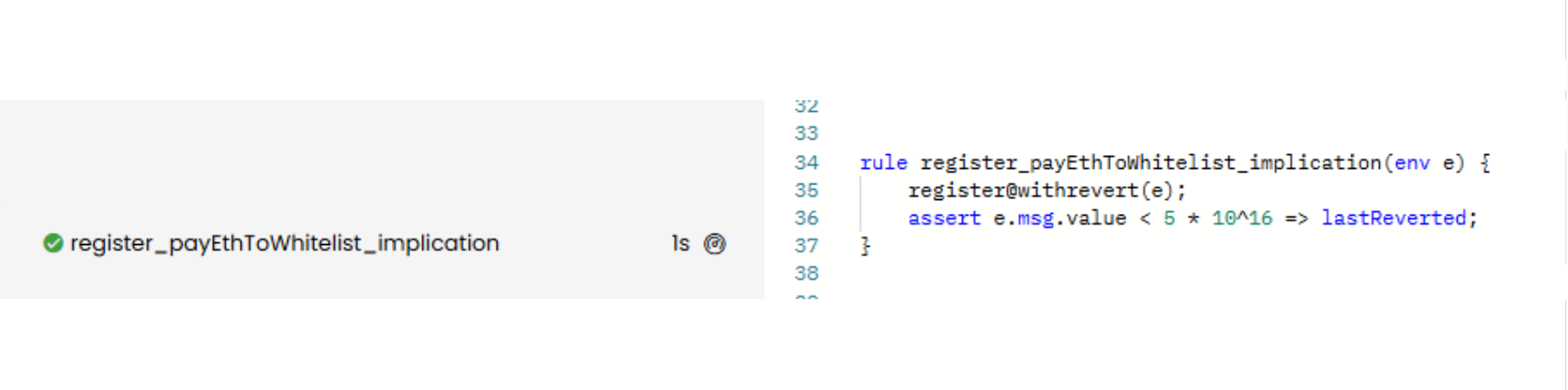
Prover run: link
Verifying ETH Balance Transfers And The Self-Transfer Corner Case
Suppose we want to formally verify balance updates where msg.sender’s balance decreases by msg.value and the contract’s balance increases by the same amount.
Below is the CVL rule, which will be explained in the next section:
rule register_nativeBalances(env e) {
mathint balanceBefore = nativeBalances[currentContract];
register(e);
mathint balanceAfter = nativeBalances[currentContract];
assert balanceAfter == balanceBefore + e.msg.value;
}
The currentContract
In the rule above, we retrieve the prior ETH balance (balanceBefore) and the final balance (balanceAfter) of the currentContract. currentContract is a built-in variable that refers to the contract being verified. Passing this variable to nativeBalances[currentContract] retrieves the balance of the said contract. In between these retrieval calls, the register() function is invoked, so we expect the balance to increase by an amount equal to msg.value.
An unexpected counterexample will cause this rule to fail. The Prover will generate a counterexample where msg.sender == currentContract. The Prover explores all possible scenarios, including cases where the contract calls itself.
This indicates that the contract sent ETH to itself rather than receiving new ETH from an external sender. As a result, the balance did not actually increase as expected (since sending ETH to itself does not change the total balance), causing the assertion balanceAfter == balanceBefore + e.msg.value to fail.
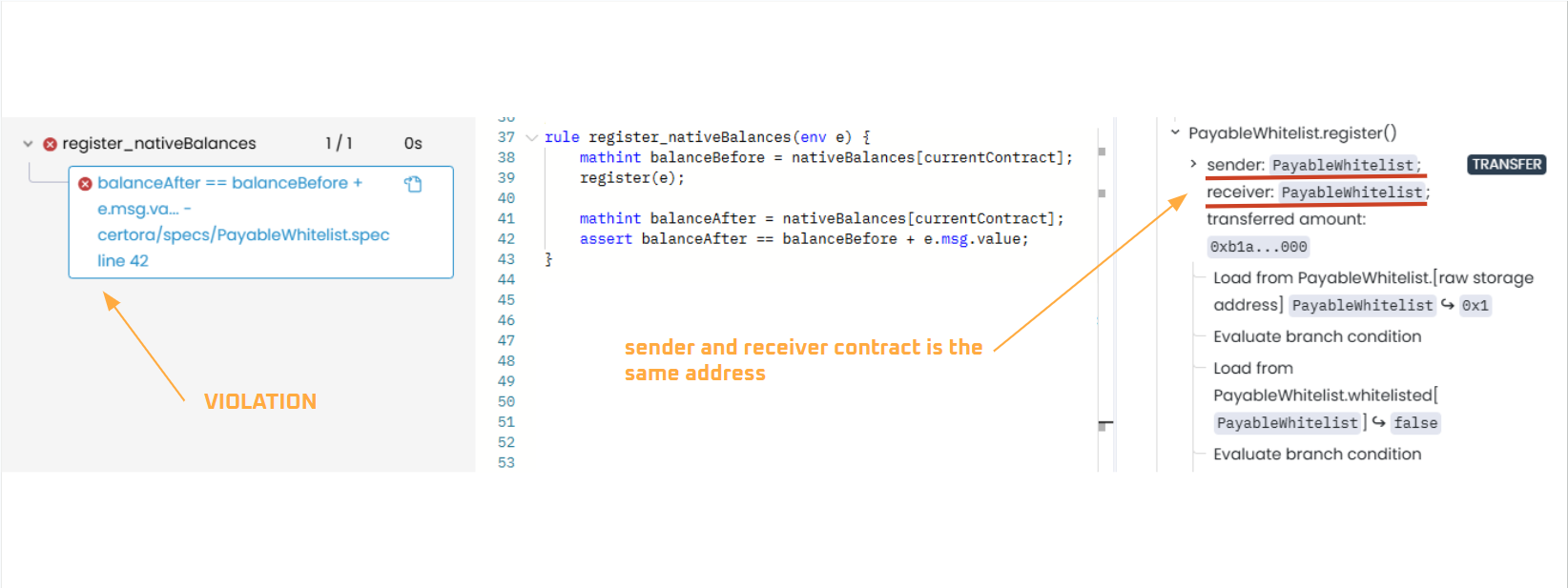
To resolve the issue, since msg.sender should not be the contract itself (currentContract), we need to filter out self-transfers when verifying ETH balance changes by adding a precondition: require(e.msg.sender != currentContract).
However, there is a caveat: in real projects, make sure the contract cannot call its own functions, as certain cases may still lead to self-calls. If not properly checked, this could hide a bug.
Here’s the corrected rule and the Prover report. As expected, this is VERIFIED:
rule register_nativeBalances(env e) {
mathint balanceBefore = nativeBalances[currentContract];
require e.msg.sender != currentContract;
register(e);
mathint balanceAfter = nativeBalances[currentContract];
assert balanceAfter == balanceBefore + e.msg.value;
}
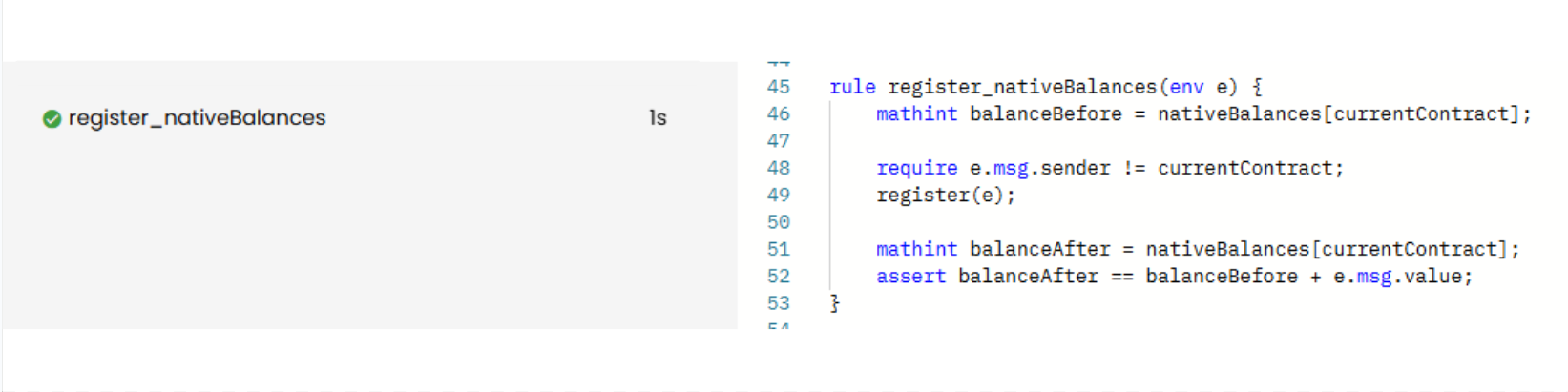
Prover run: link
Verifying All Revert Cases Using <=> and ||
Suppose we want to verify that every possible reason for reverting is explicitly accounted for. We can express the assertion as a biconditional (<=>) and disjunctively (using ORs ||) list all revert cases.
The rule below states that the only possible reasons for reverting are the following:
- the sender is already whitelisted
- the sender’s balance is insufficient
- the sender didn’t transfer enough funds
If register() reverts for any other reason, we would get an assert violation.
Here’s the rule:
rule register_allRevertCases(env e) {
bool wasWhitelisted = isWhitelisted(e.msg.sender);
mathint balanceBefore = nativeBalances[e.msg.sender];
register@withrevert(e);
assert lastReverted <=> (
wasWhitelisted || // sender already whitelisted
balanceBefore < e.msg.value || // sender's balance insufficient
e.msg.value < 5 * 10^16 // sender's transfer amount insufficient
);
}
As expected, the rule is VERIFIED:
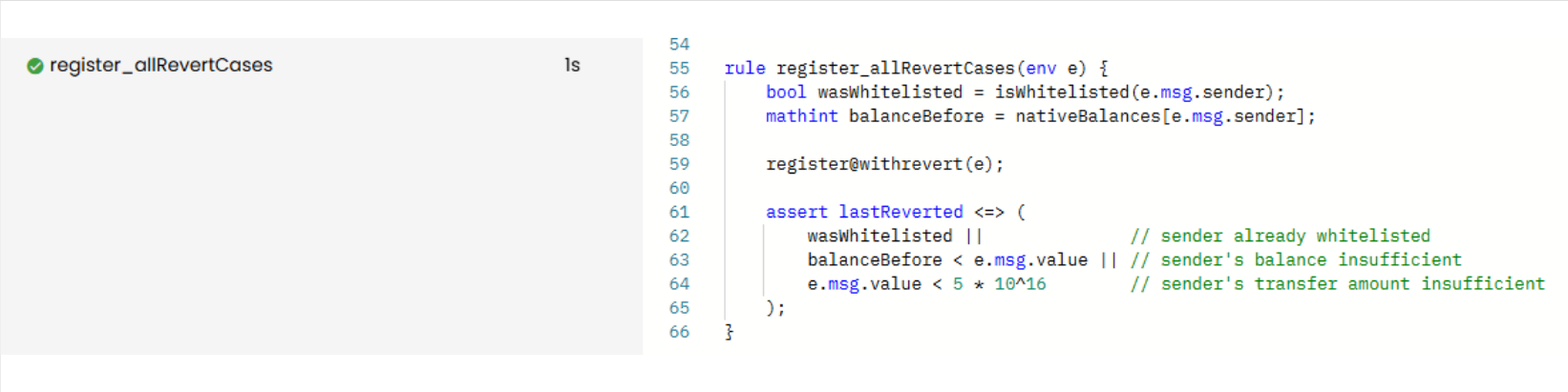
Prover run: link
Summary
- In CVL, the environment variable
e.msg.valueis used to express and verify whether a payable function should succeed or revert, typically by asserting a minimum or exact required amount. nativeBalances[address]is a built-in function that retrieves the current ETH balance of a given address and can be used to verify transfers by checking for balance changes.currentContractis a built-in variable that refers to the contract being verified.- Self-calls are included in test cases by the Prover, so in our example, we rule them out by adding
require(e.msg.sender != currentContract)to avoid false counterexamples; be cautious, as self-calls can be plausible and may reveal real bugs in real-world contracts.
This article is part of a series on formal verification using the Certora Prover