Introduction
In this chapter, we introduce the env variable in CVL, which enables us to make rules for functions that depend on msg.sender, msg.value, and other global variables in Solidity like block and tx.
We will focus on the first two, which can be accessed from the CVL variable env e as e.msg.sender and e.msg.value.
In our previous examples, we ignored them because the functions we verified didn’t rely on environment variables. Hence, we tagged these functions as envfree in the methods block. This tells the Prover to treat them as pure logic and disregard environment (global) variables to simplify the analysis.
However, in practice, transactions are heavily dependent on these environment variables (env), and here we will explore how to create rules with msg.sender and msg.value.
e.msg.sender and e.msg.value (non-payable)
Consider a simple owner-controlled counter contract, where only the owner is allowed to increment a counter:
contract OwnerCounter {
uint256 public counter;
address public owner;
constructor(address _owner) {
owner = _owner;
}
function increment() public {
require(msg.sender == owner, "not owner");
counter++;
}
}
The function increment() has a require statement that will cause a revert if the caller is not the owner. Therefore, our rule needs to depend on msg.sender.
To verify the property: “Only the owner can successfully call increment()”, we write the following CVL rule:
methods {
function owner() external returns (address) envfree;
function counter() external returns (uint256) envfree;
}
rule increment_onlyOwnerCanCallIncrement(env e) {
address current = owner();
increment@withrevert(e);
assert !lastReverted <=> e.msg.sender == current, "access control failed";
}
In the methods block, functions owner() and counter() are marked as envfree because they are view functions of the storage variables and do not depend on environment variables or env.
However, the function increment() is environment-dependent (hence the parameter e). Functions do not need to be explicitly declared in the methods block if they are assumed to be environment-dependent. Thus, we don’t include increment() in the method’s block.
In the rule block, the env e declaration can be placed as a parameter or inside the rule block. Both are valid and are merely code style preferences:
rule increment_onlyOwnerCanCallIncrement(env e) {
...
}
rule increment_onlyOwnerCanCallIncrement() {
env e;
...
}
Now, when we invoke a Solidity function that is environment-dependent, we must include the argument e:
increment@withrevert(e);
Omitting (e) would result in a compiler error, forcing you to declare the function as envfree in the methods block. However, if you blindly follow this and declare it as envfree, violations will occur, and the Prover will indicate that the function is environment-dependent.
Now, finally, let’s move to the assertion:
assert !lastReverted <=> e.msg.sender == current, "access control failed";
This checks that increment() does not revert if and only if msg.sender == owner. If the assertion fails, it means the Prover found a counterexample — either the correct owner was blocked from calling increment(), or a non-owner was able to call it successfully.
When we run this rule, however, we encounter an unexpected revert case — when msg.value != 0. This occurs because increment() is a non-payable function, meaning it cannot accept Ether.
In Solidity, a contract can receive Ether via a function call, but only if the function is explicitly marked as payable; otherwise, the transaction will revert. The amount of Ether sent is stored in the global variable msg.value, which holds the value in wei (the smallest denomination of Ether).
Since increment() is not marked as payable, any nonzero msg.value causes a revert, as shown in the report below:
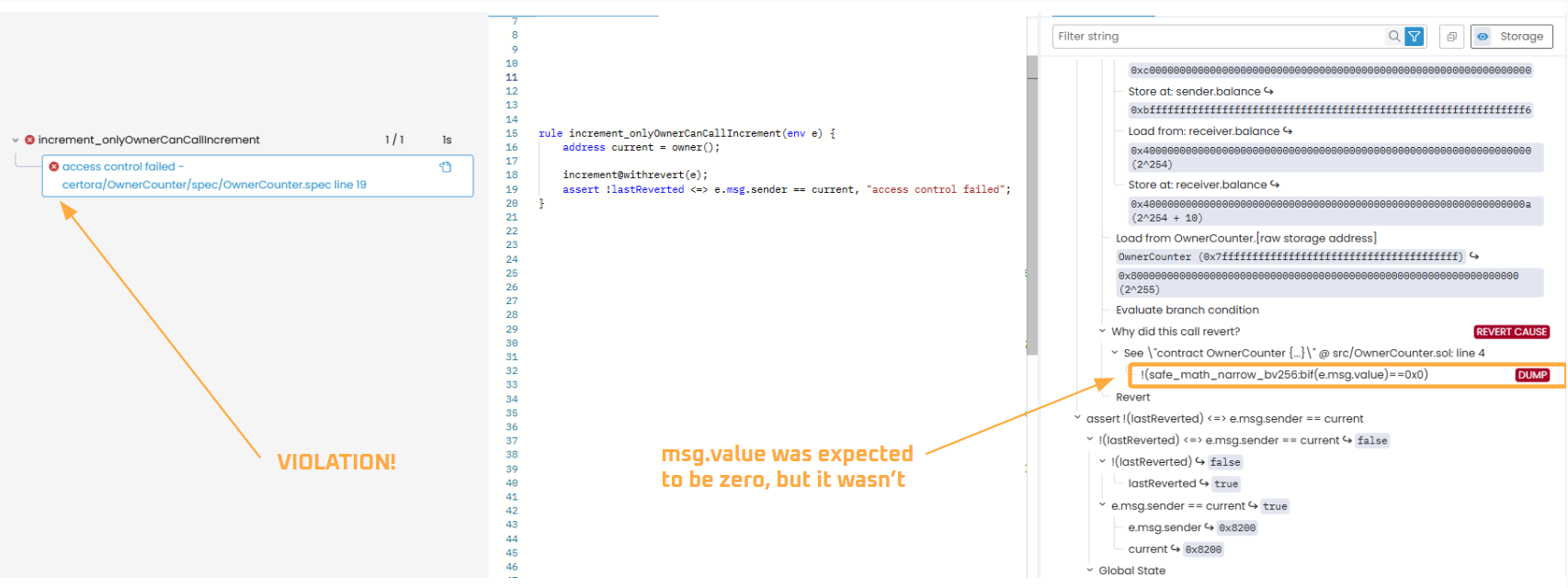
To resolve this, we need to place e.msg.value == 0 as a precondition.
Then, another unexpected revert occurs when counter == max_uint256. Since max_uint256 is the maximum value the counter can hold, attempting counter++ will cause an overflow revert (note that we are calling the function with the withrevert tag):
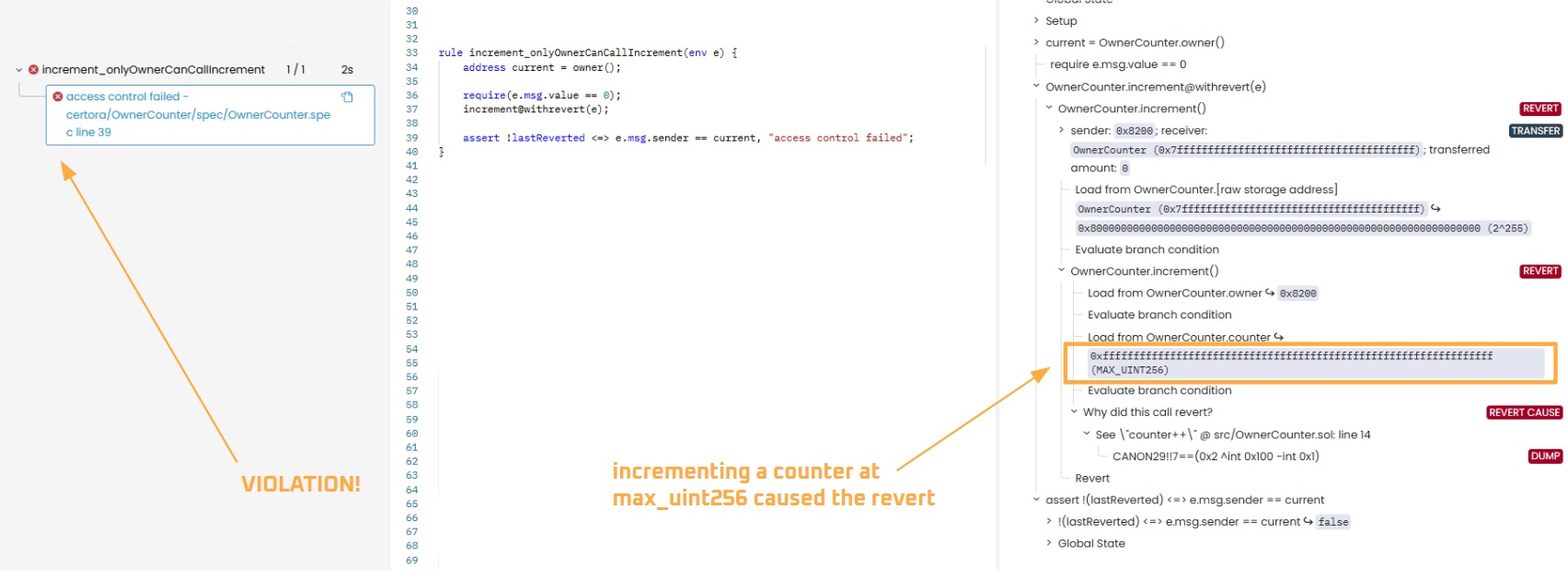
To resolve this, we need to add another precondition require(counter() < max_uint256) to prevent the counter from overflowing.
With these two unexpected revert cases identified, both conditions must be included as preconditions. Below is the corrected rule and the Prover report. As expected, the verification passes:
rule increment_onlyOwnerCanCallIncrement(env e) {
address current = owner();
require e.msg.value == 0;
require counter() < max_uint256;
increment@withrevert(e);
assert !lastReverted <=> e.msg.sender == current, "access control failed";
}
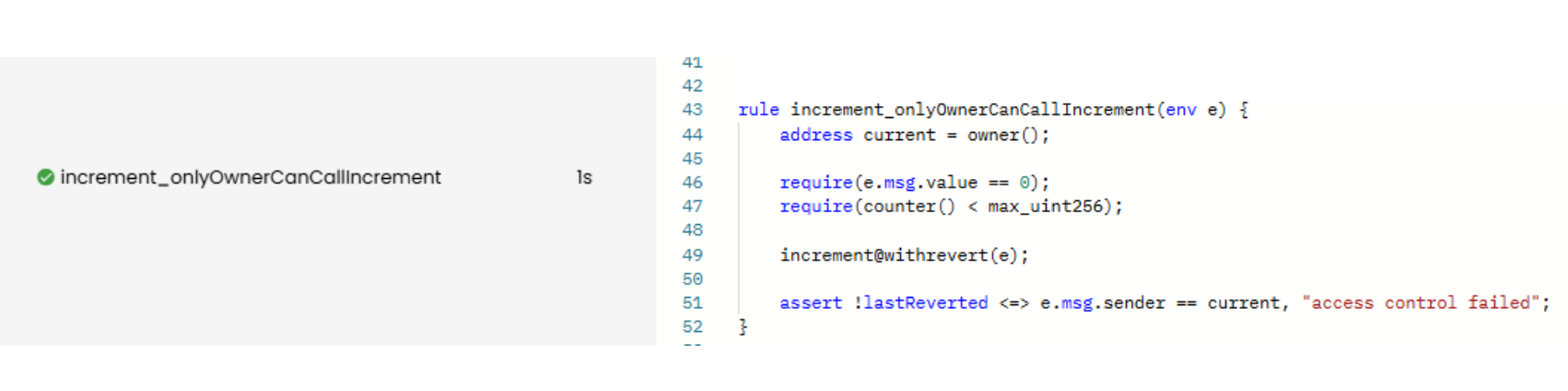
Prover run: link
Relaxing Preconditions With => Instead Of <=>
The rule we created above says “the function reverts if and only if the caller is not the owner.” Since there are other valid revert conditions, namely msg.value != 0 and counter() == max_uint256, we had to eliminate those possibilities in the precondition for “the function reverts if and only if the caller is not the owner” to be true.
If we wanted to instead state, “if a non-owner calls the function, the transaction reverts” we can use the implication operator without preconditions. Other revert cases (i.e. msg.value != 0 and the counter being at the maximum) do not cause a violation. We only care that a non-owner calling the function reverts.
Now having said that, here’s the property to formally verify: “if the caller is not the owner, the function must revert.” Below is the rule for that — a simpler one — and as expected, this rule passes:
rule increment_notOwnerCannotCallIncrement(env e) {
address current = owner();
increment@withrevert(e);
assert e.msg.sender != current => lastReverted, "access control failed";
}
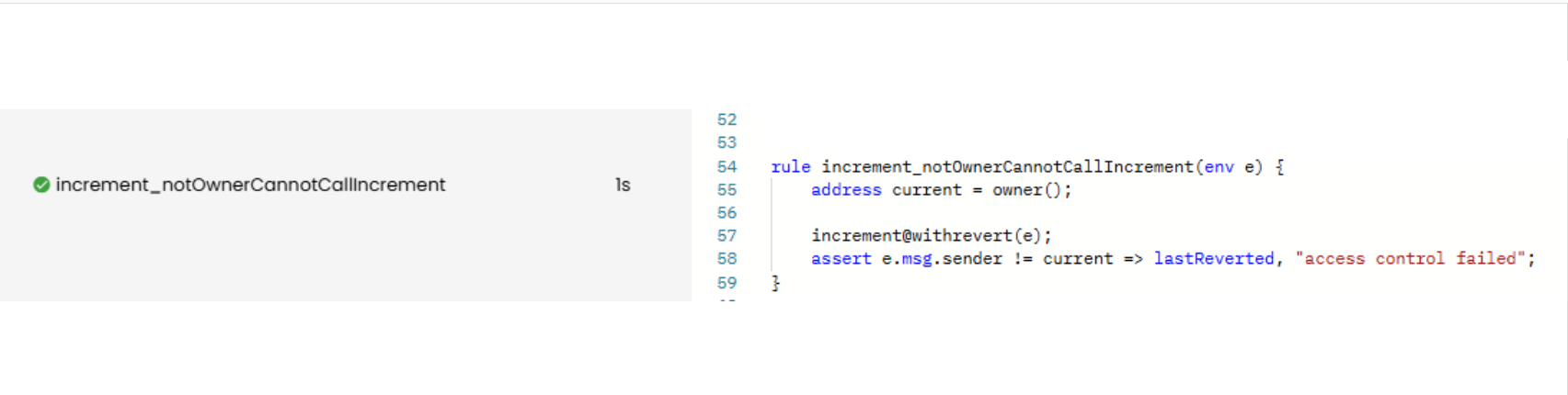
Prover run: link
Now, we understand how to write rules for environment-dependent functions. The Prover uses e.msg.sender to reason about execution based on the caller and e.msg.value to reason about ETH transfers. In the next chapter, we will explore both concepts more extensively.
Summary
- The
envvariable in CVL allows reasoning about functions that depend onmsg.sender,msg.value, and other global variables. - Such functions must include
env e, either as a rule parameter or within the rule block. - These environment-dependent functions do not need to be declared in the methods block, while
envfreefunctions must be explicitly declared and marked asenvfree. - If an environment-dependent function is not correctly implemented as such, it will still compile and run on the Prover but will produce violations and warnings.
- If
msg.valueis not properly accounted for, the Prover will generate violations and counterexamples stemming from it.
This article is part of a series on formal verification using the Certora Prover