The Internet Computer Protocol charges canisters a recurring fee in Cycles for the on-chain storage space they occupy. The storage space a canister is accounted for includes both its bytecode and state.
Storage Fees Overview
As a general overview, the storage fee of 1 Gib of data is 127_000 Cycles per second. Over a year, it amounts to 4 trillion Cycles or around $5. These fees are taken out of the canister’s Cycles Balance.
You can observe the storage fees in real time by deploying a canister and monitoring its Cycles Balance over time.
Proof of Storage Fees
Deploy any canister and do not call any of its functions:
dfx new do_nothing --type rust --no-frontend
dfx deploy
Check the Cycles balance of the canister with the command below and compare it with the balance 1 minute after:
dfx canister status <Canister-ID>
You will see that Cycles Balance reduces because the network continuously deducts Cycles from the canister to pay for storage fees.
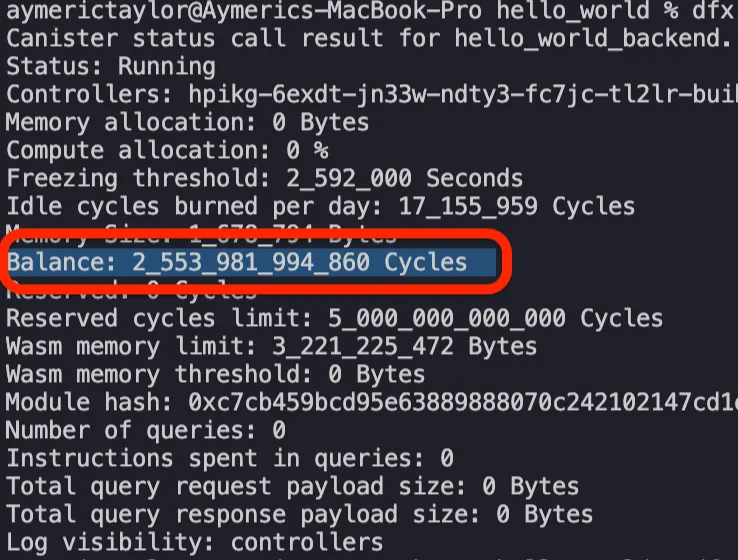
Before:
Balance: 2_553_981_994_860 Cycles
1 minute After:
Balance: 2_553_980_664_965 Cycles
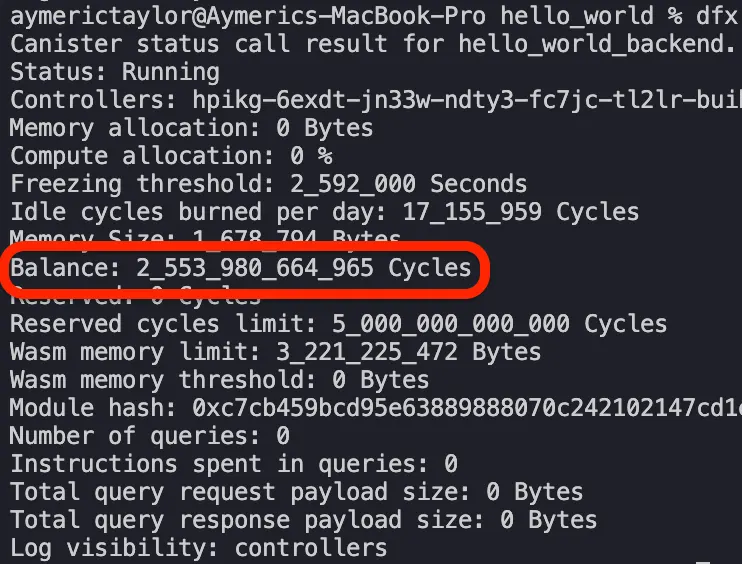
The Cycles balance decreased by approximately 1_330_000 Cycles in just around one minute. The network continuously charges canisters for storing data on-chain, regardless of on-chain activities.
How Storage Fees Are Calculated
Storage fees on the Internet Computer are charged as a fixed number of Cycles per unit of storage per second, proportional to how much on-chain space a canister occupies. This storage includes both the canister’s bytecode and its persisted state.
Base Storage Rate
As a reference point previously discussed, the network charges 127,000 Cycles per second for 1 GiB of storage.
Since storage fees are charged continuously, this cost accrues every second, regardless of whether the canister is actively processing requests.
Over the course of a year, this works out to:
- 1 GiB ≈ 4 trillion Cycles per year
- Which is approximately $5 USD per year, based on current conversion rates
Scaling Down: Cost per MiB
Because 1 GiB = 1024 MiB, we can derive the per-MiB storage cost by dividing proportionally:
Suppose a canister (including its bytecode and state) occupies 10 MiB of on-chain storage.
Using the per-MiB rate:
- 10 MiB ≈ 1,240 Cycles per second
Over a year, this amounts to approximately:
- 0.01 GiB × $5 ≈ $0.05 USD per year
This illustrates that small canisters are inexpensive to store, but costs grow predictably as storage usage increases.
What Happens When A Canister Runs Out Of Cycles?
If a canister runs out of Cycles, all of its data will be deleted from the protocol—this includes includes its storage and bytecode. Therefore, we need to actively monitor the canister’s Cycles balance and plan ahead.
Take into consideration that the canister has sufficient Cycles to cover:
- Computation costs for user function calls.
- Storage fees.
Cycles Balance Safety Mechanism: The Freezing Threshold
Canisters have a safety mechanism called the freezing threshold. When the Cycles balance becomes low and falls to a certain threshold amount, the freezing threshold mechanism stops executing all function calls to the canister.
The freezing threshold acts as a safety buffer that protects your canister from running out of Cycles unexpectedly. This gives the developers time during the “frozen” period, to:
- top-up the canister with more
Cycles - or leave it be. The canister’s
Cyclesbalance would eventually run out because of storage fees and the canister’s data will be deleted permanently from the protocol.
You can see the freezing threshold in the canister status, which indicates how long much time the canister has when the freezing threshold is activated before it runs out of Cycles.
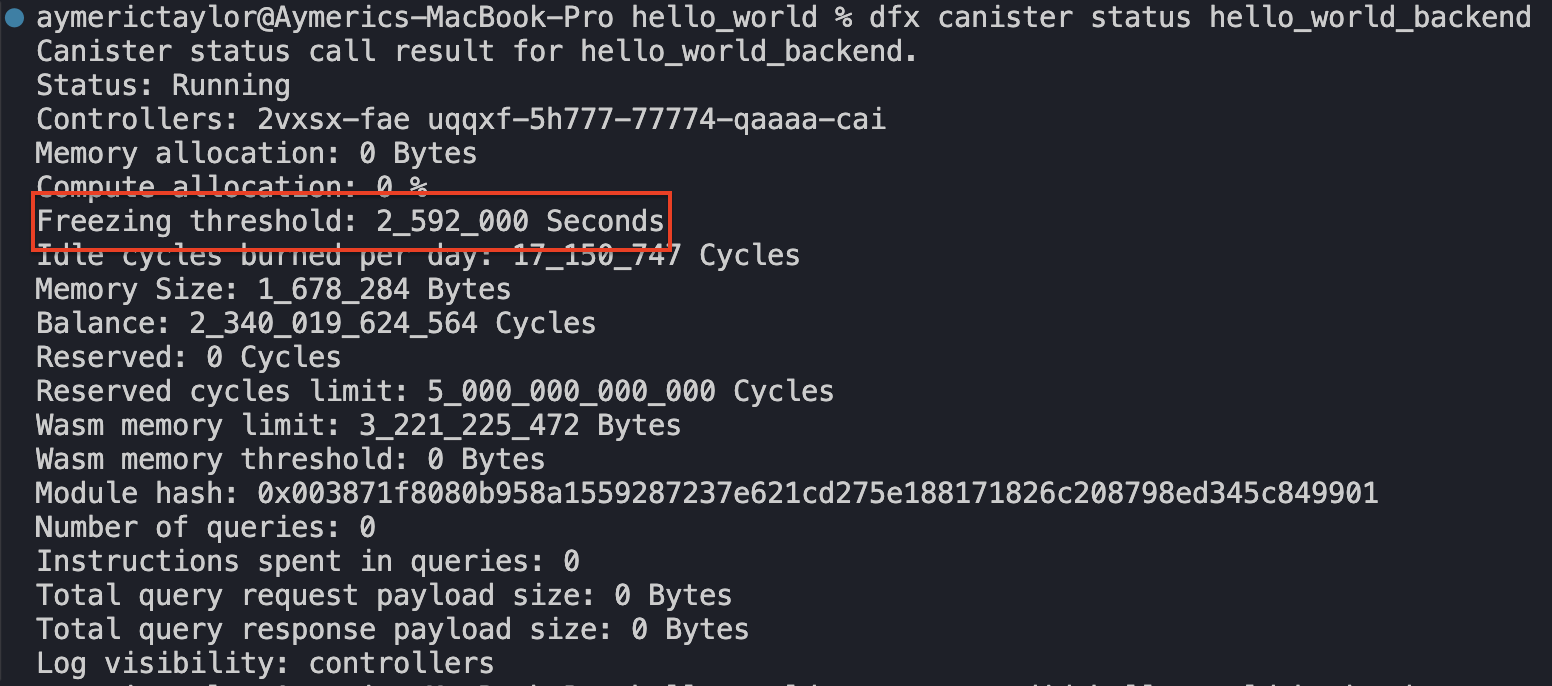
**2_592_000** seconds converts to 30 days. During these 30 days grace period, the Cycles Balance will be continually depleted by the storage fees and you need top up the canister with more Cycles or all of its data will be deleted.
Conclusion
Every canister continuously pays for the space it occupies, including both its bytecode and its persisted state, using Cycles, regardless of whether it is actively processing requests.
By understanding how storage fees are calculated, how Cycles are depleted over time, and how the freezing threshold protects canisters from sudden deletion, developers can design canisters that are predictable, resilient, and sustainable over the long term.
In the next article, we we discuss how to perform inter-canister calls