This article discusses how to safely store and access mutable variables for canisters written in Rust.
In the previous chapters, we explained and demonstrated that immutable and mutable variables are declared using static and static mut (unsafe), respectively:
// Mutable
static mut Y: u128 = 41;
// Immutable
static X: bool = false;
Declaring immutable variables this way isn’t an issue; however, declaring mutable ones is.
When we declare a global variable using static mut, it creates a single memory location that is shared across the entire program and can be accessed from anywhere. Because this memory is globally accessible, Rust cannot determine when or where the variable is being read or modified, or whether multiple parts of the program are accessing it at the same time. Without this information, the compiler cannot enforce its usual ownership and borrowing rules that ensure memory safety.
As a result, the compiler cannot guarantee that accessing a static mut variable is safe. In simpler terms, it cannot guarantee that the variable won’t be read from and written to simultaneously by different parts of the program. To make this risk explicit, Rust requires every read and write to a static mut variable to be wrapped in an unsafe block, signaling that the programmer is taking responsibility for ensuring the access is correct.
// Mutable, but unsafe
static mut Y: u128 = 41;
#[ic_cdk::query]
fn read_y() -> u128 {
// unsafe read
unsafe { Y }
}
#[ic_cdk::update]
fn set_y(new_y: u128) {
// unsafe write
unsafe { Y = new_y; }
}
Although this pattern works, using static mut together with unsafe is unidiomatic and error-prone. It shifts the responsibility for correctness and memory safety entirely to the programmer and should be avoided unless you fully understand the implications.
Instead, the idiomatic and safe way to declare mutable static variables in Rust canisters is to use thread-local storage combined with RefCell. This approach avoids unsafe altogether and is the recommended best practice for managing canister state in Rust.
Store static Variables Within The Thread-Local Storage
In Rust, a thread-local storage is a mechanism that gives each thread its own private copy of a variable. Instead of sharing one global memory location across the entire program, each thread works with its own isolated version.
Thread-Local Storage macro: thread_local!
A thread-local storage is declared with the thread_local! macro, with static variables placed inside it.
// thread local storage
thread_local! {
// place our static variables within the macro
static COUNTER: u8 = 0;
}
Note: Only static variables can be defined within thread_local!.
Since thread-local storage creates an isolated copy of a static variable for each thread, different threads never read from or write to the same memory location. This isolation is what makes storing static variables in thread-local storage safe.
Thread-local static variables
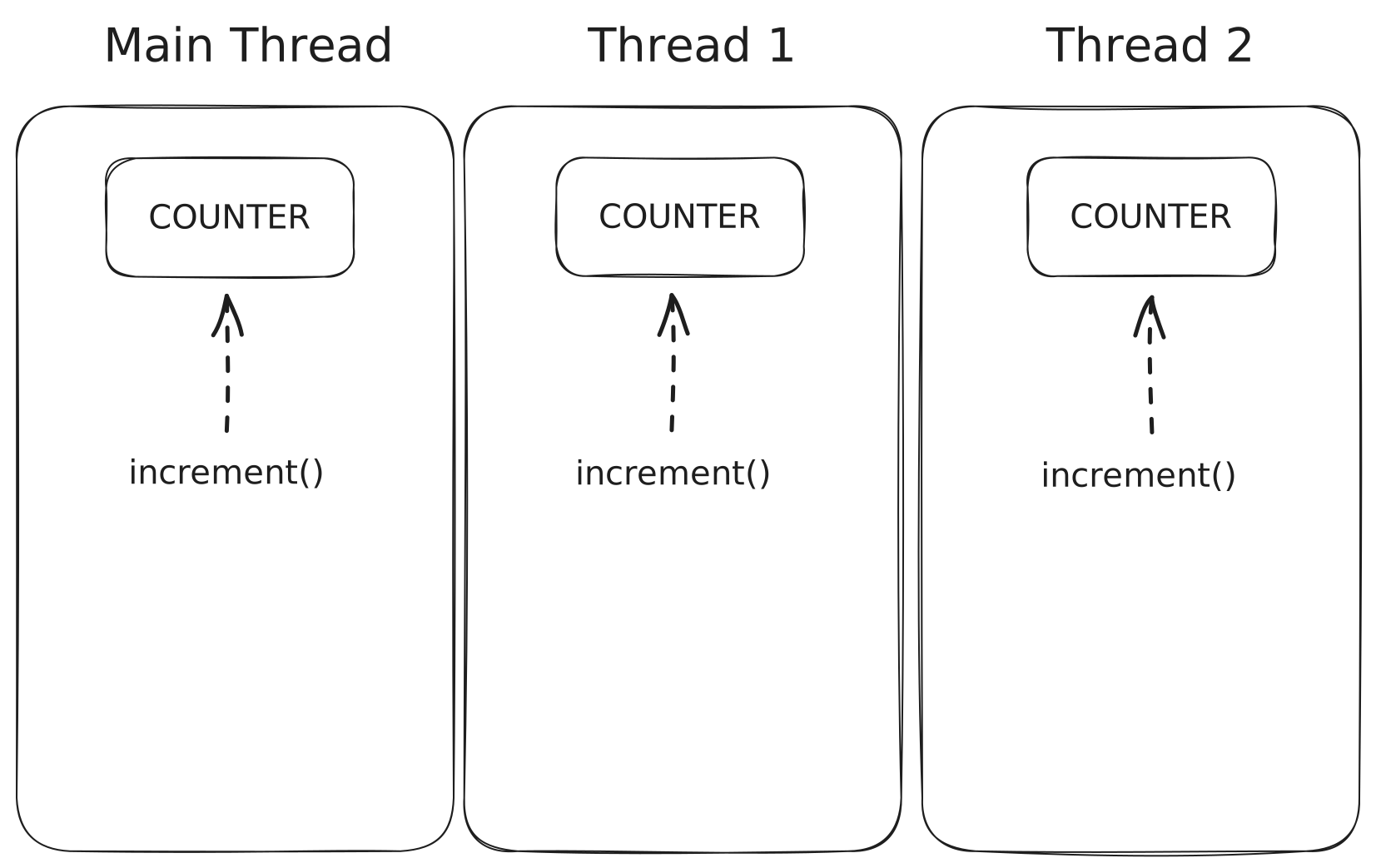
The variable COUNTER below is declared within the thread-local storage (thread_local!). Each thread that is spawned will get its own private copy of COUNTER, stored in a separate memory location. This copy is exclusive to that thread, so its data can’t be accessed or modified by any other thread.
thread_local! {
static COUNTER: u8 = 0;
}
If we have three threads, then each thread would have its own COUNTER variable that only they can increment. This way, different threads do not share the same variable, avoiding race conditions.
The examples above only showed immutable static variables. In the next section, we’ll see how to define mutable state using thread_local!, even though the mut keyword is not allowed inside the macro.
Mutability for thread-local statics
Earlier, we learned that mutable global state in Rust is usually declared using static mut. However, this approach does not work for static variables declared inside the thread_local! macro. Thread-local static variables cannot use the mut keyword, and attempting to do so results in a compilation error:
thread_local! {
static mut Z: u64 = 30; // ❌ Won’t compile
}
The thread_local! macro under the hood generates extra code for the static variables declared inside of it to safely manage per-thread storage. Therefore, we cannot add mut to the static variables.
Thread-Local statics use RefCell for mutability
To achieve mutability for static variables declared inside thread_local!, Rust requires a different approach: wrapping the variable’s type in a RefCell
RefCell is an interior mutability type. It allows a value to be mutated through controlled, runtime-checked methods, which we’ll explore shortly.
To declare a static mutable variable inside the thread-local storage, follow the instructions below:
-
First, import
RefCellfrom the standard library:use std::cell::RefCell; -
Wrap the
staticvariable’s data type (denoted by the symbolT) withRefCell,RefCell<T>:thread_local! { static Z: RefCell<bool> } -
The
staticvariable’s value is initialized withRefCell::new(value):use std::cell::RefCell; thread_local! { static Z: RefCell<bool> = RefCell::new(true); }RefCell::new(true)initializes theRefCellwith a boolean value oftrue. The value provided must match the type declared insideRefCell<bool>.
Variables using the RefCell wrapper are mutable at runtime, and access to the variable is controlled mainly through two methods:
.borrow()for read-only operations and.borrow_mut()for write operations.
Modifying a thread-local static using RefCell variable
Let’s demonstrate mutating the value of thread-local static Z: RefCell<bool>, which is a mutable state variable of type bool.
We have two functions:
set_z(_bool)that sets an arbitrary bool value toZandget_z()which reads the value ofZ.
Don’t worry if the syntax looks strange — we’ll unpack it step by step.
use std::cell::RefCell;
thread_local! {
static Z: RefCell<bool> = RefCell::new(true);
}
// read z
#[ic_cdk::query]
fn get_z() -> bool {
Z.with(|cell| *cell.borrow())
}
// mutate z
#[ic_cdk::update]
fn set_z(value: bool) {
Z.with(|cell| *cell.borrow_mut() = value);
}
ic_cdk::export_candid!();
The calls may look confusing at first:
get_z():Z.with(|cell| *cell.borrow().set_z():Z.with(|cell| *cell.borrow_mut() = value);.
But there only three key parts:
Z.with()gives us access to thread-localZ.- The
|cell| cellpattern is called a closure, which we’ll discuss in depth later. In short, it acts similarly to a callback function, where|cell|is a parameter that takes the variableZas its argument. We then usecellto perform operations onZ. - Since
Zis wrapped in aRefCell, we are required to either use.borrow()for read-only access or.borrow_mut()for mutable access to reach the innerboolvalue.
There are two layers of access: .with() from thread_local! and .borrow()/.borrow_mut() from RefCell.
To keep things simple, we’ll set aside thread_local! and focus on learning how to access values within a RefCell variable. Later, we’ll return to a full example that places a RefCell inside thread_local!.
Accessing values within RefCell<T>
A RefCell<T> is an immutable container that enables interior mutability: it allows us to read or modify the value it holds even when the RefCell itself is not declared as mut.
However, because the value is wrapped inside a RefCell, we cannot access it directly. Instead, Rust requires us to go through specific methods that enforce borrowing rules at runtime.
To understand how this works in practice, let’s start with a simple, local RefCell example.
Attempting to return a RefCell directly
Consider the following function:
use std::cell::RefCell;
#[ic_cdk::query]
fn read_refcell() -> u8 {
let x: RefCell<u8> = RefCell::new(20);
// attempt to return the inner value
}
At first glance, you might expect to return x directly. However, doing so results in a compilation error:
use std::cell::RefCell;
#[ic_cdk::query]
fn read_refcell() -> u8 {
let x: RefCell<u8> = RefCell::new(20);
return x;
}
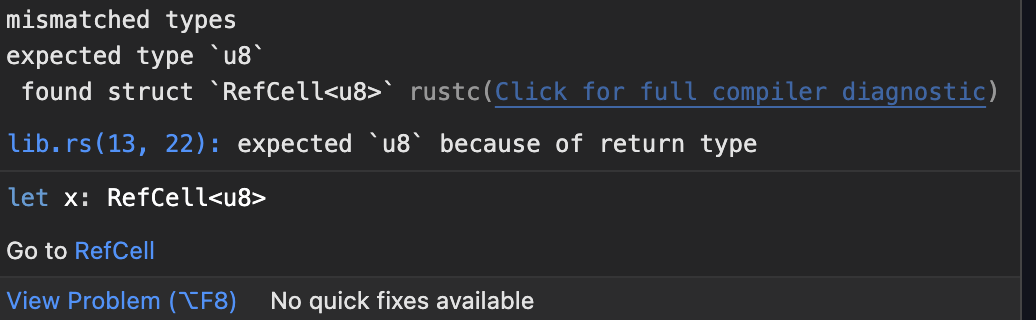
This fails because the function’s return type is u8, but x is a RefCell<u8>. Rust does not automatically extract the inner value for us.
To access the value stored inside a RefCell, we must explicitly borrow it.
Reading the inner value with .borrow()
To read the value inside a RefCell<T>, we call .borrow(). This method returns a Ref<T>, which behaves like an immutable reference to the inner value.
If we try to return x.borrow() directly, we still get a type mismatch:
use std::cell::RefCell;
#[ic_cdk::query]
fn read_refcell() -> u8 {
let x: RefCell<u8> = RefCell::new(20);
return x.borrow();
}
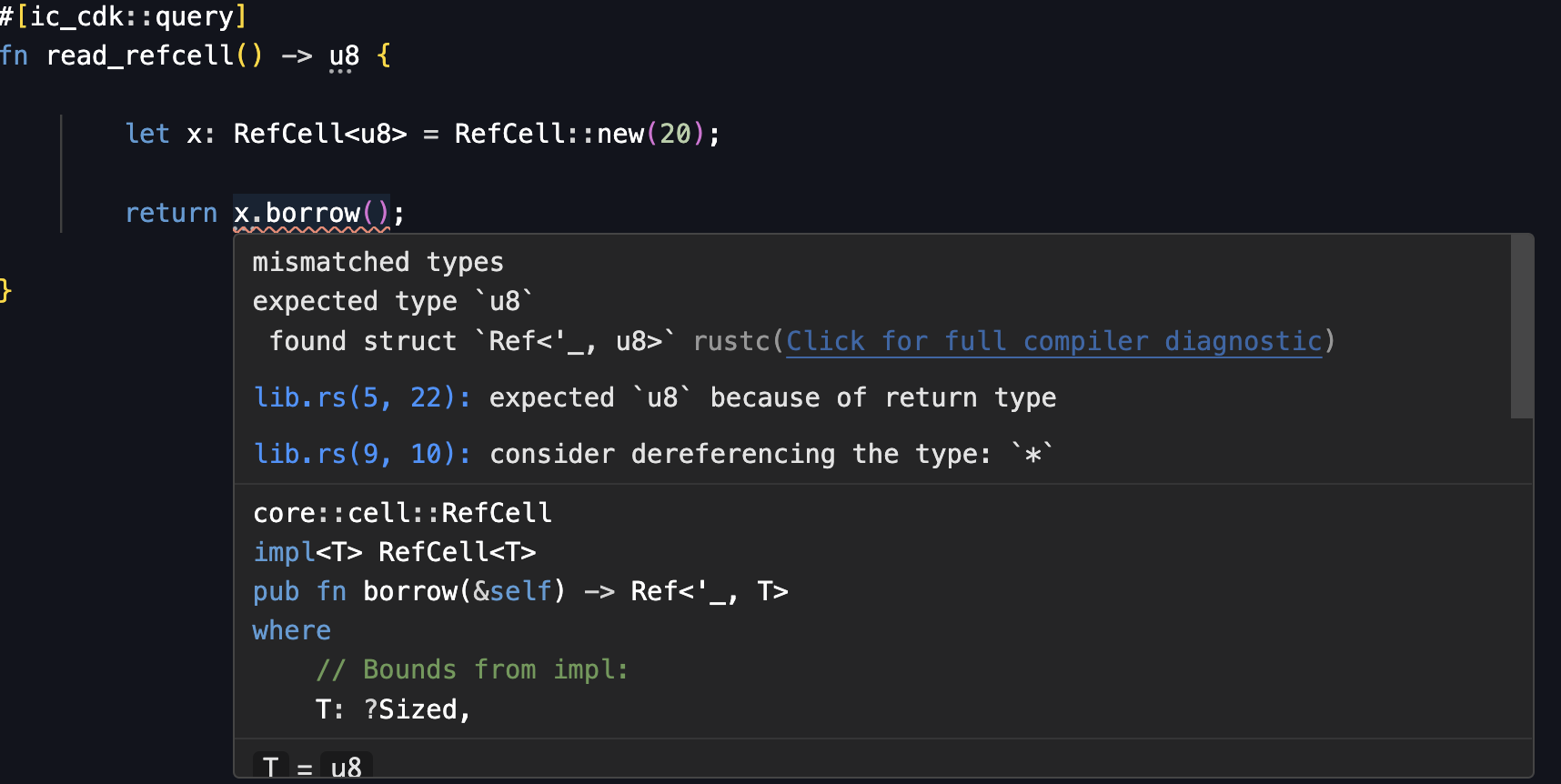
This happens because x.borrow() returns a Ref<u8>, not a u8.
To obtain the actual u8 value, we must dereference the Ref<u8> using *:
use std::cell::RefCell;
#[ic_cdk::query]
fn read_refcell() -> u8 {
let x: RefCell<u8> = RefCell::new(20);
*x.borrow()
}
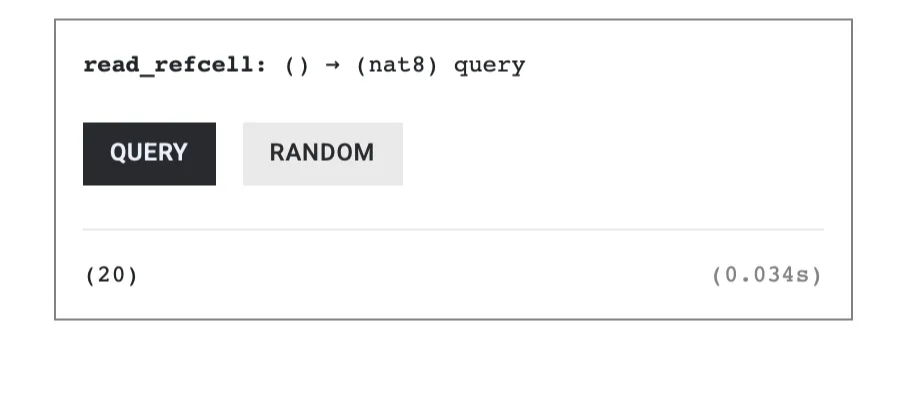
At this point, the function correctly returns the inner value 20.
Writing to a RefCell with .borrow_mut()
Reading from a RefCell uses .borrow(). To modify the inner value, we use .borrow_mut(), which provides mutable access.
In the example shown below, x’s value is changed from 20 to 40 using before *x.borrow_mut() = 40; returning its value.
use std::cell::RefCell;
#[ic_cdk::query]
fn write_refcell() -> u8 {
let x: RefCell<u8> = RefCell::new(20);
*x.borrow_mut() = 40;
return *x.borrow();
}
The next section will show how to use .with() correctly.
Accessing Thread-Local Variables with .with()
The usage of .with() is shown in the get_x() function below.
use std::cell::RefCell;
thread_local! {
static X: RefCell<u8> = RefCell::new(40);
}
#[ic_cdk::query]
fn get_x() -> u8 {
X.with(callback) // access thread-local variables using .with
}
//Call back function
fn callback(cell: &RefCell<u8>) -> u8 {
*cell.borrow()
}
ic_cdk::export_candid!();
The .with() method takes a callback function as its argument. In the example, the callback function is callback(), so we call .with(callback).
.with() will hand over the responsibility of handling the RefCell variable to the callback() function. The callback() function must have a specific input and output syntax, which is:
- It accepts a reference to the
RefCellvariable as its input:cell: &RefCell<u8>. - It returns the inner value of the
RefCellvariable,u8.
Manipulating the thread-local RefCell variable happens through the input parameter cell, which is a reference to the thread-local RefCell. We use cell.borrow() or cell.borrow_mut() to gain read or write access.
// Callback function
fn callback(cell: &RefCell<u8>) -> u8 { // cell is a reference to X
// .borrow() returns Ref<u8>, so we dereference it to get the inner value
*cell.borrow()
}
Using a Closure in Place of a Callback Function
You can replace the standalone callback() function with an inline closure. Closures in Rust are anonymous functions written directly at the call site, which keeps the code shorter and easier to follow.
use std::cell::RefCell;
thread_local! {
static X: RefCell<u8> = RefCell::new(40); // ✅ mutable
}
#[ic_cdk::query]
fn get_x() -> u8 {
X.with(|cell| *cell.borrow()) // closure is implemented instead of callback
}
Closure syntax explained
|cell|defines the closure input parameter; here, it is a reference to the thread-localRefCell<u8>.- Inside the closure,
.borrow()creates an immutable borrow, and*dereferences it to yield the rawu8. - We do not have to specify the input or the return type since they’re inferred by the compiler.
Closures behave the same as separate callback functions but are more practical because they are inline, avoid boilerplate, and let the compiler infer parameter and return types for you.
Writing to a Thread-Local RefCell
Now, we demonstrate accessing a thread-local static variable of type RefCell using .with(), a closure (|cell| cell...), and .borrow() & .borrow_mut() for read and write access.
The set_x() method below sets the value of X to any u8 you provide:
use std::cell::RefCell;
thread_local! {
static X : RefCell<u8> = RefCell::new(20);
}
#[ic_cdk::update]
fn set_x(a: u8) {
X.with(|cell| *cell.borrow_mut() = a);
}
#[ic_cdk::query]
fn get_x() -> u8 {
X.with(|cell| *cell.borrow())
}
ic_cdk::export_candid!();
Calling set_x(255), followed by get_x() will return 255.

The value of X is now 255, from 20, indicating that the state change was persisted.
To summarize up to this point, use .borrow() or .borrow_mut() to access the inner value of RefCell variables, and for thread_local! variables, you must also wrap that access inside a .with() call.
.with() combined with .borrow() and .borrow_mut()
There is a shortcut to calling a static thread-local Refcell variable. Instead of calling .with() and .borrow() or .borrow_mut() individually, we can combine them together:
.with()+.borrow()=.with_borrow(),.with()+.borrow_mut()=. with_borrow_mut(),
The RefCell reference inside of the closure would, under the hood have the .borrow() method automatically called on them. The COUNTER canister below demonstrates using them:
use std::cell::RefCell;
thread_local! {
static COUNTER : RefCell<u8> = RefCell::new(20);
}
#[ic_cdk::update]
fn increment() {
// .with() + .borrow() = .with_borrow()
COUNTER.with_borrow_mut(|cell| *cell += 1);
}
#[ic_cdk::query]
fn get_counter() -> u8 {
// .with() + .borrow_mut() = .with_borrow_mut()
COUNTER.with_borrow(|cell| *cell)
}
ic_cdk::export_candid!();
From this point forward, our code examples will use .with_borrow() and .with_borrow_mut() for simplicity.
In the next section we’ll learn about composite data types to declare state variables such as Vec<T>, and HashMap<K, V>.