Rust provides three keywords for declaring variables and their scope: let, const, and static. In ICP canisters, the static keyword is used to declare a state/storage variable that persists its data on the ICP blockchain.
The let keyword
let creates a local variable whose lifetime ends when it goes out of scope. This keyword is often used within functions.
fn bar() {
let local_variable = 20;
}
The const keyword
const defines a constant variable whose value is inlined directly into the bytecode. We use this to declare a global or local constant.
// global scope
const GLOBAL_CONSTANT : bool = true;
fn bar() {
// local scope
let local_variable = 20;
const local_constant = 20;
}
Note: Naming conventions for Rust global variables uses UPPER_SNAKE_CASE.
The static keyword declares a State Variable
static defines a global state variable with a single memory location shared across the entire program. We use the static keyword to define a state/storage variable, for example:
// global scope
// state/storage variable
static STATE_VARIABLE: u8 = 20;
// constant variable
const GLOBAL_CONSTANT: bool = true;
// some function
fn bar() {
// local scope
let local_variable = 20;
const local_constant = 20;
}
In normal Rust, static variables exist only for the lifetime of the program and get discarded when the program ends. However, ICP does extra work behind the scenes to persist a static variable’s value in the blockchain.
Static Variables Mutability
static variables are immutable by default, meaning their value cannot change once the canister is deployed. The static variable X below will store its value in the storage, but it cannot be mutated.
// Immutable State Variable
static X: u8 = 20;
To make a static variable mutable at runtime, the mut keyword must be explicitly added after the static keyword. static mut Y’s value will be kept in the storage, and it can be mutated.
// Add the MUT keyword to Static to make it mutable
static mut Y: u8 = 20;
*The use of static mut to declare mutable state variables is unsafe. *****However, we will still introduce it as it is foundational knowledge that builds upon the recommended way to declare mutable static variables.
Before we begin working with mutable variables, let’s first learn how to query an immutable one.
Immutable Variables (static)
FOO below is an immutable state variable, declared with the static keyword and initialized with a fixed value of 1000.
// Immutable
static FOO: u64 = 1000;
Because FOO is immutable, you can only read its value. Add a query function get_foo() that returns FOO:
static FOO: u64 = 1000;
// NEW CODE HERE
#[ic_cdk::query]
fn get_foo() -> u64 {
return FOO;
}
The canister code above includes an immutable variable FOO, stored in the canister’s state, and a query function get_foo() that returns its value.
Deploy the canister
Replace the contents of lib.rs from hello_world with the code above and deploy it locally:
-
Add
ic_cdk::export_candid!();at the end of your main canister file:static FOO: u64 = 1000; // NEW CODE HERE #[ic_cdk::query] fn get_foo() -> u64 { return FOO; } ic_cdk::export_candid!(); -
Generate the Candid Interface:
generate-did hello_world_backendNote: Always perform step 1 and 2 to update the Candid Interface.
-
Deploy the canister
dfx deploy
Call get_foo() and it should return 1000.
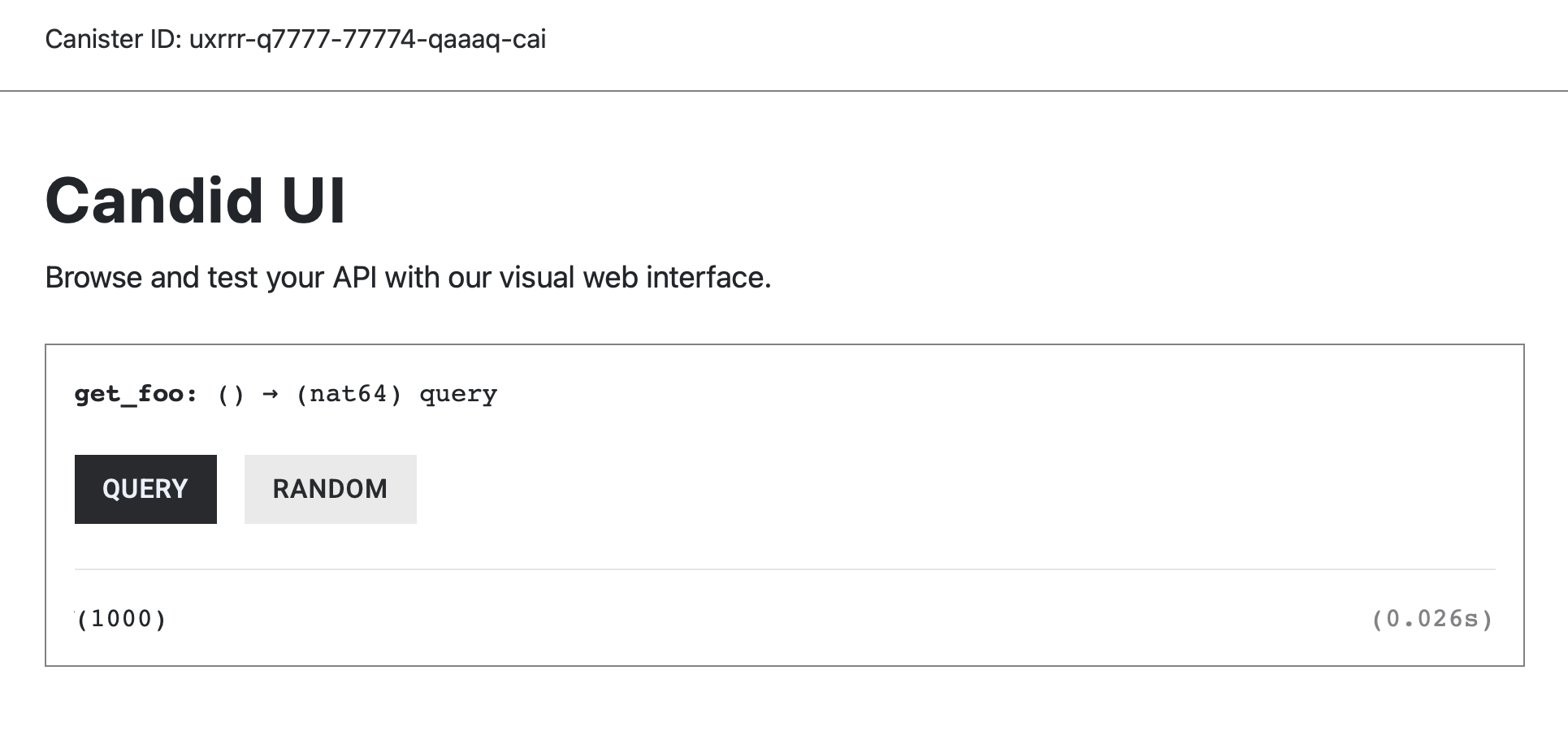
Currently, the variable static FOO is immutable during runtime. Let’s see, how we can make this variable mutable.
Mutable Variables (Unsafe static mut )
To allow mutations to static variables, add the mut keyword: static mut.
// Mut keyword is added here
static mut FOO: u64 = 1000;
#[ic_cdk::query]
fn get_foo() -> u64 {
return FOO;
}
ic_cdk::export_candid!();
Once the mut keyword is added, you’ll notice that the compiler will immediately flag an error in get_foo(). The error says “use of mutable statics is unsafe and requires an unsafe function or block.”
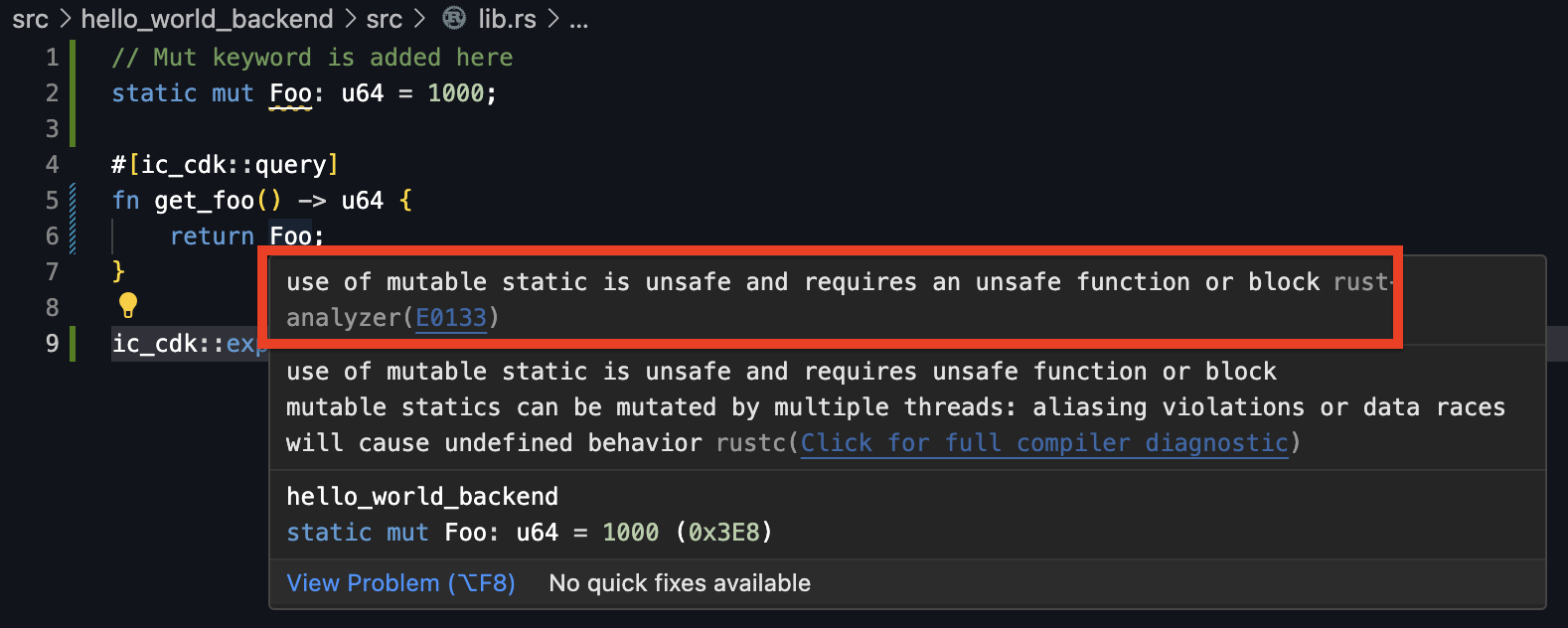
We can fix this error by wrapping the statement “return FOO;" with an unsafe {} block.
static mut FOO: u8 = 20;
#[ic_cdk::query]
fn get_foo() -> u8 {
// wrap it with unsafe and the compile error goes away
unsafe {
return FOO;
}
}
ic_cdk::export_candid!();
Rust requires wrapping all access to static mut variables in an unsafe{} block; otherwise, it raises an error. We’ll explain why static mut needs the unsafe block in the next section.
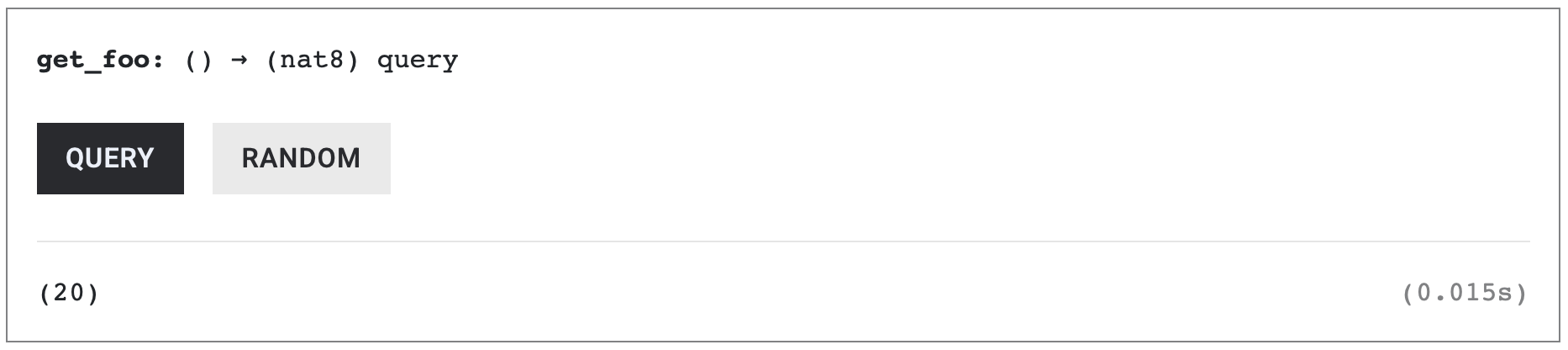
Re-deploy the canister and get_foo() should work:
Why access to static mut requires unsafe
A static mut is a global variable that any function can read or write to. The Rust language takes into account the cases where multiple threads or multiple instances of the program may access static mut at the same time. This allows concurrent access to the variable, which can lead to race conditions. Therefore, it enforces you to use unsafe to acknowledge this risk.
Race Condition Example from Using static mut Variables
In the normal Rust code below, we have a COUNTER variable that two threads increment 5 million times simultaneously. The simultaneous reads and writes would most likely clash, producing a race condition that corrupts the data.
static mut COUNTER: u64 = 0;
fn main() {
// first thread
let t1 = std::thread::spawn(|| {
for _ in 0..5_000_000 {
unsafe { COUNTER += 1; }
}
});
// second thread
let t2 = std::thread::spawn(|| {
for _ in 0..5_000_000 {
unsafe { COUNTER += 1; }
}
});
t1.join().unwrap();
t2.join().unwrap();
println!("expected: 10_000_000, got: {}", unsafe { COUNTER });
}
Test the program above on Rust Playground. In the perfect scenario, we should expect COUNTER to have a final value of 10 million, but the result often falls short of ten million because the read-and writes clash.
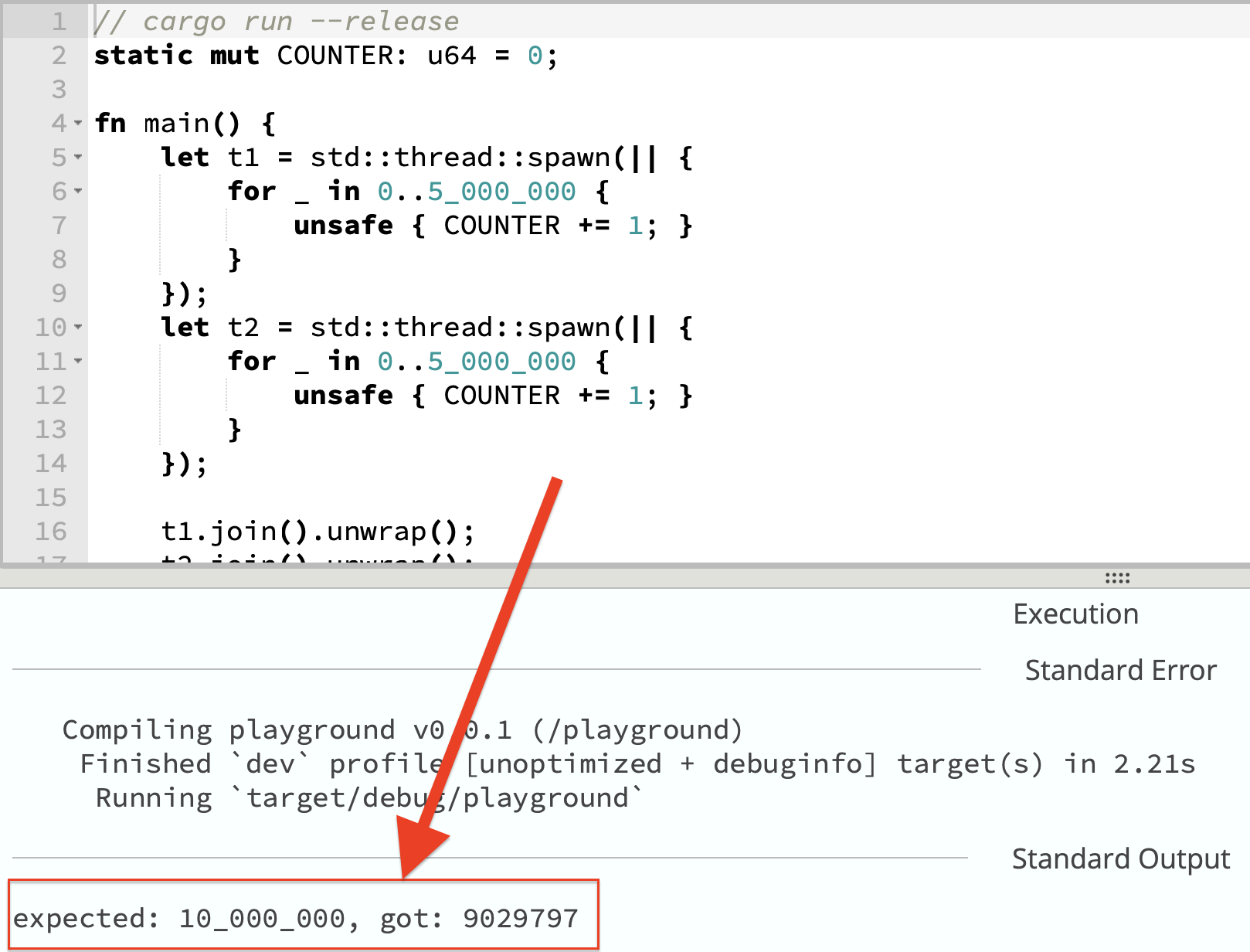
Canisters on ICP run single-threaded, it disallows multi-threading. So race conditions like this don’t occur.
However, static mut still bypasses other Rust safety guarantees such as its ownership and borrowing rules, which can lead to more undefined behaviors.
For the reasons above, using static mut for declaring your mutable variables is not recommended.
We’ll introduce the recommended way to write mutable state variables later. For now, we’ll stick to using static mut to declare a mutable state variable. In next chapter, we will work with state-changing functions in detail.