This article discusses how to revert (trap) functions and handle logic or runtime errors in Rust canisters.
Ethereum developers typically guard against errors by using revert checks that abort execution and roll back state changes. For example:
contract RevertExample {
function safeDivide(uint256 a, uint256 b) public pure returns (uint256) {
require(b != 0, "division by zero"); // reverts if b is 0
return a / b;
}
}
On ICP, the equivalent of reverting a function is to call the trap("error message") API.
Reverting Execution in Rust Canisters
With that comparison in mind, let’s look at how execution is aborted in Rust canisters on the Internet Computer.
Reverting with trap()
trap() is a System API that tells the runtime to abort execution and roll back the state changes made by the current call (this is only true if the function call does not perform an inter-canister call).
use ic_cdk::api::trap;
trap("error message") takes a string slice (&str) as its argument. When the trap is triggered, execution immediately aborts and the provided message is returned to the caller as the trap error.
use ic_cdk::api::trap;
#[ic_cdk::update]
fn safe_divide(a:u64, b:u64) -> u64 {
if b==0 {
trap("division by zero");
}
return a / b;
}
ic_cdk::export_candid!();
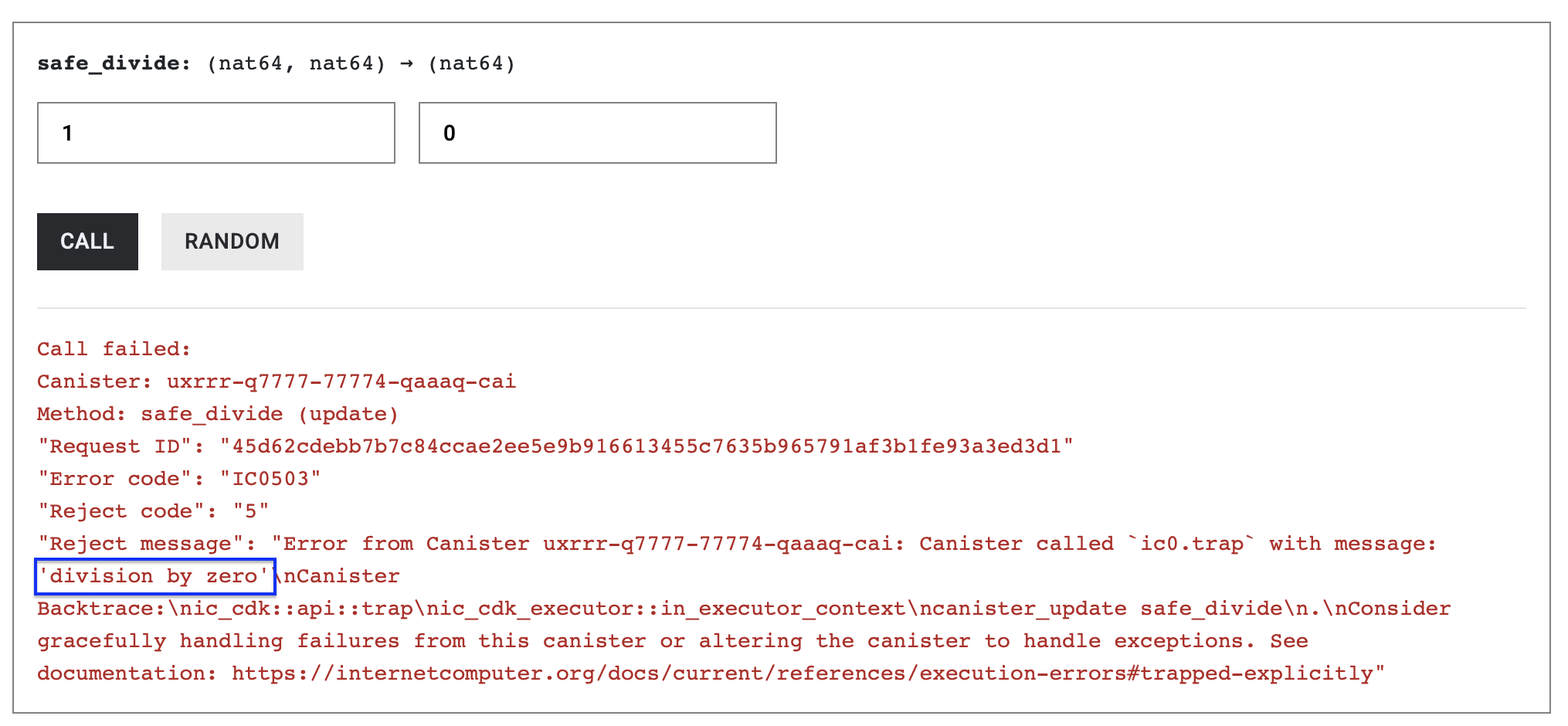
Deploy the canister above and assign argument b as 0. The function would return an error along with the custom trap error message.
Revert with the assert!()
We can also revert a function by using the assert!() macro, which causes a panic at runtime if the defined conditions are violated. Within the safeDivide function below, we replaced the trap() API with the assert!() macro
#[ic_cdk::update]
fn safe_divide(a:u64, b:u64) -> u64 {
// revert
assert!(b!=0, "division by zero");
return a / b;
}
ic_cdk::export_candid!();
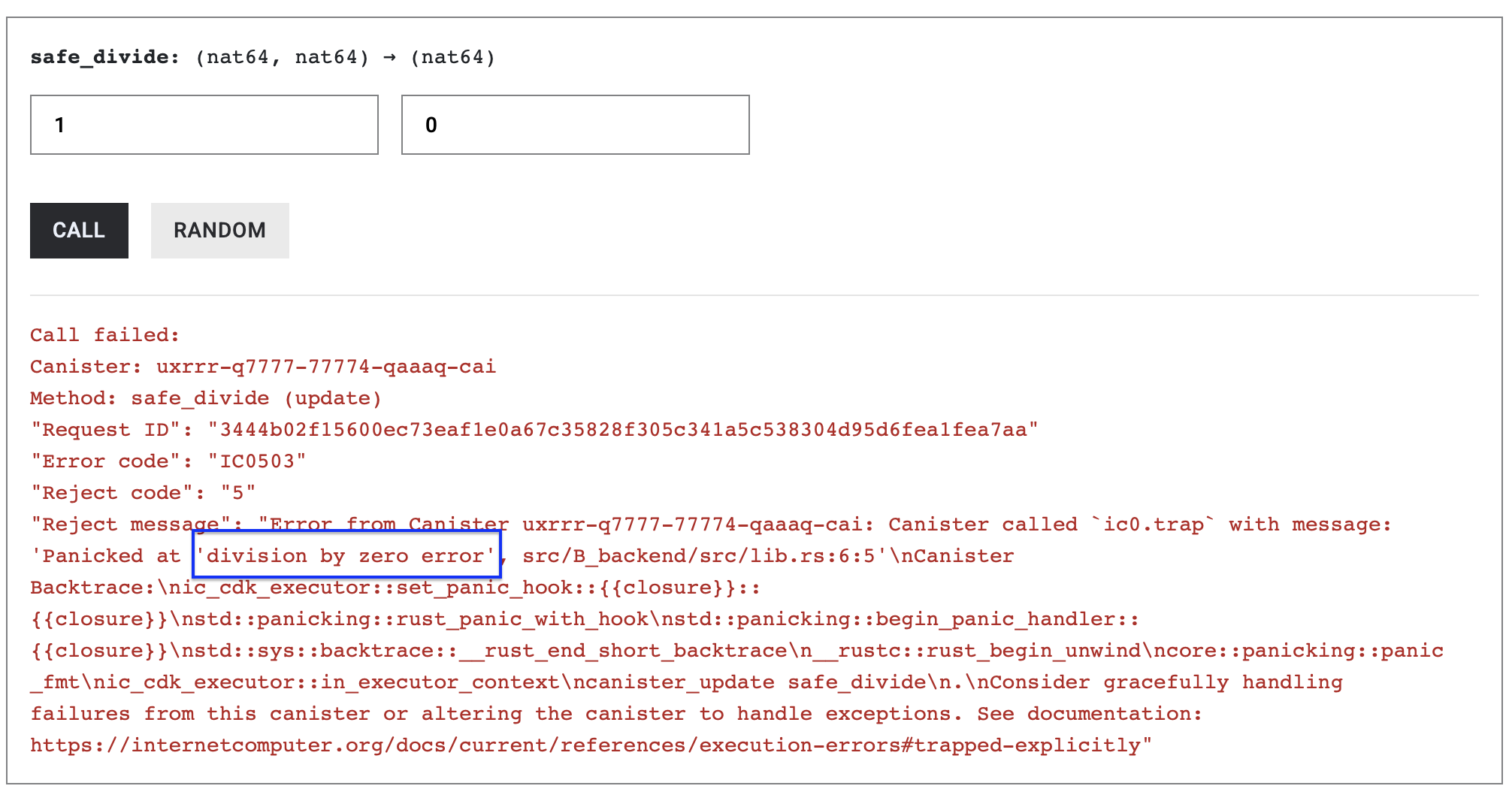
Deploy the canister above and call safeDivide(), you would also expect to see the “division by zero” error message.
A panic at runtime under the hood causes the canister to trap(). Therefore using both traps and asserts are acceptable, the utilization of trap() or assert!() depends on your preference.
Limitations Associated with Reverts
Reverting transactions with trap() can be tricky. In the case where the function call involves calling another canister (inter-canister calls), a revert would only partially rollback some of the state-changes that were made (the details are discussed in the fourth module). This could leave our canister in an awkward situation where only some of the state-changes were rolled back, and some, permanently committed.
Returning Errors Instead of Reverting
To avoid these pitfalls, instead of forcefully reverting execution when an error occurs, we can design our functions to return an explicit success or failure value.The simplest approach is to return a boolean:
- true indicates that the function completed successfully
- false indicates that the function encountered an error
However, a boolean only tells us that something went wrong—not why. To address this, Rust provides the Result type, which allows functions to return detailed error information.
Boolean-Based Error Handling
To understand this idea more concretely, let’s consider a storage variable called EVEN_ONLY, which is meant to store only even numbers.
use std::cell::RefCell;
thread_local!{
static EVEN_ONLY : RefCell<u64> = RefCell::new(2);
}
To enforce this rule, we’ll add an a set_even_only() function that only allows even numbers to be saved to EVEN_ONLY.
use std::cell::RefCell;
thread_local!{
static EVEN_ONLY : RefCell<u64> = RefCell::new(2);
}
#[ic_cdk::update]
fn set_even_only(new_number : u64) -> bool {
if new_number % 2 == 0 {
// store the number
EVEN_ONLY.with_borrow_mut(|cell| *cell = new_number);
true
} else {
// do nothing
false
}
}
The if statement is used to check whether the number is even— if it is, store the number, if not, do nothing. Then, to return a success or failure indicator, we can return a boolean.
truemeans that the function logic passed,falsemeans that some business logic was violated or some other errors.
The drawback of this approach is that the function can only return a single false value, without indicating why the operation failed. If multiple error conditions are possible, there’s no way to tell which one occurred.To illustrate this limitation, we’ll update set_even_only to enforce two separate conditions:
- The number has to be even, and
- Only the owner can make changes
In the canister below, we added an OWNER variable, a constructor for OWNER, and applied an only owner access control to set_even_only().
use std::cell::RefCell;
use candid::Principal;
use ic_cdk::api::msg_caller;
thread_local! {
static EVEN_ONLY : RefCell<u64> = RefCell::new(2);
// new owner
static OWNER : RefCell<Principal> = RefCell::new(Principal::anonymous());
}
// initialize Owner
#[ic_cdk::init()]
fn init(_owner: Principal) {
OWNER.with_borrow_mut(|cell| *cell = _owner);
}
#[ic_cdk::update]
fn set_even_only(new_number: u64) -> bool {
let canister_owner = OWNER.with_borrow(|cell| cell.clone());
// return false if not owner
if msg_caller() != canister_owner {
return false;
}
if new_number % 2 == 0 {
EVEN_ONLY.with_borrow_mut(|cell| *cell = new_number);
true
} else {
false
}
}
A simple false return gives no indication of whether the failure was due to invalid input (odd number) or insufficient access permission (caller is not the owner). By having the function return a Result<T, E> type, we can communicate explicitly why the operation failed.
The Result Type: Result<T,E>
The Result type, Result<T,E>, allows functions to return a clear success or error signal without failing the function and provide an attached value to either signal :
- Success signal:
Ok(payload) - Error signal:
Err(payload)
Continuing from the even number example above, we’ll have the function return a Result<T,E> type. Result returns wraps your return value in an Ok() or Err() wrapper. Ok() indicating success and Err() indicator failure.
use std::cell::RefCell;
thread_local!{
static EVEN_ONLY : RefCell<u64> = RefCell::new(2);
}
#[ic_cdk::update]
fn set_even_only(new_number : u64) -> Result<String,String> {
if new_number % 2 == 0 {
EVEN_ONLY.with_borrow_mut(|cell| *cell = new_number);
Ok("Success".to_string())
else{
Err("Not an Even Number".to_string())
}
}
The value that’s wrapped is defined in the Result<T,E>.
Tis the type to return in theOk()case, left hand side, andEis the type to return in theErr()case, right hand side.
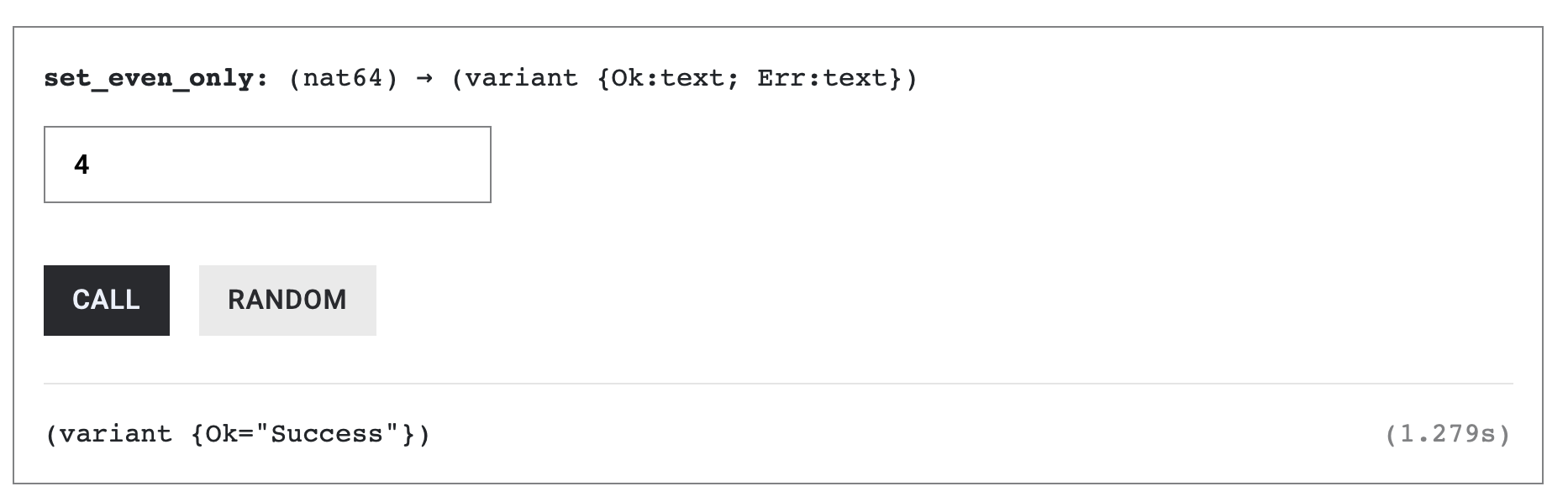
If its a success, it returns “success” wrapped in by Ok() and
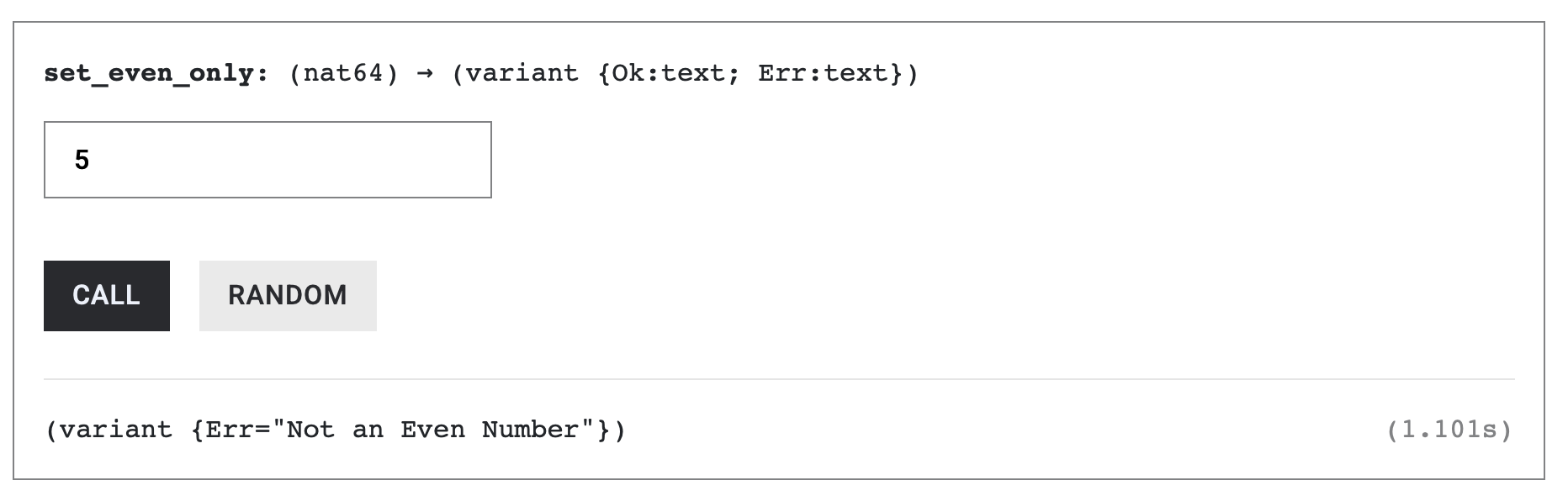
in the fail case, “Not an Even Number” wrapped in an Err()
Using enums for Structured Errors
Using enums, we can define a fixed set of possible error cases that our function might return. For example, instead of just returning "Not an Even Number".to_string(), we can define an enum that captures the possible errors in our function:
#[derive(Debug)]
enum SetEvenError {
NotEven,
NotOwner,
}
Now we can update our set_even_only function to return a Result<T, SetEvenError>. This way, the caller knows whether the error was due to the number not being even, or because the caller was not the owner.
use std::cell::RefCell;
thread_local! {
static EVEN_ONLY: RefCell<u64> = RefCell::new(2);
static OWNER: RefCell<String> = RefCell::new("alice".to_string());
}
#[ic_cdk::update]
fn set_even_only(new_number: u64, caller: String) -> Result<String, SetEvenError> {
let owner = OWNER.with(|o| o.borrow().clone());
if caller != owner {
return Err(SetEvenError::NotOwner);
}
if new_number % 2 != 0 {
return Err(SetEvenError::NotEven);
}
EVEN_ONLY.with_borrow_mut(|cell| *cell = new_number);
Ok("Success".to_string())
}
Another advantage of enums is that they are easy to extend. If later we wanted to add a new rule, like requiring the number to be less than 100, we could just add a new TooLarge case to the SetEvenError enum and update the function accordingly.
This structured approach makes it much clearer to both developers and users why a function failed, and it ensures that all possible error cases are considered at compile time.
To summarize, returning an error indicator is encouraged because:
- Reverting implicates an inconsistent state roll-back due to asynchronous execution.
- Provides Good UI to the client to resolve errors quickly.