A library call executes the logic of a declared contract class in the context and storage of the contract that invokes it. This is similar to Solidity’s delegatecall but uses class hashes rather than deployed contract addresses.
In this article, you’ll learn how library calls work in detail and the two implementation approaches in Cairo contracts.
How library calls work
Consider this code example with two contracts: CallerContract and CalledContract.
CalledContract is a contract class that defines reusable logic that deployed contracts can execute via library calls. It has an add() function that takes two numbers and returns their sum:
#[starknet::interface]
pub trait ICalledContract<TContractState> {
fn add(self: @TContractState, a: u32, b: u32) -> u32;
}
#[starknet::contract]
mod CalledContract {
#[storage]
struct Storage {
// no storage needed
}
#[abi(embed_v0)]
impl CalledContractImpl of super::ICalledContract<ContractState> {
fn add(self: @ContractState, a: u32, b: u32) -> u32 {
a + b
}
}
}
CallerContract is a deployed contract that stores CalledContract’s class hash. When its calculate() function is called, it executes the add() function from CalledContract’s class via a library call and then stores the result in its own storage:
#[starknet::interface]
pub trait ICallerContract<TContractState> {
fn calculate(ref self: TContractState, a: u32, b: u32) -> u32;
}
#[starknet::contract]
mod CallerContract {
use starknet::{ClassHash, get_caller_address, get_contract_address};
use starknet::storage::{StoragePointerWriteAccess};
#[storage]
struct Storage {
result: u32, // CallerContract's storage
called_class: ClassHash,
}
#[constructor]
fn constructor(ref self: ContractState, called_class_hash: ClassHash) {
self.called_class.write(called_class_hash);
}
#[abi(embed_v0)]
impl CallerContractImpl of super::ICallerContract<ContractState> {
fn calculate(ref self: ContractState, a: u32, b: u32) -> u32 {
let caller = get_caller_address();
let this = get_contract_address();
// Execute add() from CalledContract via library call
// Library call details will be shown later
let sum = // ... library call to add(a, b) ...
// Store result in CallerContract's storage
self.result.write(sum);
sum
}
}
}
Here’s a diagram showing how CallerContract executes code from CalledContract through a library call:
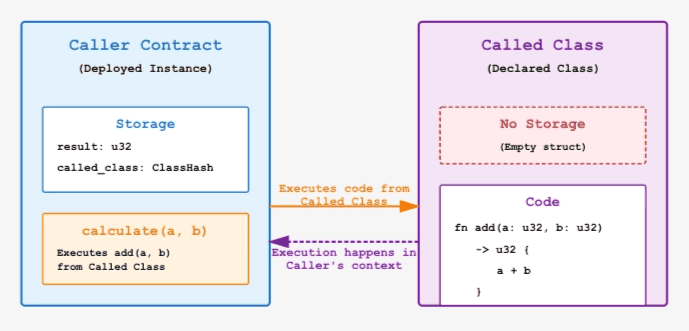
Library calls preserve the caller’s context
When a user calls CallerContract.calculate(), inside CallerContract:
get_caller_address()returns the user’s addressget_contract_address()returnsCallerContract’s address
When CallerContract executes the add() function from CalledContract’s class via a library call, the execution stays in CallerContract’s context. This means:
get_caller_address()still returns the user’s address (preserved from the original call)get_contract_address()still returnsCallerContract’s address- Storage updates happen in
CallerContract’s storage (theresultfield gets modified)
The code from CalledContract executes as if it were written directly inside CallerContract.
get_contract_address()always returns the address of the contract whose context is active, not necessarily whose code is running.
Library call comparison with Solidity’s delegatecall:
| Aspect | Cairo library call | Solidity DELEGATECALL |
|---|---|---|
| Target | Contract class (declared class hash) | Deployed library contract |
| Mechanism | library_call_syscall |
DELEGATECALL opcode |
| Context | Caller’s context | Caller’s context |
| Storage Modified | Caller’s storage | Caller’s storage |
| msg.sender equivalent | Original user’s address preserved | Original msg.sender preserved |
The key difference from regular cross-contract calls is whose storage gets updated and in whose context the code executes.
Ways to make library calls
There are two ways to make library calls on Starknet:
- Using the library dispatcher
- Using the
library_call_syscalldirectly
Let’s walk through each one of them.
1. Using the Library Dispatcher
A library dispatcher is a compiler-generated struct that enables type-safe library calls to contract classes. It wraps a ClassHash and implements the trait that the compiler generates from your #[starknet::interface].
When you call a function via library dispatcher, you simply invoke it like a regular function. Internally, the dispatcher:
- computes the function selector from the function name at compile time
- serializes the function arguments into
felt252values - uses
library_call_syscallto execute the call with the class hash, function selector, and serialized arguments - deserializes the returned
Span<felt252>back into the expected Cairo types
Like contract dispatchers (used in cross-contract calls), library dispatchers come in two variants:
- Regular library dispatcher: Makes library calls and reverts the entire transaction if the call panics
- Safe library dispatcher: Makes library calls and returns
Result<T, Array<felt252>>, allowing you to handle failures without reverting. However, certain system-level failures such as using a class hash that doesn’t exist on-chain and errors in legacy Cairo Zero classes still cause immediate transaction reverts that cannot be caught.
Let’s examine how a Calculator contract uses library dispatcher to execute calculation functions from a MathUtils class. We’ll create a MathUtils class that defines reusable code. This class is declared on-chain but never deployed as a contract instance, so no storage is allocated:
#[starknet::interface]
trait IMathUtils<TContractState> {
fn add(self: @TContractState, a: u256, b: u256) -> u256;
fn multiply(self: @TContractState, a: u256, b: u256) -> u256;
}
// Math utilities class (declared but never deployed)
#[starknet::contract]
mod MathUtils {
#[storage]
struct Storage {
// no storage needed
}
#[abi(embed_v0)]
impl MathUtilsImpl of super::IMathUtils<ContractState> {
fn add(self: @ContractState, a: u256, b: u256) -> u256 {
a + b
}
fn multiply(self: @ContractState, a: u256, b: u256) -> u256 {
a * b
}
}
}
// Calculator contract (deployed instance that uses MathUtils)
#[starknet::interface]
trait ICalculator<TContractState> {
fn add(ref self: TContractState, a: u256, b: u256) -> u256;
fn multiply(ref self: TContractState, a: u256, b: u256) -> u256;
fn get_result(self: @TContractState) -> u256;
}
#[starknet::contract]
mod Calculator {
use starknet::storage::{StoragePointerReadAccess, StoragePointerWriteAccess};
use starknet::ClassHash;
use super::{IMathUtilsDispatcherTrait, IMathUtilsLibraryDispatcher};
#[storage]
struct Storage {
math_class: ClassHash,
result: u256, // Calculator's storage
}
#[constructor]
fn constructor(ref self: ContractState, math_class: ClassHash) {
self.math_class.write(math_class);
}
#[abi(embed_v0)]
impl CalculatorImpl of super::ICalculator<ContractState> {
fn add(ref self: ContractState, a: u256, b: u256) -> u256 {
// Executes MathUtils add() in Calculator's context
let sum = IMathUtilsLibraryDispatcher { class_hash: self.math_class.read() }
.add(a, b);
// Calculator stores the result
self.result.write(sum);
sum
}
fn multiply(ref self: ContractState, a: u256, b: u256) -> u256 {
// Executes MathUtils multiply() in Calculator's context
let product = IMathUtilsLibraryDispatcher { class_hash: self.math_class.read() }
.multiply(a, b);
// Calculator stores the result
self.result.write(product);
product
}
fn get_result(self: @ContractState) -> u256 {
self.result.read()
}
}
}
In the Calculator contract, we import the auto-generated dispatcher types from the IMathUtils
interface:
use super::{IMathUtilsDispatcherTrait, IMathUtilsLibraryDispatcher};
Then, when we want to execute code from MathUtils, we create a dispatcher instance with the class hash and call the function. For example, in the add function:
let sum = IMathUtilsLibraryDispatcher { class_hash: self.math_class.read() }
.add(a, b)
This creates the dispatcher instance and immediately calls the add function from MathUtils.
When we call Calculator.add(5, 3), it makes a library call to the MathUtils class that
executes the add function. The calculation happens in Calculator’s context, and
Calculator stores the result (8) in its own storage.
When we call Calculator.multiply(4, 2), it executes the multiply function from
MathUtils, then stores the product (8) in Calculator’s storage.
The get_result() function directly reads from Calculator’s storage, returning whatever value was last stored.
This shows how library calls enable code reuse without deploying separate contract instances. Calculator executes logic from the MathUtils class as if it were part of its own code.
2. Using the library_call_syscall directly
Since the library dispatcher uses library_call_syscall under the hood, you can also call this syscall directly when you need manual serialization handling.
Here’s how the Calculator contract looks when you use library_call_syscall directly:
#[starknet::interface]
pub trait ICalculator<TContractState> {
fn add_direct(ref self: TContractState, a: u256, b: u256) -> u256;
fn get_result(self: @TContractState) -> u256;
}
#[starknet::contract]
mod Calculator {
use starknet::storage::{StoragePointerReadAccess, StoragePointerWriteAccess};
use starknet::syscalls::library_call_syscall;
use starknet::{ClassHash, SyscallResultTrait};
#[storage]
struct Storage {
math_class: ClassHash,
result: u256,
}
#[constructor]
fn constructor(ref self: ContractState, math_class: ClassHash) {
self.math_class.write(math_class);
}
#[abi(embed_v0)]
impl CalculatorImpl of super::ICalculator<ContractState> {
fn add_direct(ref self: ContractState, a: u256, b: u256) -> u256 {
// Manually serialize function arguments
let mut calldata: Array<felt252> = array![];
Serde::serialize(@a, ref calldata);
Serde::serialize(@b, ref calldata);
// Make the direct library syscall
let mut res = library_call_syscall(
self.math_class.read(),
selector!("add"),
calldata.span(),
).unwrap_syscall();
// Manually deserialize the response
let sum = Serde::<u256>::deserialize(ref res).unwrap();
// Store the result
self.result.write(sum);
sum
}
fn get_result(self: @ContractState) -> u256 {
self.result.read()
}
}
}
The add_direct function shows the three-step process of making direct library calls:
-
Manual Serialization: We create an empty array and serialize each parameter (
aandb) intofelt252values usingSerde::serialize(). This converts ouru256parameters into the low-level format that the syscall expects. -
Direct Library Syscall: We call
library_call_syscallwith three parameters:- The class hash of
MathUtils(retrieved from storage) - The function selector (
"add") - The serialized calldata
- The class hash of
-
Manual Deserialization: The syscall returns raw
felt252data, which we manually deserialize back into au256usingSerde::<u256>::deserialize().
When this function executes, it runs the MathUtils code within Calculator’s context. Calculator then stores the result in its own storage.
Using library_call_syscall directly allows explicit serialization handling but requires
more code than using the library dispatcher.
Direct low-level syscalls should only be used when you need to handle serialization manually or when the function selector must be determined at runtime. The library dispatcher requires compile-time knowledge of which function to call (e.g., dispatcher.add()), making it unsuitable for cases where the function depends on user input or contract state. In such scenarios, you use library_call_syscall directly.