简介
蕴含运算符经常被用作 if 语句的替代品,因为它更加简洁。
考虑以下示例:一个函数 mod(x, y),它接受两个无符号整数作为参数并返回 x 模 y 的结果。模运算计算的是 x 除以 y 的余数。
该函数的 Solidity 实现如下:
/// Solidity
function mod(uint256 x, uint256 y) external pure returns (uint256) {
return x % y;
}
假设我们想要形式化验证以下属性:“如果 x < y,那么模运算结果必须等于 x。”在 CVL 中使用 if 语句来表达这一点会导致编译错误,因为规则(rule)中的最后一条语句必须是 assert 或 satisfy:
/// this rule will not compile
rule mod_ifXLessThanY_resultIsX_usingIf() {
uint256 x;
uint256 y;
mathint result = mod(x, y);
if (x < y) {
assert result == x;
}
}
ERROR
: Failed to run Certora Prover locally. Please check the errors below for problems in the specifications (.spec files) or the prover_args defined in the .conf file.
CRITICAL
: [main] ERROR ALWAYS - Found errors in certora/specs/ImplicationOperator.spec:
CRITICAL
: [main] ERROR ALWAYS - Error in spec file (ImplicationOperator.spec:15:5): last statement of the rule mod_ifXLessThanY_resultIsX_usingIf is not an assert or satisfy command (but must be)
为了解决这个问题,一种变通方法是在最后添加一个无意义的断言:
if (P) {
assert Q;
}
assert true;
rule mod_ifXLessThanY_resultIsX_usingIf() {
uint256 x;
uint256 y;
mathint result = mod(x, y);
if (x < y) {
assert result == x;
}
assert true; // trivially TRUE
}
然而,这种解决方案引入了一个毫无意义的断言,从而使规范(specification)变得杂乱。另一种变通方法是使用 if-else 语句,在 else 分支中执行有意义的断言:
if (P) {
assert Q;
} else {
assert (something_else);
}
rule mod_ifXLessThanY_resultIsX_usingIfElse() {
uint256 x;
uint256 y;
mathint result = mod(x, y);
if (x < y) {
assert result == x;
} else {
assert result != x;
}
}
然而,我们最初并不关心断言:“如果 x >= y,那么 result != x。”在许多情况下(如上所示),我们并不希望为每个可能的分支都创建断言。
CVL 中的蕴含运算符 (=>)
为了优雅地处理这个问题,我们使用蕴含运算符(=>)。通过蕴含,我们可以简洁地表达条件,同时避免 if-else 语句所带来的控制流复杂性。
因此,我们可以等价地使用 assert P => Q,而不是写成 if (P) assert Q(这无法编译):
rule mod_ifXLessThanY_thenResultIsX() {
uint256 x;
uint256 y;
mathint result = mod(x, y);
assert x < y => result == x;
}

Prover 运行:链接
P => Q 的形式可以读作“如果 P,则 Q”,或者简单地读作“P 蕴含 Q”。需要注意的是,Q => P 并不一定与其等价,我们将在下一节中看到这一点。
P 蕴含 Q P => Q
让我们看另一个例子:Solady 经过 gas 优化的 max 函数。正如上一章所讨论的,它返回两个输入项 x 和 y 中的较大者,如果它们相等则默认返回 x。
下面是其实现,与上一章一样,我们将其可见性从 internal 更改为 external,以避免对构建 harness 的需求(这超出了本章的范围):
/// Solidity
function max(uint256 x, uint256 y) external pure returns (uint256 z) {
assembly {
z := xor(x, mul(xor(x, y), gt(y, x)))
}
}
现在让我们形式化验证以下属性:“如果 x 大于 y,则 max(x, y) 的返回值必须是 x。”我们可以在 CVL 中将其表达为:
rule max_ifXGreaterThanY_resultX() {
uint256 x;
uint256 y;
mathint result = max(x, y);
assert x > y => result == x;
}
在这条规则中,条件(x > y)和预期结果(result == x)构成了蕴含 P => Q。不出所料,该属性已验证(VERIFIED)。
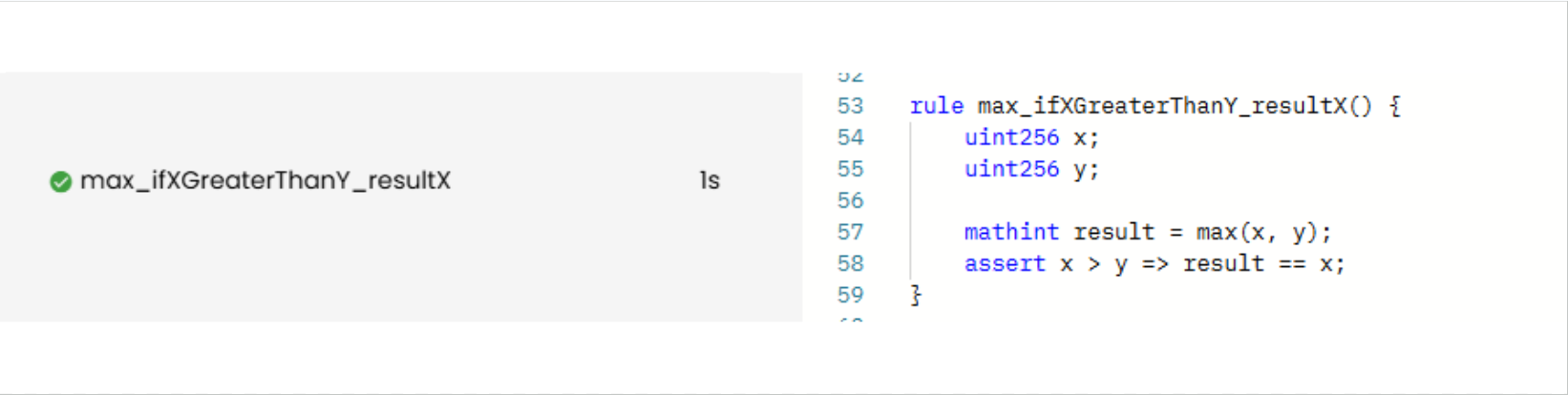
Prover 运行:链接
注意:对 max 函数的验证尚未完成。我们将在下一节中讨论。
P => Q 不等价于 Q => P
现在让我们考虑反向的蕴含命题:“如果 max(x, y) 的返回值是 x,那么 x > y”,即 result == x => x > y。起初这似乎是成立的;然而,当 x == y 时,函数仍然返回 x。这与 x > y 的断言相矛盾,使得该蕴含在那种情况下为假。
以下是验证失败的规则:
rule max_ifResultIsX_thenXGreaterThanY() {
uint256 x;
uint256 y;
mathint result = max(x, y);
assert result == x => x > y;
}
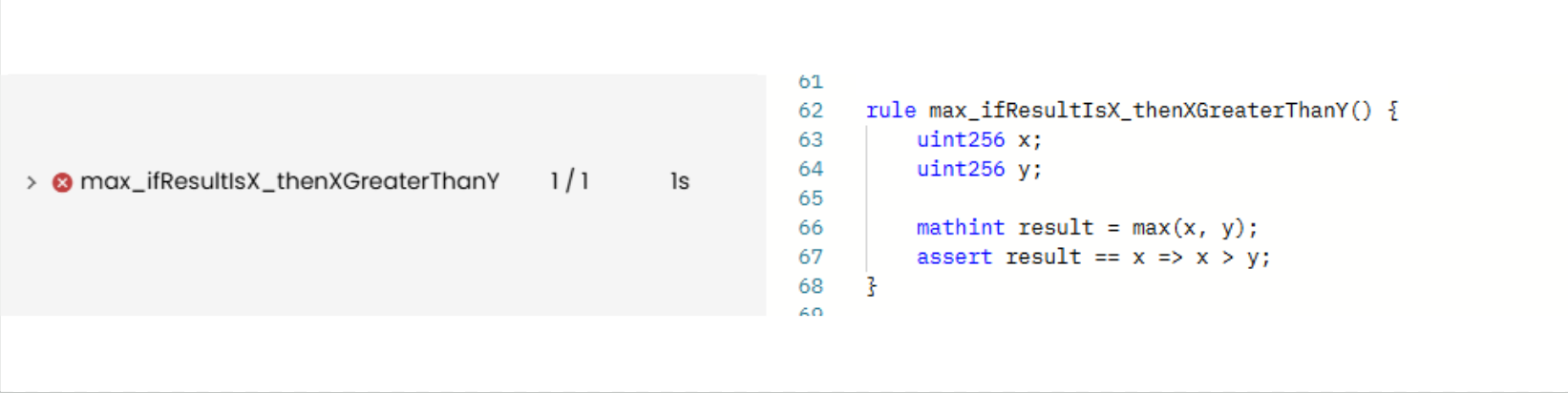
反例
当规则被违反时,Prover 会展示一个反例。在这种情况下,result == x 不仅在 x > y 时发生——它在 x == y 时也会发生。反例具体展示了 x = 3 且 y = 3:
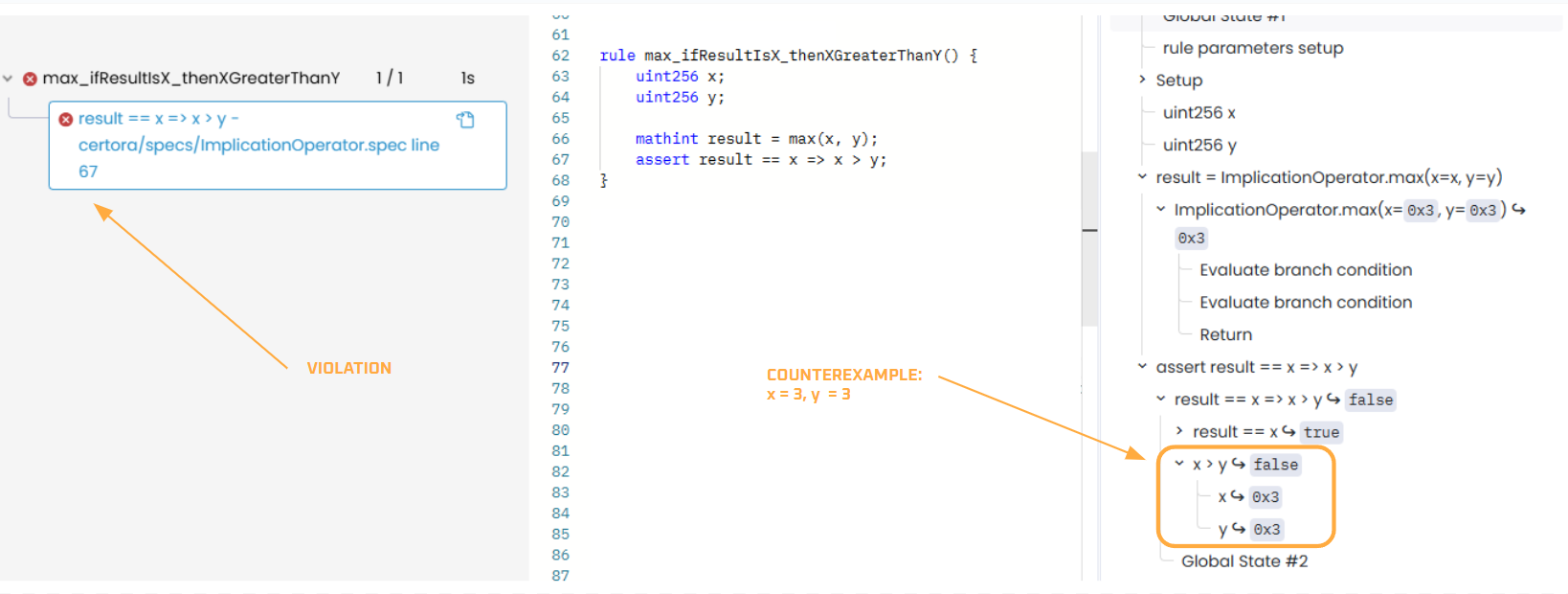
为了修复这个问题,我们需要修改条件,涵盖所有使 result == x 成立的情况:包括 x > y 和 x == y。
这是修改后的规则,其中 || 是 OR(逻辑或)运算符:
rule max_ifResultIsX_thenXGreaterOrEqualToY() {
uint256 x;
uint256 y;
mathint result = max(x, y);
assert result == x => x > y || x == y;
}
或者,更简单的写法:
rule max_ifResultIsX_thenXGreaterOrEqualToY_simplified() {
uint256 x;
uint256 y;
mathint result = max(x, y);
assert result == x => x >= y;
}
现在它验证通过(VERIFIED)了:
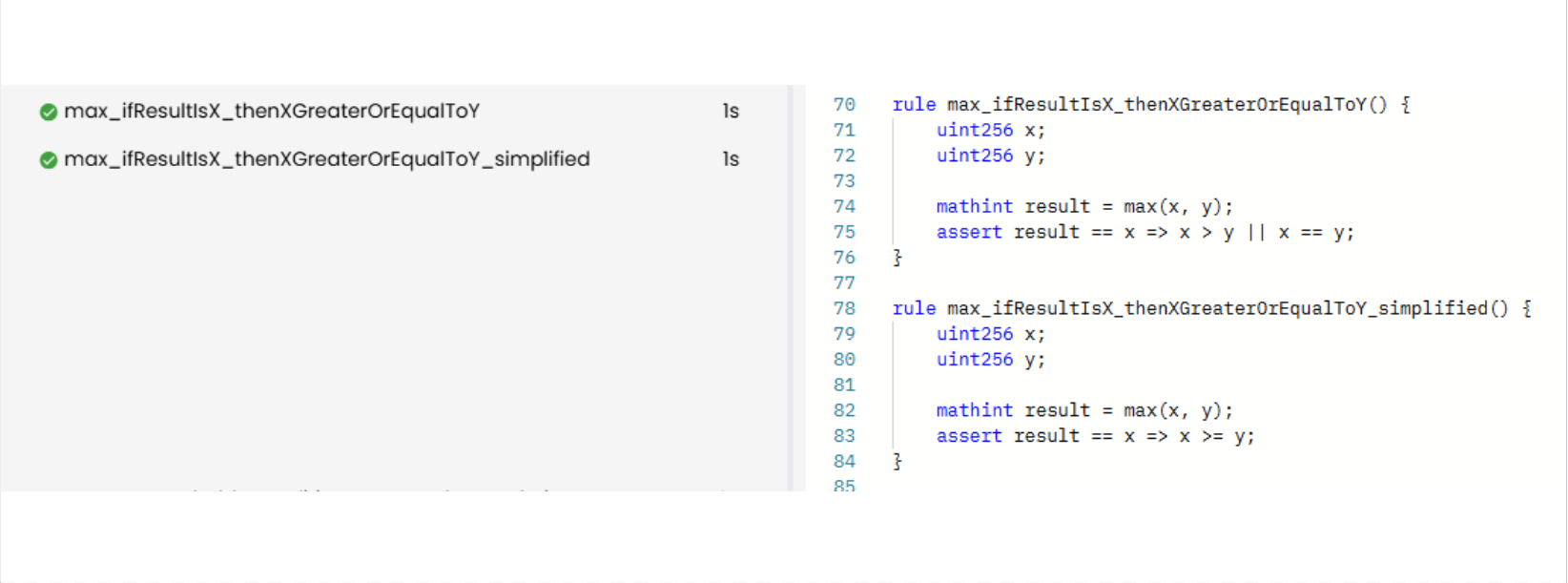
Prover 运行:链接
现在,为了完成验证,我们还要验证一个属性:当 y 大于或等于 x 时,max(x, y) 返回 y。以下是该规则:
rule max_ifResultIsY_thenYGreaterOrEqualToX() {
uint256 x;
uint256 y;
mathint result = max(x, y);
assert result == y => y >= x;
}
不出所料,它验证通过(VERIFIED)了:
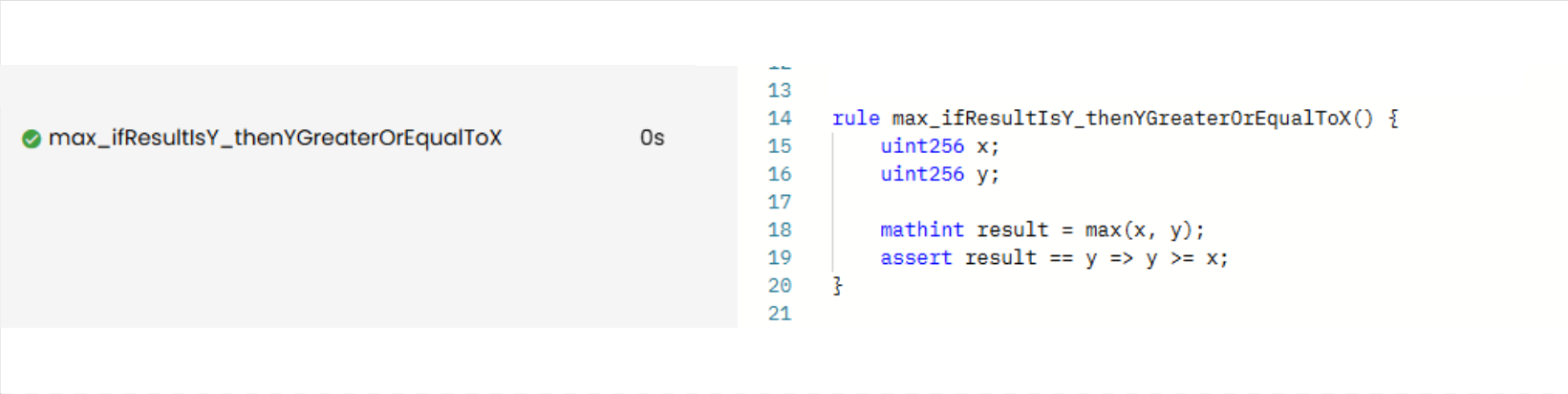
Prover 运行:链接
P => Q 等价于 !Q => !P
将蕴含 P => Q 重写为其逆否命题形式 !Q => !P,为我们提供了一种思考规范(specification)的替代方法。
让我们回顾之前包含断言 x > y => result == x 的规则:
rule max_ifXGreaterThanY_resultX() {
uint256 x;
uint256 y;
mathint result = max(x, y);
assert x > y => result == x;
}
在原始形式中,该规则关注的是当 x 大于 y 时会发生什么,即 max(x, y) 的返回值是 x。
在逆否命题形式 assert !(result == x) => !(x > y) 中,我们转而关注如果 max(x, y) 的返回值不是 x 会发生什么。在这种情况下,我们预期 x 不会大于 y(或者简而言之,x <= y):
rule max_ifResultNotX_thenXNotGreaterThanY() {
uint256 x;
uint256 y;
mathint result = max(x, y);
assert result != x => x <= y;
}
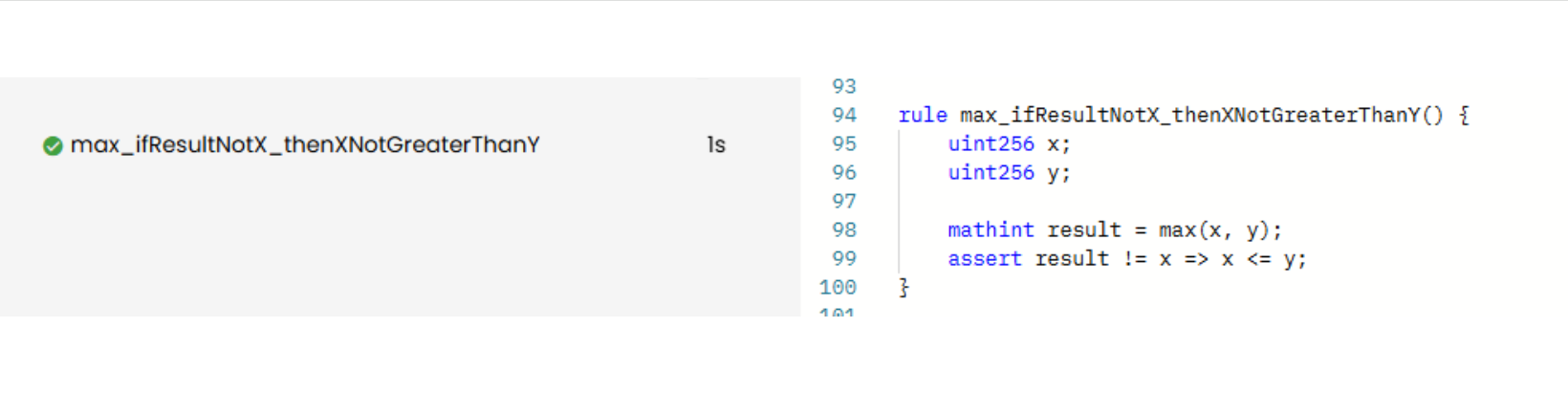
Prover 运行:链接
两种形式表达了相同的逻辑真理,只是视角不同。
为了更好地理解这一点,让我们使用一个常见的类比:
- “如果下雨了,那么地是湿的,” 或者
hasRained => isGroundWet
它的逆否命题是:
- “如果地不是湿的,那么肯定没有下雨,” 或者
!isGroundWet => !hasRained
然而,没有下雨这一事实并不能保证地不是湿的。可能是有人在地上泼了水。因此,!hasRained => !isGroundWet 在逻辑上是不成立的。
蕴含中的空洞为真与恒真式
既然我们理解了蕴含的工作原理,我们在编写这些语句时也必须保持谨慎。我们可能会在不知不觉中写出带有虚假保证的蕴含语句,这是我们接下来要探讨的话题。
当 P 始终为 FALSE 时,不管 Q 是什么, P => Q 均为 TRUE(空洞为真)
当条件(P)不可达(始终为假)时,即不存在 P 成立的可能状态,蕴含式就会出现“空洞为真(vacuously true)”。在这种情况下,整个语句 P => Q 会自动被认为是真,无论结果(Q)是什么。
这是因为如果 P 永远不可能为真,那么就不存在该蕴含被违反的实例。因此,也就不存在反例。
让我们以这个为例:“如果 x < 0,那么 result == y。”由于 x 是 uint256 类型,它永远不可能是负数。这使得 x < 0 成为一个不可达的状态。无论我们在右侧(Q)断言什么,该蕴含始终会验证通过。
以下是 CVL 中空洞为真的规则:
rule max_unreachableCondition_vacuouslyTrue() {
uint256 x;
uint256 y;
mathint result = max(x, y);
assert x < 0 => result == y;
}
这条规则验证通过(VERIFIED),但并不是因为 x < 0 导致了 result == y。它能通过验证仅仅是因为 x < 0 在任何有效的执行路径中都是不可达的,使得蕴含出现了空洞为真的情况。由于条件永远不会发生,这就确认了不存在反例:
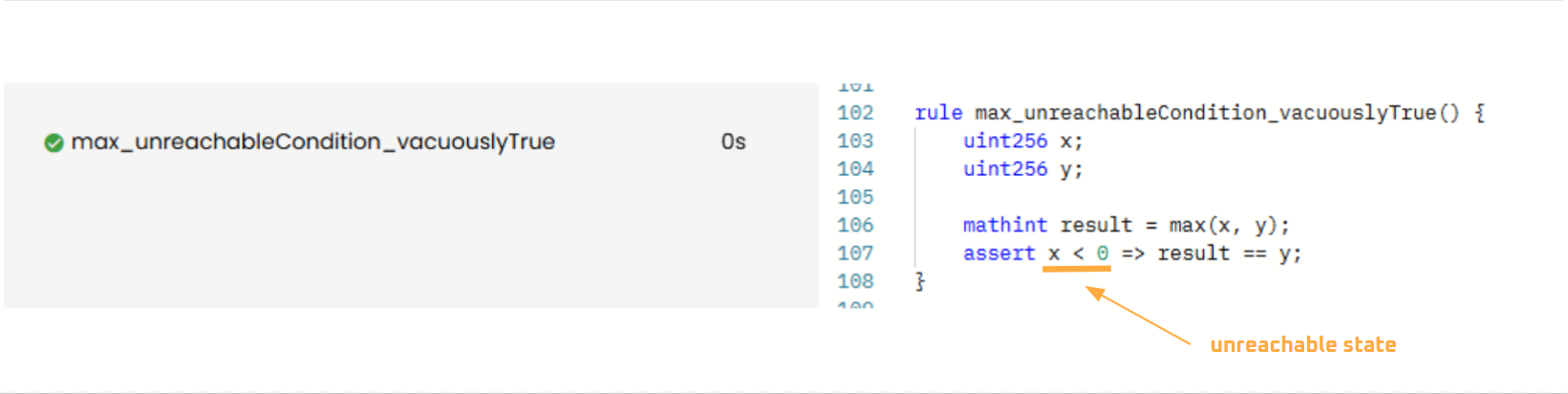
Prover 运行:链接
既然条件(P)永远不会发生,结果(Q)就可以是任何东西——哪怕是像 1 == 2 这样荒谬的东西,如下所示:
rule max_unreachableCondition_vacuouslyTrueObvious() {
uint256 x;
uint256 y;
mathint result = max(x, y);
assert x < 0 => 1 == 2;
}
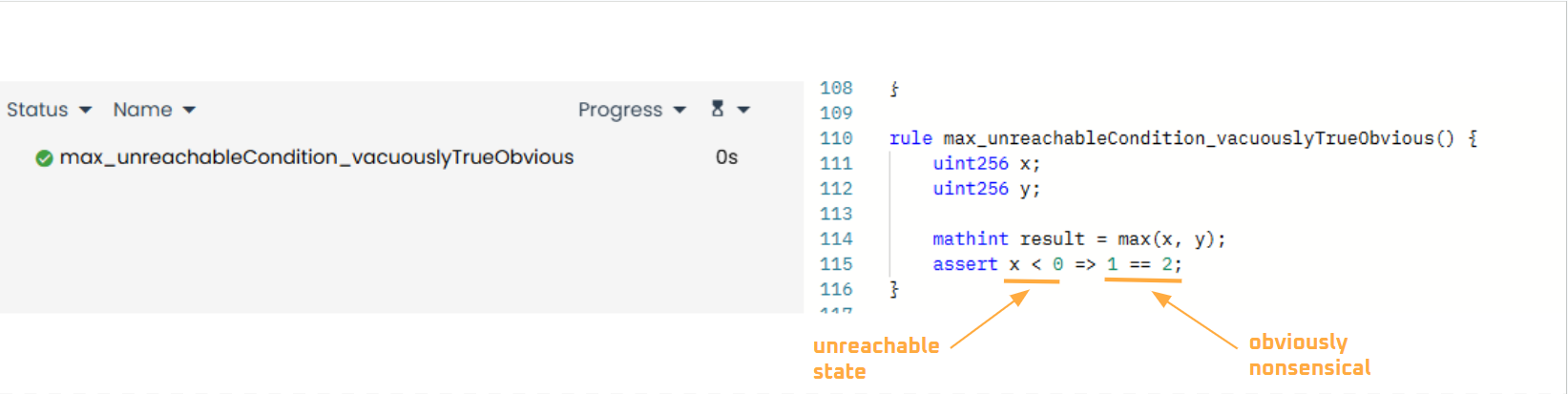
Prover 运行:链接
当 Q 始终为 TRUE_ 时,不管 P 是什么,_ P => Q 均为 TRUE(恒真式)
当结果(Q)始终为真,而不管条件(P)是什么时,蕴含式就会变成恒真式(tautology)。在这种情况下,整个语句 P => Q 会自动被认为是真,即使条件是无关的或具误导性的。
这是因为如果 Q 始终为真,结果就得到了保证;因此,蕴含命题永远不可能为假。
让我们使用这个例子:“如果 x > y,那么 result >= 0。”
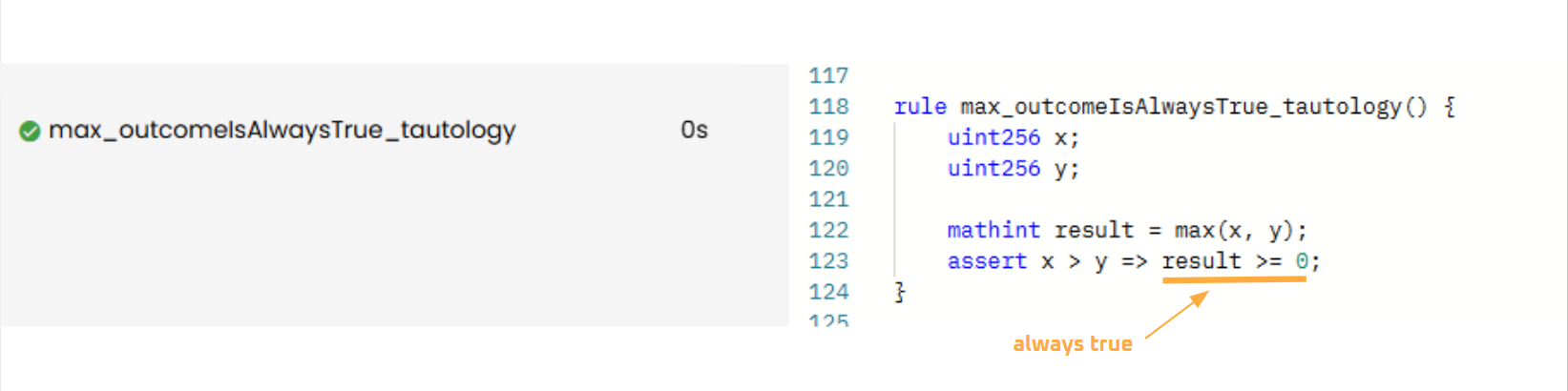
乍一看,这似乎意味着 x > y 保证了非负的结果。但是 result 是一个 uint256,按其类型定义,它始终大于或等于零。所以表达式 result >= 0 始终为真。
以下是 CVL 中的恒真式规则:
rule max_outcomeIsAlwaysTrue_tautology() {
uint256 x;
uint256 y;
mathint result = max(x, y);
assert x > y => result >= 0;
}
该规则验证通过(VERIFIED),并非因为 x > y 导致 result >= 0,而是因为按类型定义 result >= 0 始终为真,这使得该蕴含成为了恒真式:
Prover 运行:链接
形式化验证 Solmate 的 mulDivUp()
既然我们掌握了基础知识,现在我们将使用蕴含运算符来形式化验证 Solmate 的 mulDivUp()。顾名思义,该函数将两个无符号整数相乘,将结果除以另一个无符号整数,如果有余数则向上取整。如果没有余数,它直接返回商。
我们将要形式化验证的属性分为两类:舍入行为(rounding behavior)和回退行为(revert behavior)。但在开始之前,我们将对原始的 mulDivUp() 代码做一个小调整。
Solmate 的 mulDivUp() 函数的可见性是 internal,为了方便起见,我们将把它更改为 external。否则,就有必要设置一个 harness 合约,这超出了本章的范围,并可能会在现阶段引入不必要的认知负担。
以下是 mulDivUp() 函数:
/// Solidity
uint256 internal constant MAX_UINT256 = 2**256 - 1;
function mulDivUp(
uint256 x,
uint256 y,
uint256 denominator
) external pure returns (uint256 z) {
assembly {
// Equivalent to require(denominator != 0 && (y == 0 || x <= type(uint256).max / y))
if iszero(mul(denominator, iszero(mul(y, gt(x, div(MAX_UINT256, y)))))) {
revert(0, 0)
}
// If x * y modulo the denominator is strictly greater than 0,
// 1 is added to round up the division of x * y by the denominator.
z := add(gt(mod(mul(x, y), denominator), 0), div(mul(x, y), denominator))
}
}
对汇编代码的解释超出了本章的范围。然而,注释有助于我们理解代码的功能。
下面这几行,
// Equivalent to require(denominator != 0 && (y == 0 || x <= type(uint256).max / y))
if iszero(mul(denominator, iszero(mul(y, gt(x, div(MAX_UINT256, y)))))) {
revert(0, 0)
}
正如注释所暗示的,代表了一个 require 语句,强制执行以下条件:
denominator != 0,这可以防止除以零,因为不允许除以零。y == 0 || x <= type(uint256).max / y,意思是:- 如果
y == 0,条件成立,因为x * y必然等于0。在这种情况下,不需要进行溢出检查。 - 否则,如果
y != 0,x必须小于或等于type(uint256).max / y,以确保x * y不会超过type(uint256).max,从而防止溢出。
- 如果
现在我们得出结论,需要形式化验证的属性如下:
- 如果
denominator == 0,则函数发生 revert。 - 如果
x * y > MAX_UINT256,则函数发生 revert。
在接下来的一行中,
// If x * y modulo the denominator is strictly greater than 0,
// 1 is added to round up the division of x * y by the denominator.
z := add(gt(mod(mul(x, y), denominator), 0), div(mul(x, y), denominator))
如注释所述,函数按以下方式处理舍入:
- 如果
x * y % denominator > 0,则在x * y / denominator的基础上加上1,以补偿 Solidity 中整数除法的截断。由于 Solidity 是向下取整的,加上1实际上实现了向上取整。 - 如果
x * y % denominator == 0,则不需要进行舍入调整,直接返回结果。
现在我们得出结论,需要形式化验证的属性如下:
- 如果
x * y % denominator > 0,则结果为x * y / denominator + 1。 - 如果
x * y % denominator == 0,则结果为x * y / denominator。
既然我们现在了解了函数的工作原理以及要形式化验证哪些属性,我们就可以开始编写规则了。让我们先从舍入行为的规则开始。
舍入行为
以下是针对舍入行为属性的 CVL 规则规范。
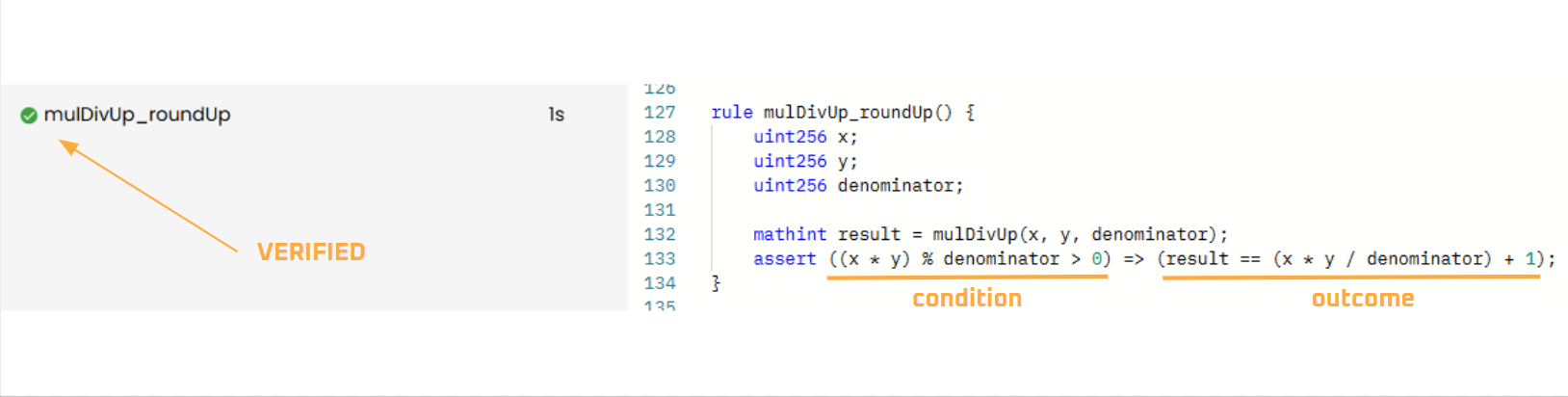
规则 mulDivUp_roundUp() 中的断言指出,当 x 和 y 的乘积除以 denominator 且有余数时,结果会增加 1。
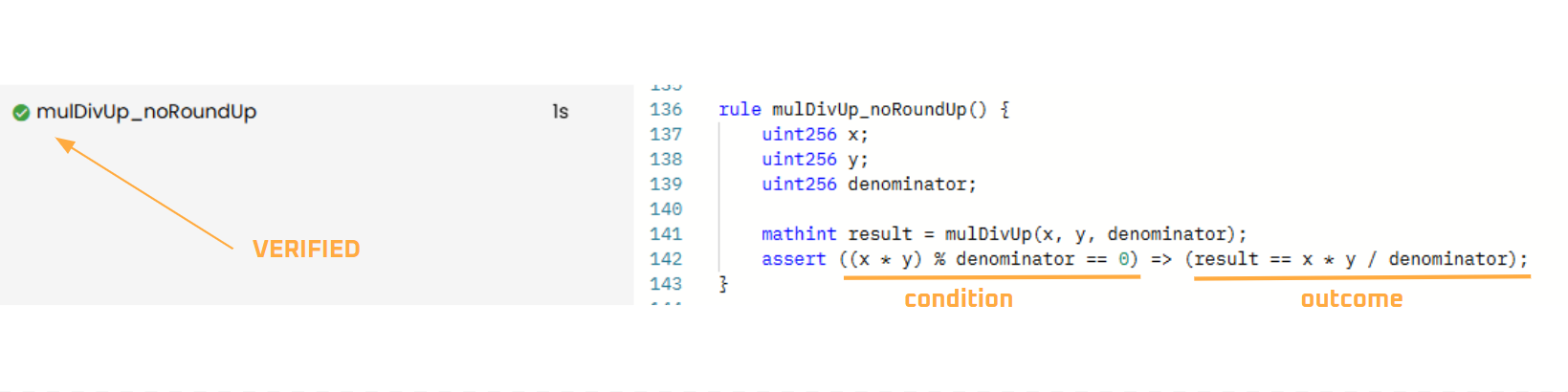
类似地,规则 mulDivUp_noRoundUp() 中的断言指出,当 x 和 y 的乘积除以 denominator 且没有余数时,直接返回原结果。
不出所料,这些规则验证通过(VERIFIED):
rule mulDivUp_roundUp() {
uint256 x;
uint256 y;
uint256 denominator;
mathint result = mulDivUp(x, y, denominator);
assert ((x * y) % denominator > 0) => (result == (x * y / denominator) + 1);
}
rule mulDivUp_noRoundUp() {
uint256 x;
uint256 y;
uint256 denominator;
mathint result = mulDivUp(x, y, denominator);
assert ((x * y) % denominator == 0) => (result == x * y / denominator);
}
Prover 运行:链接
现在,让我们进入该函数属性的下一个类别:回退(revert)行为。
回退行为
如前所述,有两种情况会导致 mulDivUp() 发生 revert:
- 如果
denominator == 0 - 如果
x * y > MAX_UINT256
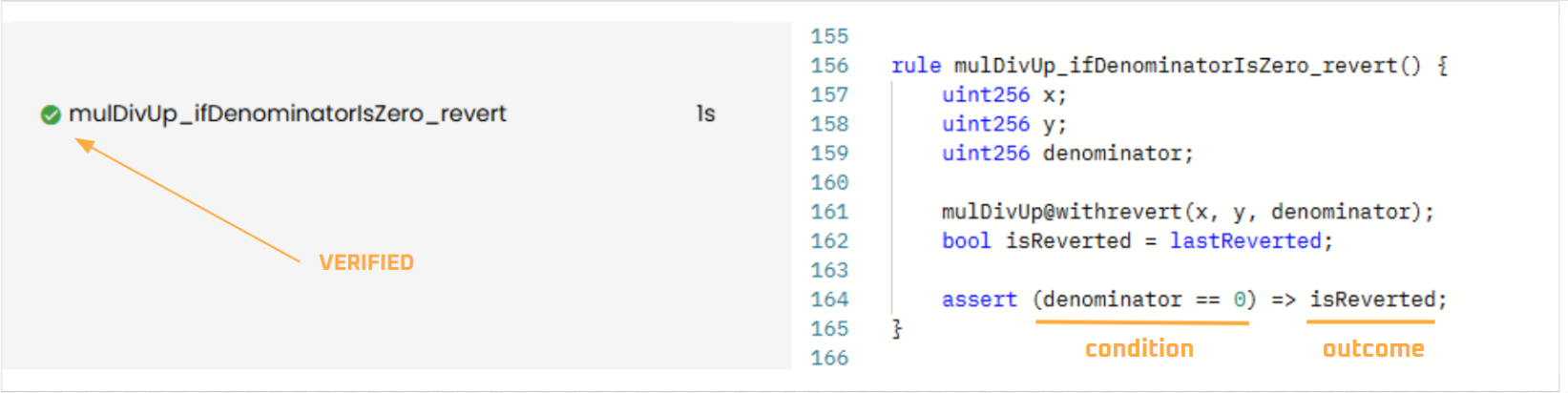
在形式化验证 revert 时,我们必须在调用函数时包含 @withrevert 标签。默认情况下,Prover 只执行不发生 revert 的路径,这意味着传递给 mulDivUp(x, y, denominator) 的所有参数都不会引发 revert。然而,向函数添加 @withrevert 指示 Prover 也去考虑那些会导致 revert 的参数。这使我们能够在蕴含语句中处理发生 revert 的情况。
以下是 CVL 规则规范:
rule mulDivUp_ifDenominatorIsZero_revert() {
uint256 x;
uint256 y;
uint256 denominator;
mulDivUp@withrevert(x, y, denominator);
bool isReverted = lastReverted;
assert (denominator == 0) => isReverted;
}
rule mulDivUp_ifXYExceedsMaxUint_revert() {
uint256 x;
uint256 y;
uint256 denominator;
mulDivUp@withrevert(x, y, denominator);
bool isReverted = lastReverted;
assert (x * y > max_uint256) => isReverted;
}
不出所料,这些规则验证通过(VERIFIED):
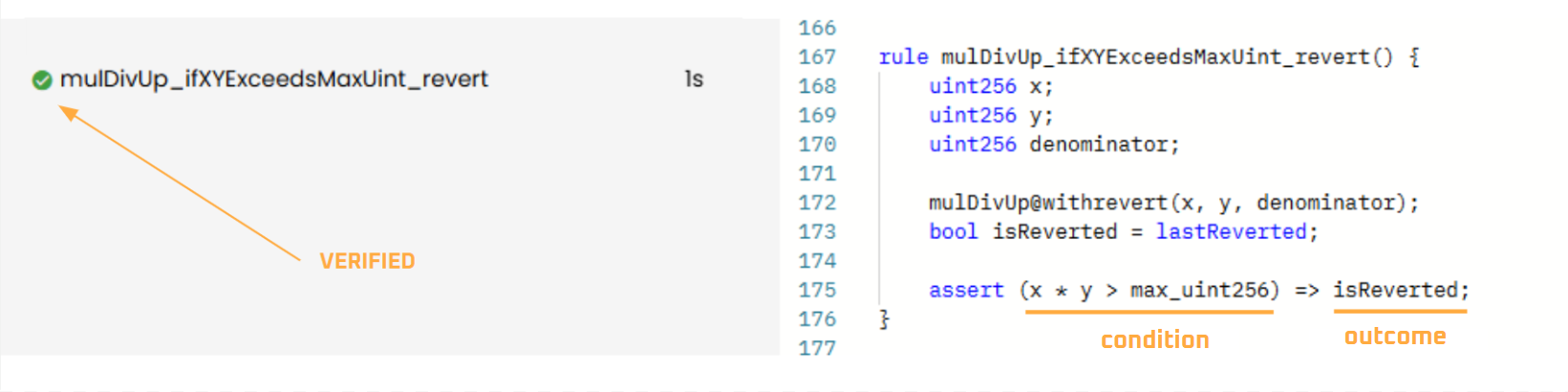
Prover 运行:链接
这里有一个更有趣的方法。到目前为止,我们使用的是 P => Q 结构,这意味着条件(P)导致结果(Q)。但是如果我们将其反转为 Q => P,这意味着结果(Q)是由条件(P)引起的;因此,我们必须考虑导致 Q 的所有 P 的可能情况。
下面是具体实现,在第一条规则中,我们故意遗漏了一个 revert 情况,而在第二条规则中,我们涵盖了所有情况。结果,第一条规则导致了违反(VIOLATION),而第二条规则验证通过(VERIFIED):
rule mulDivUp_allRevertCases_violated() {
uint256 x;
uint256 y;
uint256 denominator;
mulDivUp@withrevert(x, y, denominator);
bool isReverted = lastReverted;
assert isReverted => (denominator == 0);
}
rule mulDivUp_allRevertCases() {
uint256 x;
uint256 y;
uint256 denominator;
mulDivUp@withrevert(x, y, denominator);
bool isReverted = lastReverted;
assert isReverted => (denominator == 0 || x * y > max_uint256);
}
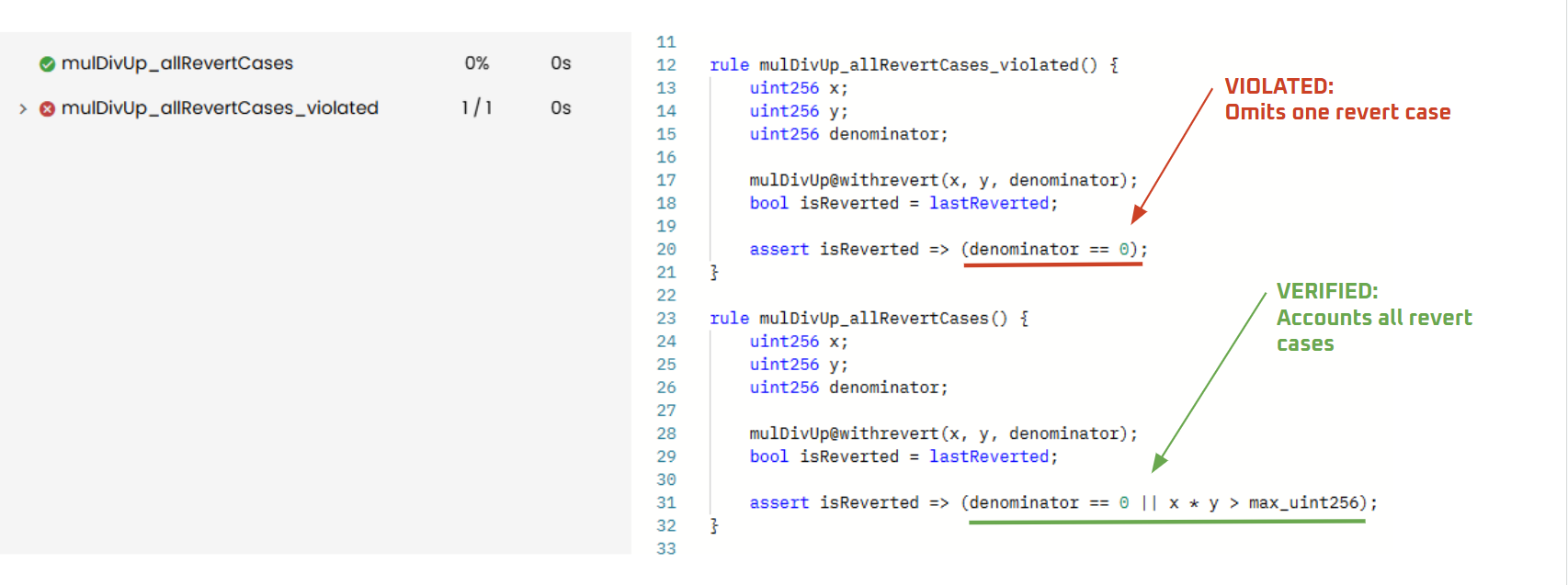
Prover 运行:链接
在下一个小节中,我们将形式化验证非 revert 情况,这是一个可选步骤,因为我们已经涵盖了所有 revert 情况。不过,我们仍然会这样做,因为它可能在未来会有用例。
非回退行为(可选)
如果我们可以形式化验证发生 revert 的路径,我们同样可以验证不发生 revert 的路径。为此,我们需要将语句重新构建为:
denominator != 0x * y <= MAX_UINT256
并将它们组合起来,如下面的 CVL 规则实现所示:
rule mulDivUp_noRevert() {
uint256 x;
uint256 y;
uint256 denominator;
mulDivUp@withrevert(x, y, denominator);
bool isReverted = lastReverted;
assert ((denominator != 0) && (x * y <= max_uint256)) => !isReverted;
}
不出所料,规则验证通过(VERIFIED):
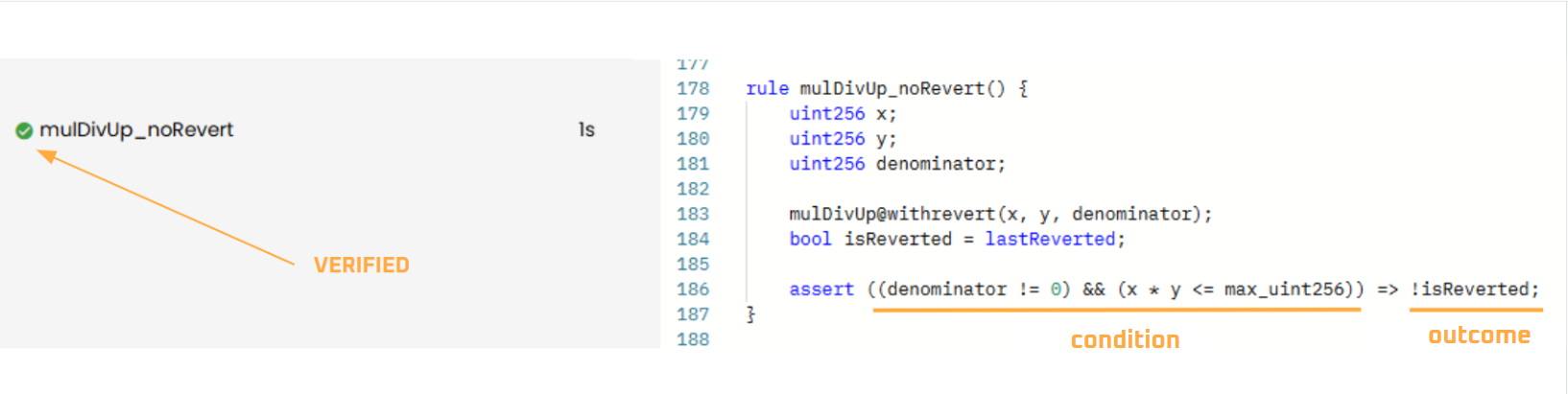
Prover 运行:链接
总结
- 蕴含语句由条件
P、结果Q以及蕴含运算符(=>)组成。 - 蕴含运算符定义了一种单向的条件关系,这意味着
P => Q并不意味着Q => P。 P => Q及其逆否命题!Q => !P在逻辑上是等价的,但提供了不同的视角,将焦点从条件成立时转移到条件不成立时。- 要使一个蕴含具有意义(既非空洞为真,也非恒真式),
Q(结果)必须依赖于P(条件)为真。 - 当
P不可达(始终为假)时,就会出现空洞为真(vacuous truth),由于缺乏反例,无论Q是什么,P => Q都为真。 - 当
Q始终为真时,就会出现恒真式(tautology),无论P是什么,P => Q都为真。 - 虚假求真(空洞为真)和恒真式会在形式化验证中造成误导性的保证。
给读者的练习
- 形式化验证 Solady min 始终返回最小值。
- 形式化验证 Solady zeroFloorSub 返回
max(0, x - y)。换句话说,如果x小于y,它返回0。否则,它返回x - y。
本文是关于使用 Certora Prover 进行形式化验证系列文章的一部分