在任何正确的 ERC20 实现中,所有账户余额的总和必须始终等于代币的总供应量。 在任何状态更改过程中,这一属性都应始终保持为真。如果某个调用(无论是直接调用还是序列调用的一部分)违反了这一不变量,则标志着合约的逻辑和设计中存在根本性缺陷。
在本章中,我们将利用前几章中所学的有关 ghost 变量和 hook 的知识,来形式化验证这个关键的不变量。
添加用于验证的智能合约
在本教程中,我们将使用由 Transmission11 开发的 Solmate 库 中的 ERC20 合约。为了将此合约包含到你的项目中,请在你的 Certora 项目目录的 contracts 子目录内创建一个名为 ERC20.sol 的新文件。然后,复制 Solmate 的 ERC20 实现 的代码并将其粘贴到该文件中。
// SPDX-License-Identifier: AGPL-3.0-only
pragma solidity 0.8.25;
/// @notice Modern and gas efficient ERC20 + EIP-2612 implementation.
/// @author Solmate (https://github.com/transmissions11/solmate/blob/main/src/tokens/ERC20.sol)
/// @author Modified from Uniswap (https://github.com/Uniswap/uniswap-v2-core/blob/master/contracts/UniswapV2ERC20.sol)
/// @dev Do not manually set balances without updating totalSupply, as the sum of all user balances must not exceed it.
contract ERC20 {
/*//////////////////////////////////////////////////////////////
EVENTS
//////////////////////////////////////////////////////////////*/
event Transfer(address indexed from, address indexed to, uint256 amount);
event Approval(address indexed owner, address indexed spender, uint256 amount);
/*//////////////////////////////////////////////////////////////
METADATA STORAGE
//////////////////////////////////////////////////////////////*/
string public name;
string public symbol;
uint8 public immutable decimals;
/*//////////////////////////////////////////////////////////////
ERC20 STORAGE
//////////////////////////////////////////////////////////////*/
uint256 public totalSupply;
mapping(address => uint256) public balanceOf;
mapping(address => mapping(address => uint256)) public allowance;
/*//////////////////////////////////////////////////////////////
EIP-2612 STORAGE
//////////////////////////////////////////////////////////////*/
uint256 internal immutable INITIAL_CHAIN_ID;
bytes32 internal immutable INITIAL_DOMAIN_SEPARATOR;
mapping(address => uint256) public nonces;
/*//////////////////////////////////////////////////////////////
CONSTRUCTOR
//////////////////////////////////////////////////////////////*/
constructor(
string memory _name,
string memory _symbol,
uint8 _decimals
) {
name = _name;
symbol = _symbol;
decimals = _decimals;
INITIAL_CHAIN_ID = block.chainid;
INITIAL_DOMAIN_SEPARATOR = computeDomainSeparator();
}
/*//////////////////////////////////////////////////////////////
ERC20 LOGIC
//////////////////////////////////////////////////////////////*/
function approve(address spender, uint256 amount) public virtual returns (bool) {
allowance[msg.sender][spender] = amount;
emit Approval(msg.sender, spender, amount);
return true;
}
function transfer(address to, uint256 amount) public virtual returns (bool) {
balanceOf[msg.sender] -= amount;
// Cannot overflow because the sum of all user
// balances can't exceed the max uint256 value.
unchecked {
balanceOf[to] += amount;
}
emit Transfer(msg.sender, to, amount);
return true;
}
function transferFrom(
address from,
address to,
uint256 amount
) public virtual returns (bool) {
uint256 allowed = allowance[from][msg.sender]; // Saves gas for limited approvals.
if (allowed != type(uint256).max) allowance[from][msg.sender] = allowed - amount;
balanceOf[from] -= amount;
// Cannot overflow because the sum of all user
// balances can't exceed the max uint256 value.
unchecked {
balanceOf[to] += amount;
}
emit Transfer(from, to, amount);
return true;
}
/*//////////////////////////////////////////////////////////////
EIP-2612 LOGIC
//////////////////////////////////////////////////////////////*/
function permit(
address owner,
address spender,
uint256 value,
uint256 deadline,
uint8 v,
bytes32 r,
bytes32 s
) public virtual {
require(deadline >= block.timestamp, "PERMIT_DEADLINE_EXPIRED");
// Unchecked because the only math done is incrementing
// the owner's nonce which cannot realistically overflow.
unchecked {
address recoveredAddress = ecrecover(
keccak256(
abi.encodePacked(
"\x19\x01",
DOMAIN_SEPARATOR(),
keccak256(
abi.encode(
keccak256(
"Permit(address owner,address spender,uint256 value,uint256 nonce,uint256 deadline)"
),
owner,
spender,
value,
nonces[owner]++,
deadline
)
)
)
),
v,
r,
s
);
require(recoveredAddress != address(0) && recoveredAddress == owner, "INVALID_SIGNER");
allowance[recoveredAddress][spender] = value;
}
emit Approval(owner, spender, value);
}
function DOMAIN_SEPARATOR() public view virtual returns (bytes32) {
return block.chainid == INITIAL_CHAIN_ID ? INITIAL_DOMAIN_SEPARATOR : computeDomainSeparator();
}
function computeDomainSeparator() internal view virtual returns (bytes32) {
return
keccak256(
abi.encode(
keccak256("EIP712Domain(string name,string version,uint256 chainId,address verifyingContract)"),
keccak256(bytes(name)),
keccak256("1"),
block.chainid,
address(this)
)
);
}
/*//////////////////////////////////////////////////////////////
INTERNAL MINT/BURN LOGIC
//////////////////////////////////////////////////////////////*/
function _mint(address to, uint256 amount) internal virtual {
totalSupply += amount;
// Cannot overflow because the sum of all user
// balances can't exceed the max uint256 value.
unchecked {
balanceOf[to] += amount;
}
emit Transfer(address(0), to, amount);
}
function _burn(address from, uint256 amount) internal virtual {
balanceOf[from] -= amount;
// Cannot underflow because a user's balance
// will never be larger than the total supply.
unchecked {
totalSupply -= amount;
}
emit Transfer(from, address(0), amount);
}
}
理解挑战
要将我们的不变量表达为 CVL 表达式,我们需要两个值:
- 代币总供应量
- 所有账户余额的总和
我们的合约中有一个名为 totalSupply 的公共状态变量,它记录了任意状态下的代币总供应量,并且可以使用名为 totalSupply() 的 getter 函数读取其值。然而,核心挑战在于,合约并没有提供任何内置的方法来获取所有余额的总和。
“解决方案”
为了获取所有账户余额的总和,我们将创建一个名为 sumOfBalances 的 ghost 变量,并使用 init_state 公理将其初始值设置为 0。每次对 balanceOf 映射进行写操作时,ghost 变量 sumOfBalances 都会通过一个 store hook 进行更新。
我们知道,store hook 可以让我们访问正在更新的余额的旧值和新值。我们利用这些值来计算变动,并相应地更新我们的 ghost 变量:
sumOfBalances = sumOfBalances - oldValue + newValue;
例如,如果某个用户的余额从 100 增加到 150,我们的 hook 会从 sumOfBalances 中减去 100 并加上 150,从而正确地将总和增加 50。通过对每次余额更新应用这种增量(delta)计算,我们的 ghost 变量 sumOfBalances 将追踪合约状态的变化,从而映射出所有余额的总和。
一旦 Prover 能够获取这两个值(来自合约的实际 totalSupply 和我们精确维护的 sumOfBalances ghost 变量),我们就可以使用 CVL 中的 invariant 块来正式声明不变量,断言总供应量始终等于所有账户余额的总和。
逐步编写完整的规范
现在让我们把讨论过的所有内容付诸实践,按照以下步骤编写一个完整的规范,以验证所有余额的总和是否与代币总供应量相匹配:
- 在你的 Certora 项目目录内,导航到
specs子目录并创建一个名为erc20.spec的新文件。 - 在
erc20.spec中,定义一个名为sumOfBalances的 ghost 变量。
ghost mathint sumOfBalances;
- 接下来,我们使用
init_state公理,在 invariant 的 base case 中将sumOfBalances的初始值设置为0。
ghost mathint sumOfBalances {
init_state axiom sumOfBalances == 0;
}
该公理仅在 invariant 的 base case 中约束 ghost 变量,建立一致的构造函数后(post-constructor)状态。如果没有这个基准线,Prover 可能会为 ghost 变量假设任意初始值,从而使得不变量保持(invariant preservation)变得毫无意义。
- 定义一个 store hook,以追踪
balanceOf映射的变化并相应地更新我们的 ghost 变量sumOfBalances。
ghost mathint sumOfBalances {
init_state axiom sumOfBalances == 0;
}
hook Sstore balanceOf[KEY address account ] uint256 newAmount (uint256 oldAmount) {
sumOfBalances = sumOfBalances - oldAmount + newAmount;
}
- 现在我们已经拥有了这两个值——合约的
totalSupply()和我们的 ghost 变量sumOfBalances——我们可以如下所示定义核心不变量:
ghost mathint sumOfBalances {
init_state axiom sumOfBalances == 0;
}
hook Sstore balanceOf[KEY address account ] uint256 newAmount (uint256 oldAmount) {
sumOfBalances = sumOfBalances - oldAmount + newAmount;
}
invariant totalSupplyEqSumOfBalances()
to_mathint(totalSupply()) == sumOfBalances;
- 最后,添加一个 methods 块,其中将包含
totalSupply()的函数签名。
methods {
function totalSupply() external returns(uint256) envfree;
}
ghost mathint sumOfBalances {
init_state axiom sumOfBalances == 0;
}
hook Sstore balanceOf[KEY address account ] uint256 newAmount (uint256 oldAmount) {
sumOfBalances = sumOfBalances - oldAmount + newAmount;
}
invariant totalSupplyEqSumOfBalances()
to_mathint(totalSupply()) == sumOfBalances;
- 导航到
confs子目录,创建一个名为erc20.conf的新文件。
{
"files": [
"contracts/ERC20.sol:ERC20"
],
"verify": "ERC20:specs/erc20.spec",
"msg": "Testing erc20 functionality"
}
运行验证
执行完上述所有步骤后,通过在终端中运行命令 certoraRun confs/erc20.conf 来提交代码进行验证。
在你选择的任何 Web 浏览器中打开由 Prover 提供的 verification result 以查看类似下图的结果:
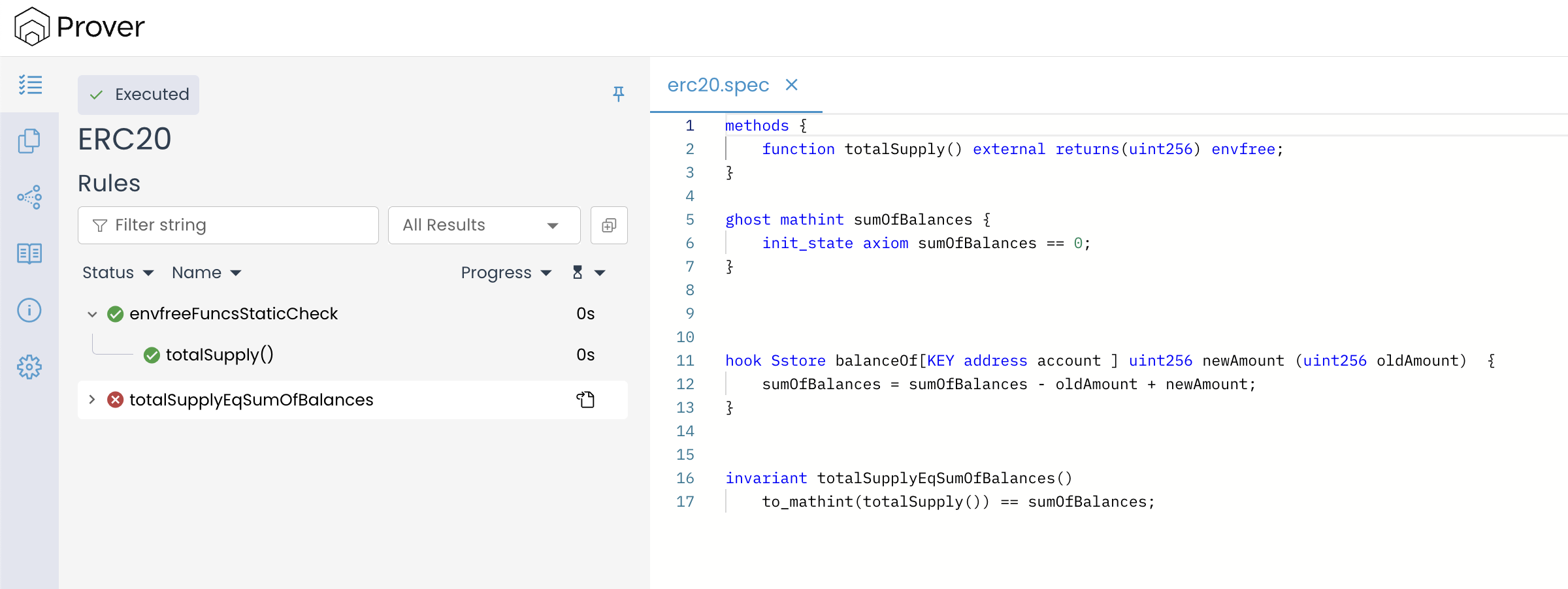
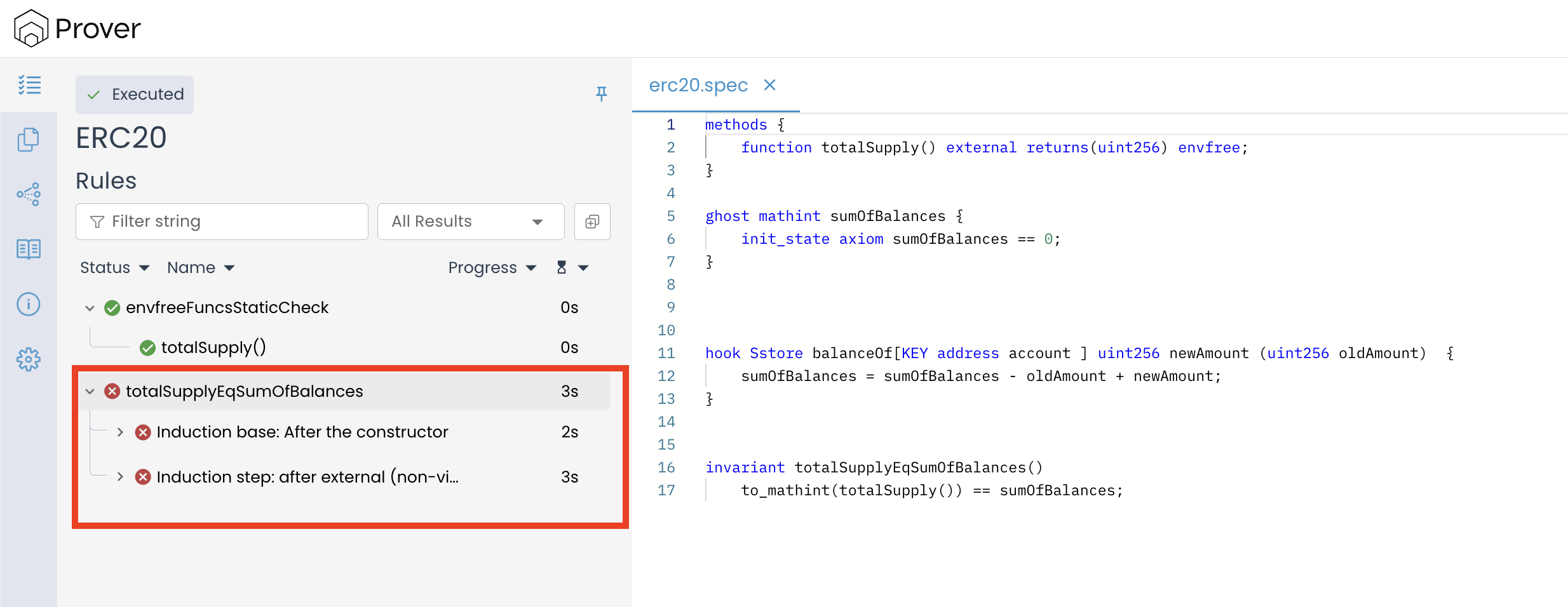
在我们的验证结果中,可以看到不变量检查在两个地方都失败了:构造函数调用之后和方法执行期间。
当我们点击 “induction base: After the constructor” 违规项时,Prover 会建议在你的配置中添加 optimistic_loop 键并将其值设置为 true,或者将 loop_iter 的值增加到大于 1。
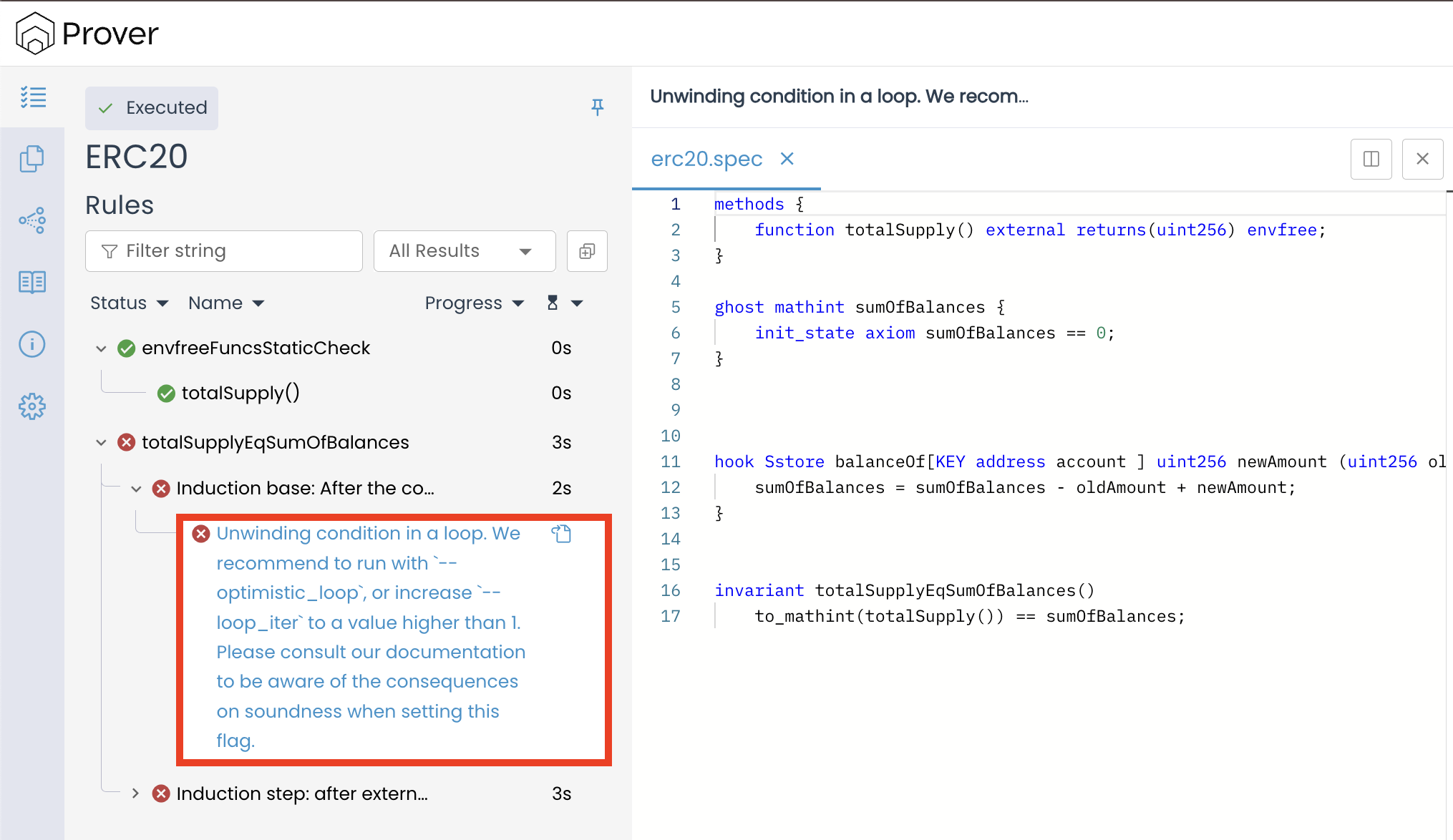
现在,让我们采纳 Prover 的建议,通过将 optimistic_loop 键设为 true 来更新配置文件。我们将在后面名为 “How Strings Lead to Loops?” 的章节中更深入地探讨这个问题。
{
"files": [
"contracts/ERC20.sol:ERC20"
],
"verify": "ERC20:specs/erc20.spec",
"optimistic_loop": true,
"msg": "Testing erc20 functionality"
}
完成后,通过在终端中运行命令 certoraRun confs/erc20.conf 重新运行 Prover。在新的验证结果中,我们可以看到我们的不变量在构造函数执行期间成功通过,但在方法执行期间失败了,特别是对于 transfer() 和 transferFrom() 函数。
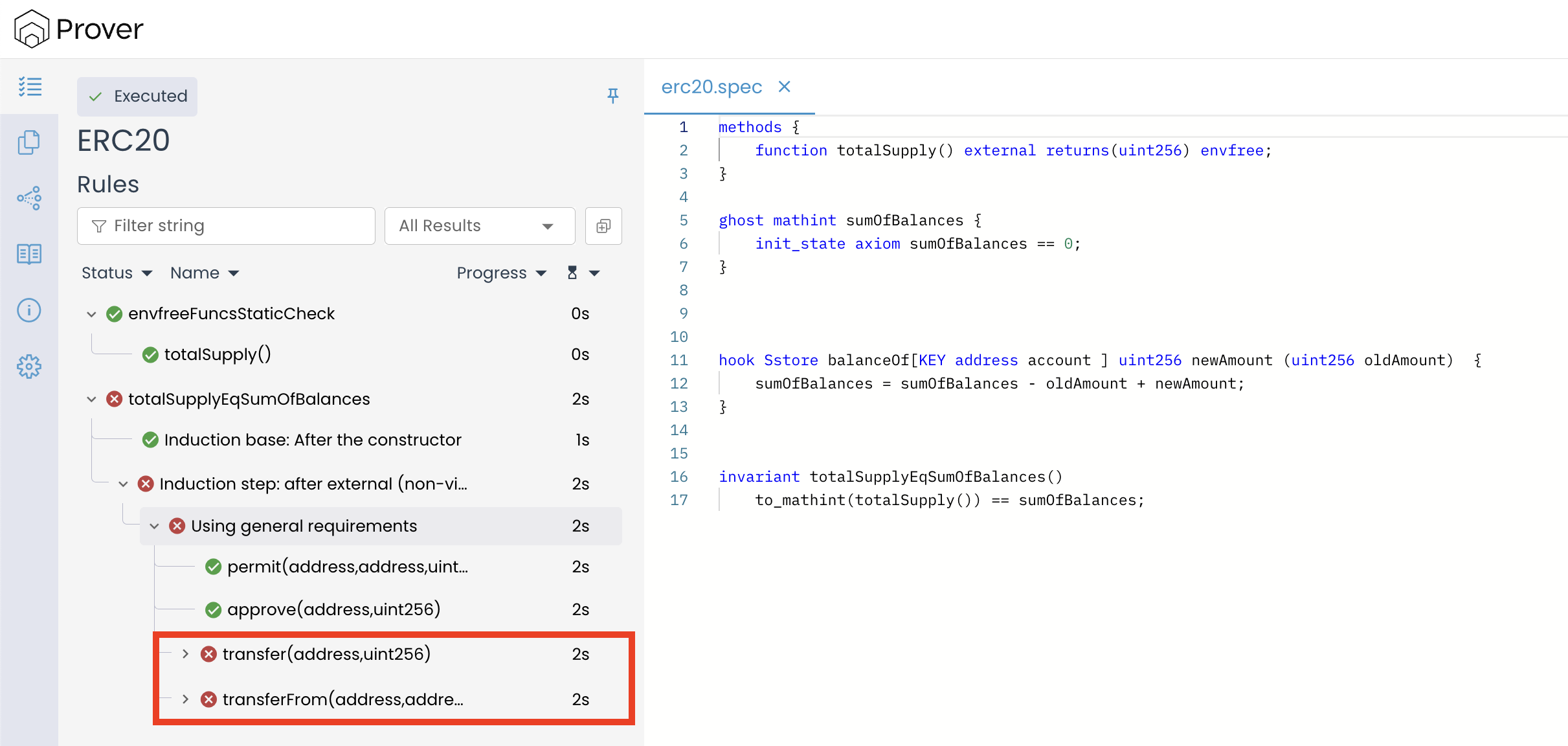
要了解违规的原因,请点击 transfer() 或 transferFrom() 函数的 call trace。在我们的例子中,我们将分析 transfer() 函数的 call trace。
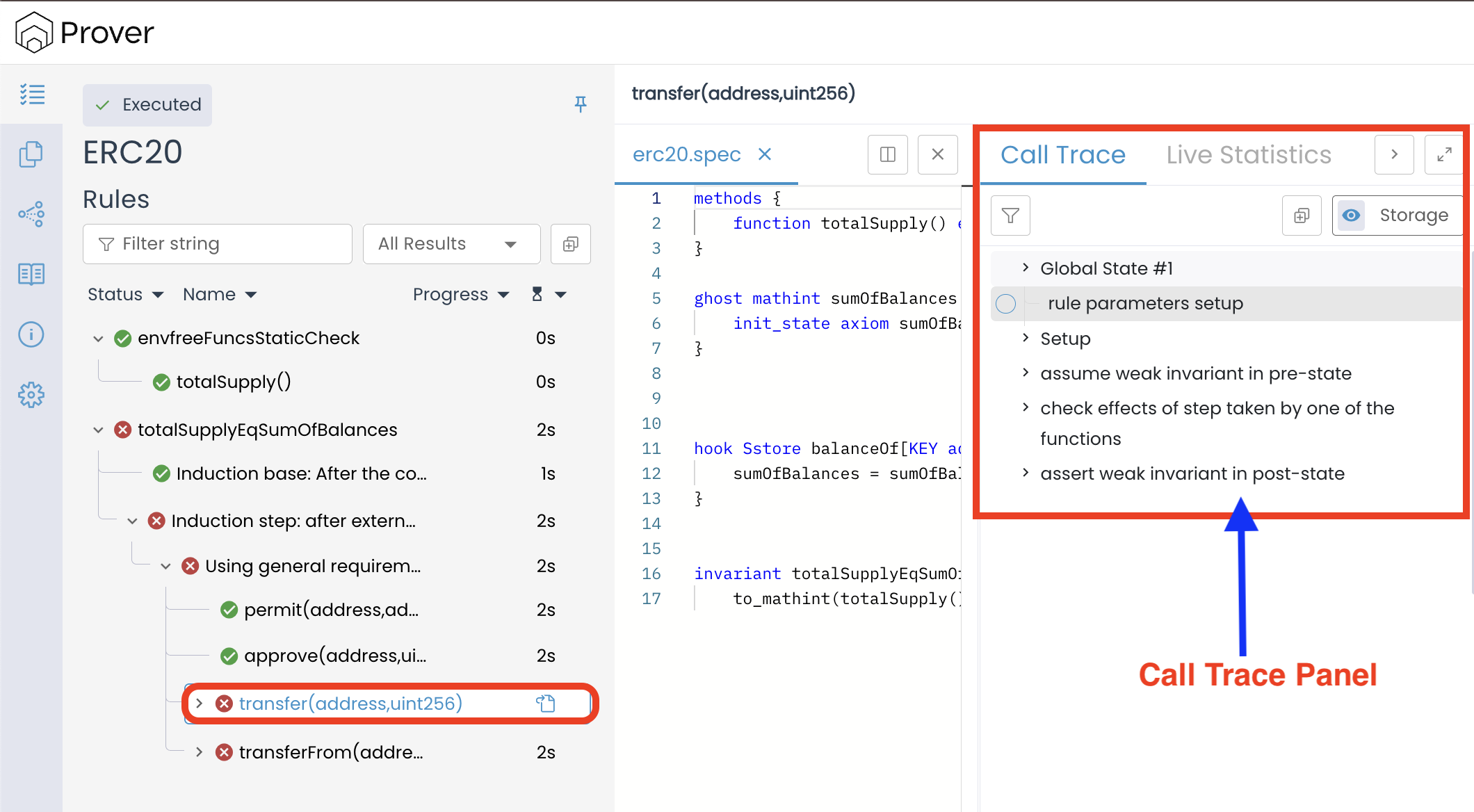
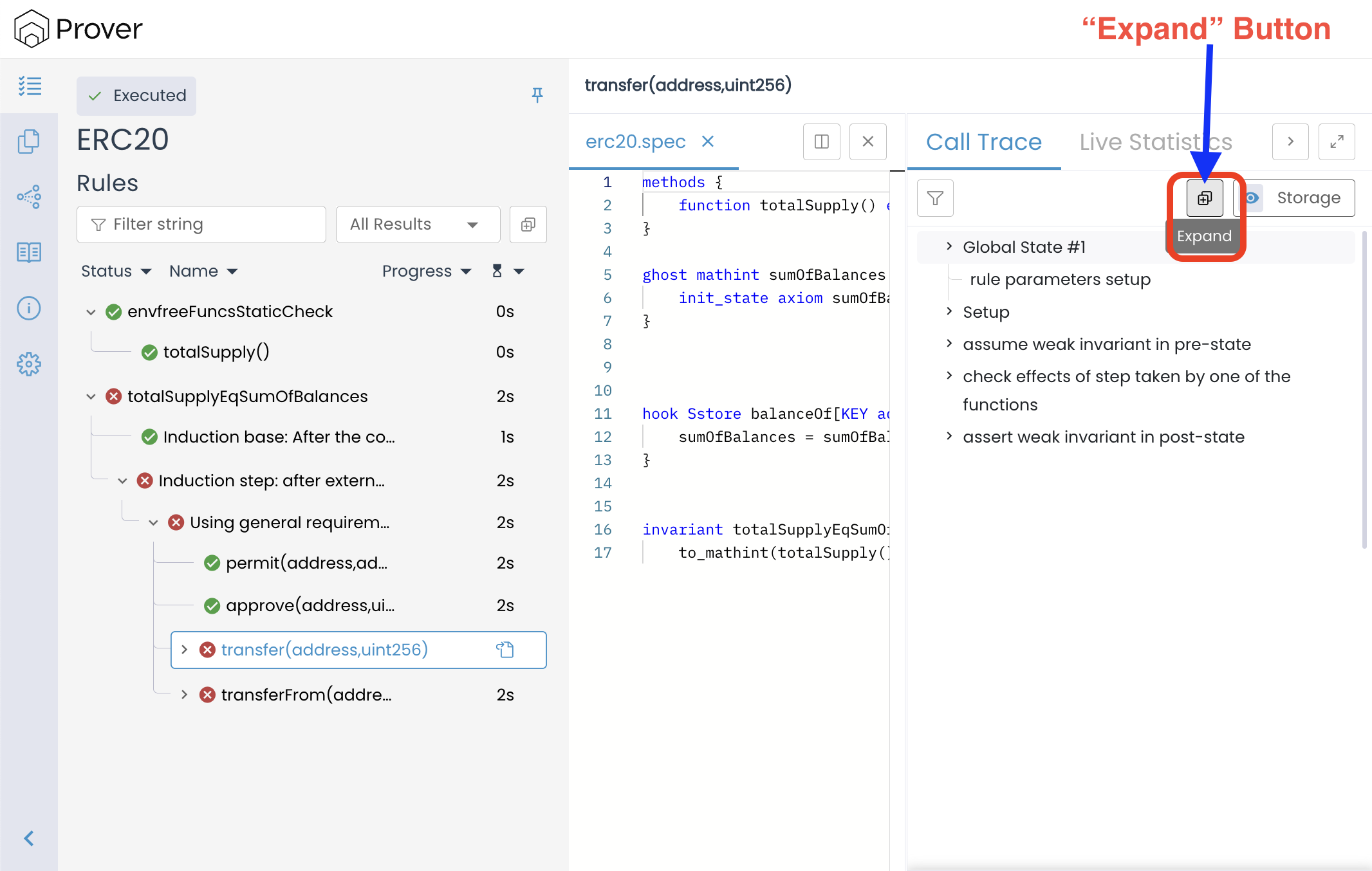
要查看完整的 call trace,请点击 Call Trace 面板右上角的 “Expand” 按钮。
在 call trace 中,我们可以看到单个账户 0x7 和 0x8200 的初始余额分别被设置为 2^256 − 4 和 0xf000000000000000000000000000000000000000000000000000000000000000。以十进制形式表示,它们分别对应 115792089237316195423570985008687907853269984665640564039457584007913129639932 和 108890810646419256008710686707116392212123736112785533035372916772359555072000。
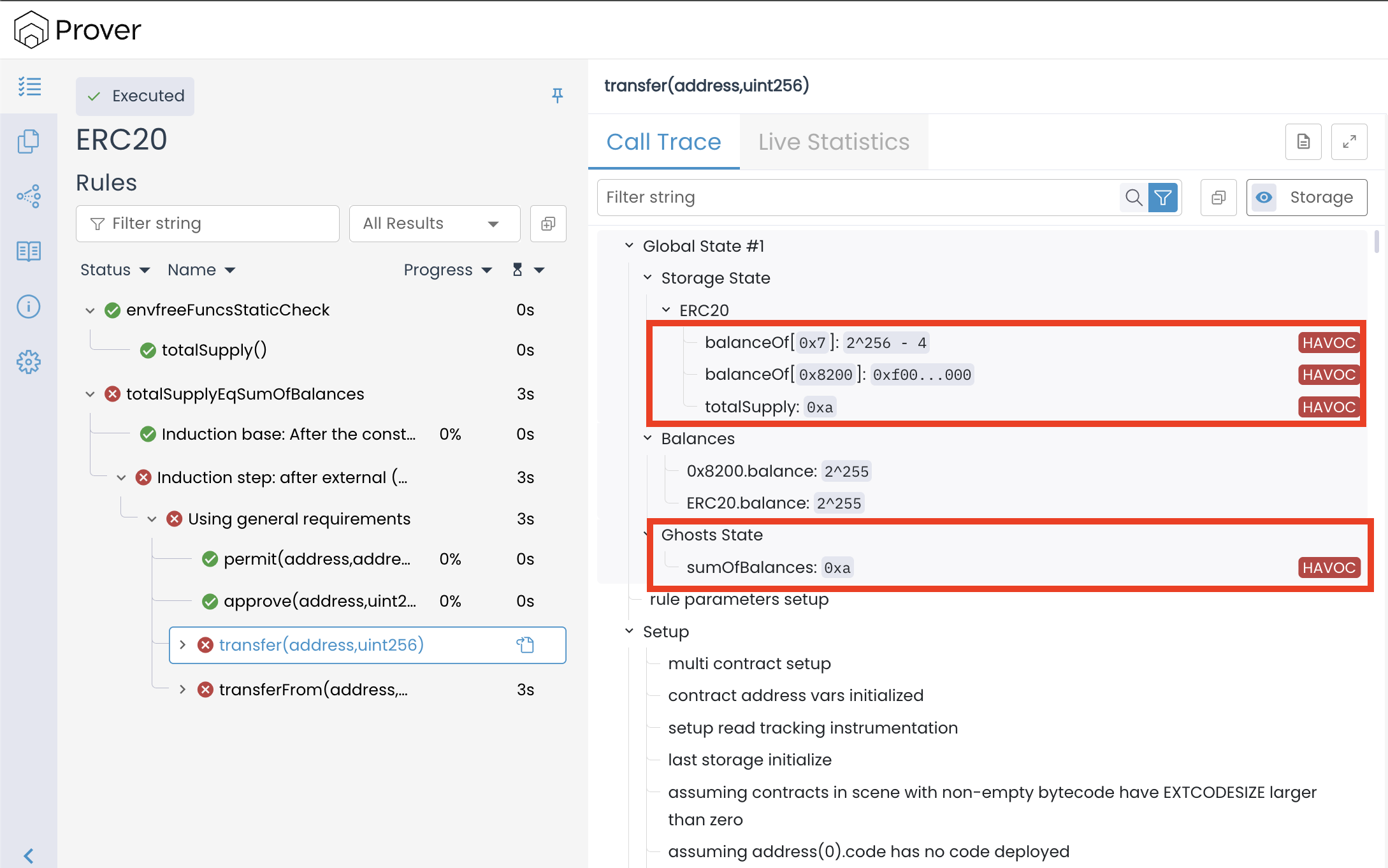
这两个值都是 Prover 通过 havocing 分配的,并且落在 0 到 2^{256} - 1 的数值范围内。然而,在任何正确实现的 ERC20 合约中,单个账户余额永远不应超过所有余额的总和。在这种情况下,这两个账户的初始余额都远远大于总供应量(0xa)和 sumOfBalances,这创造了一种在实际部署中根本不可能存在的初始状态。
Prover 之所以这样做,是因为它本身并不理解 ERC20 代币的业务逻辑;它仅仅将存储视为原始数据。除非有明确的约束,否则它会假设任何 uint256 值都是有效的起点。
为了避免这种情况,我们特别需要告诉 Prover,初始的单个账户余额不应大于 sumOfBalances。为此,我们将使用 CVL 提供的 require 语句来约束 Prover 应该考虑的值。
使用 require 语句约束初始余额
在我们的 erc20.spec 文件中,将下面显示的代码添加到我们的 store hook 中,以限制可以分配给任何账户余额的值的范围。完成后,重新运行 Prover 以查看验证结果:
hook Sstore balanceOf[KEY address account] uint256 newAmount (uint256 oldAmount) {
require oldAmount <= sumOfBalances; //add this line
sumOfBalances = sumOfBalances - oldAmount + newAmount;
}
在 new result 中,你会注意到 Prover 不再发现任何违规项。
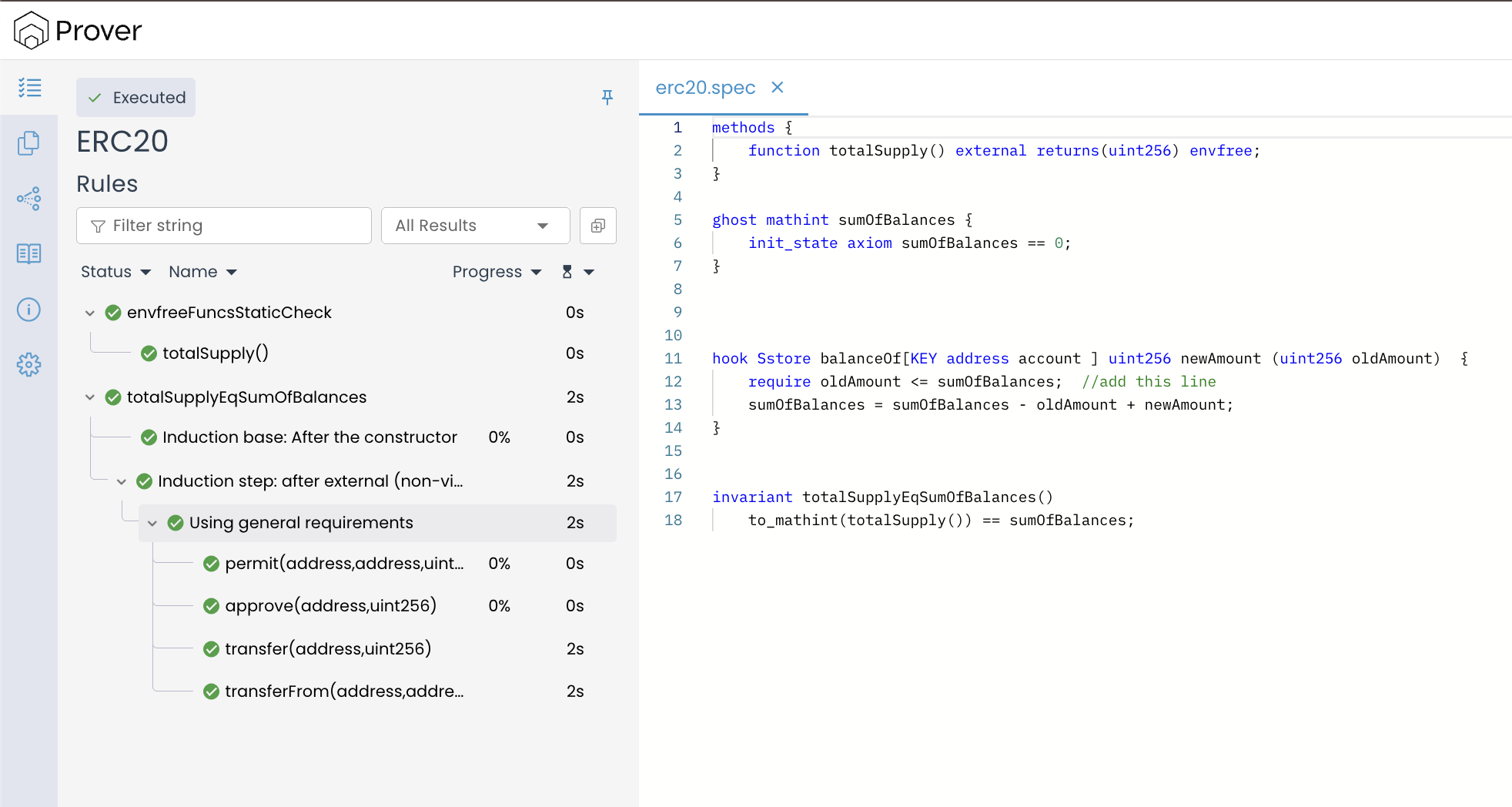
我们的不变量 totalSupplyEqSumOfBalances 通过了验证,因为在 store hook 中添加了 require oldAmount <= sumOfBalances; 这一行之后,Prover 将只探索该条件为真的执行路径。这有效地排除了依赖单一余额高于总和的反例**(例如,transfer 中发送方或接收方的余额),从而确保 Prover 专注于单个余额保持在总供应量逻辑界限内**的场景。结果就是验证成功了,证实了不变量在所有允许的状态转换下都得以保持。
另一种方法:Load Hook
虽然向 Sstore hook 添加约束是有效的,但还有另一种方法,我们可以在 Load Hook 中对单个余额添加约束。
要实现此方法,请按照以下步骤操作:
- 在
balanceOf映射上定义一个 load hook,以拦截每次对balanceOf的读取。
hook Sload uint256 balance balanceOf[KEY address addr] {}
- 在这个 hook 中使用
require sumOfBalances >= to_mathint(balance);引入一个约束。
hook Sload uint256 balance balanceOf[KEY address addr] {
require sumOfBalances >= to_mathint(balance);
}
- 从
Sstorehook 中移除约束,以便我们完全依赖 load hook 逻辑。
hook Sstore balanceOf[KEY address account] uint256 newAmount (uint256 oldAmount) {
require oldAmount <= sumOfBalances; //remove this line
sumOfBalances = sumOfBalances - oldAmount + newAmount;
}
以上述建议的更改之后,更新后的规范如下所示:
methods {
function totalSupply() external returns(uint256) envfree;
}
ghost mathint sumOfBalances {
// Constraining pre-constructor ghost value through axiom
init_state axiom sumOfBalances == 0;
}
// Added a load hook on balanceOf mapping
hook Sload uint256 balance balanceOf[KEY address addr] {
// Introduce a constraint
require sumOfBalances >= to_mathint(balance);
}
hook Sstore balanceOf[KEY address account] uint256 newAmount (uint256 oldAmount) {
// Delta Update
sumOfBalances = sumOfBalances - oldAmount + newAmount;
}
invariant totalSupplyEqSumOfBalances()
to_mathint(totalSupply()) == sumOfBalances;
如果使用此更改重新运行验证(从 Sstore hook 中移除 require 并仅将其保留在 Sload hook 中),不变量 totalSupplyEqSumOfBalances 仍将通过。
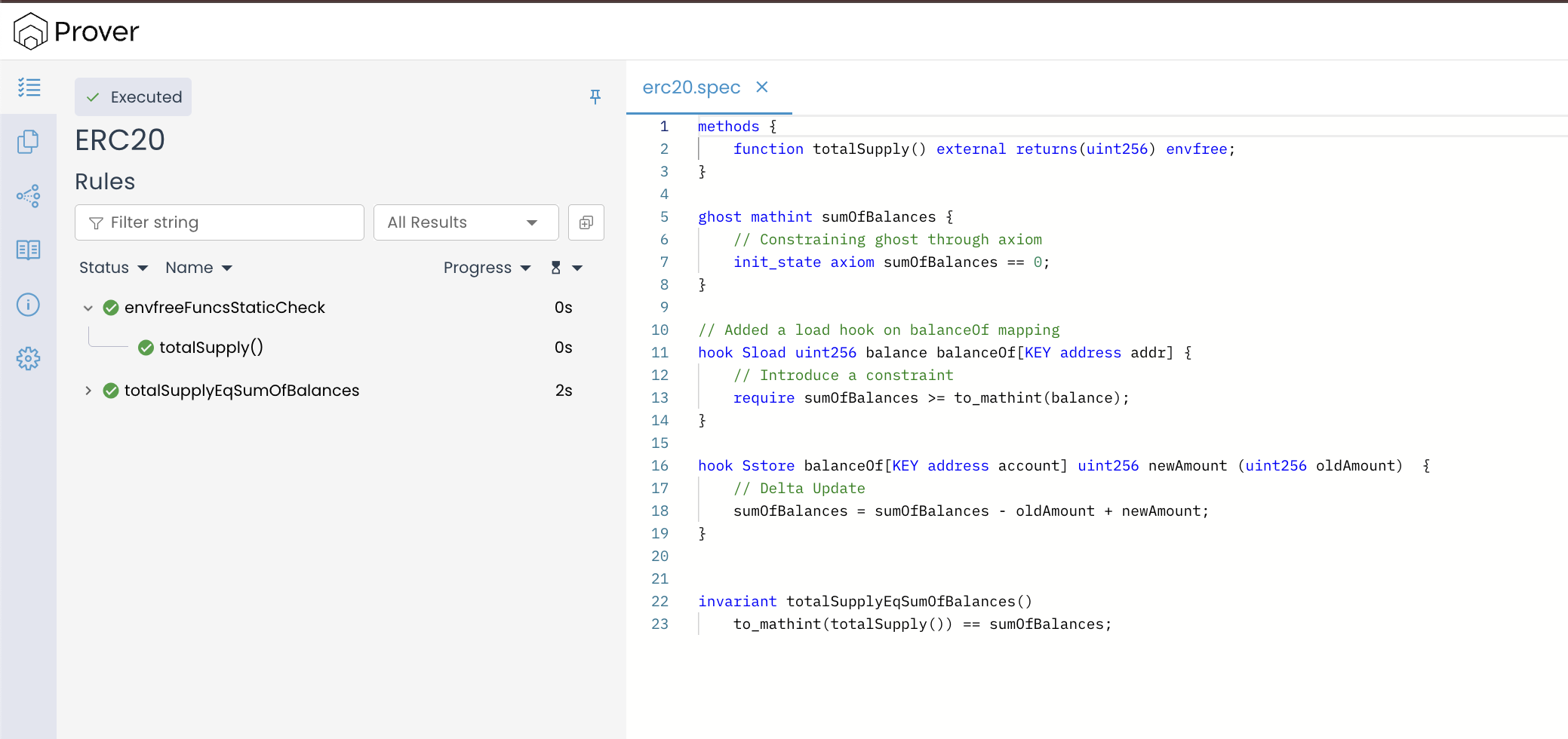
这之所以有效,是因为 load hook 显式地过滤掉了任何单个账户余额大于所有余额总和的状态。如果 Prover 试图使用这样一个不可能的初始状态来构建反例,它最终会在评估合约逻辑时读取该余额。在该读取发生的瞬间,load hook 内部的 require 语句会检查该余额是否与我们的 ghost 变量一致。由于该余额是不切实际的极大值,该条件检查会失败,于是 Prover 被迫丢弃这整条执行路径。
Sstore vs. Sload:在哪里放置约束?
这两个版本都“有效”,因为它们都排除了会违反我们不变量的不可能状态,但 load hook 方法提供了更可靠、更全面的保护。让我们来拆解一下原因:
Store Hook 实际上保证了什么
当我们将约束放在 store hook 中时:
hook Sstore balanceOf[KEY address account] uint256 newAmount (uint256 oldAmount) {
require oldAmount <= sumOfBalances;
sumOfBalances = sumOfBalances - oldAmount + newAmount;
}
在上面的代码中,我们实际上是在告诉 Prover:“每当你在 balanceOf[account] 写入数据时,请确保之前的值(oldAmount)不大于 sumOfBalances”
这就产生了一个盲区:
- 如果 Prover 从未写入某个特定的
balanceOf[addr]slot,那么针对该地址的 hook 就永远不会被触发。 - 这意味着 Prover 仍然可以自由地从一个奇怪的初始值开始(通过 havoc),比如
balanceOf[addr] = 2^{256} - 1,即使sumOfBalances = 10。 - 只要合约不尝试向该 slot 写入,
Sstore中的require就永远不会被检查,而这种不可能的状态在读取和逻辑推理期间就能一直存在。
简而言之,store hook 仅仅是在说:“如果你通过写入数据触及了这个 slot,那么之前的值必须是合理的。” 它并没有说:“无论你什么时候查看它们,所有余额都总是合理的。”
Load Hook 能够保证什么
现在,来看看 load hook 的版本:
hook Sload uint256 balance balanceOf[KEY address addr] {
require sumOfBalances >= to_mathint(balance);
}
它会在 Prover 每次从 balanceOf 读取余额时运行。在这里,我们告诉 Prover:“每当你读取余额时,该余额必须小于或等于 sumOfBalances”
这带来了两个重要效果:
- Prover 无法在任何计算中使用不可能的余额。 如果它试图假设
balanceOf[addr]大于sumOfBalances然后去读取它,load hook 中的require就会失败,并且该执行路径会立即被丢弃。 - 即使从未向该 slot 写入过,这一点也同样适用。 Prover 在开始时可能会将
balanceOf[addr]havoc 成某个任意值,但在它读取该值的瞬间,load hook 就会对其进行检查。如果该值是不可能的,整条路径就会被抛弃。
load hook 就像是一个全局完整性检查(sanity check):“你看到的任何余额,都必须与 ghost 变量 sumOfBalances 保持逻辑上的一致。”
这就是为什么当我们关心保持 sumOfBalances 与实际余额一致并避免不可能的 ERC20 状态时,load hook 方法通常是更好的选择。
结论
在本章中,我们验证了基本的 ERC20 不变量:总供应量 = 所有余额的总和。
我们通过使用 ghost 变量来追踪总和,并使用 hook 将该 ghost 变量与合约的存储进行同步,从而实现了这一目标。至关重要的是,我们演示了为什么将约束放在 Sload hook 中通常比放在 Sstore hook 中更安全。通过在数值被_读取_时进行监督,我们有效地消除了盲区,否则 Prover 在该盲区中可能会假设存在不可能的初始状态。
这些技术允许你在底层存储之上证明高级业务规则,从而确保你的验证仅专注于有效、符合现实的合约行为。
本文是 formal verification using the Certora Prover 系列文章的一部分。